Your larynx

With
Adam MishanAdam Mishan shows you how to locate your larynx and vocal cords by finding your Adam's apple, the first step to understanding how your voice works.

What's in the course
24 lessons (1h 9m) · 4 free










Lesson transcript
Understanding Your Vocal Cords
When beginning to sing, it's important to know where your vocal cords are located in your body.
Locating Your Vocal Cords
To locate your vocal cords, you first have to find your Adam's apple or voice box. Follow these steps:
- Put your finger on your chin.
- Slide your finger down your neck until you feel a little notch.
- For men, the notch is much more pronounced than it will be for women.
- This notch is located in the upper half of your neck.
If you've slid your finger down past the upper half of your neck, you've probably gone too far into what's called your cricothyroid.
Becoming Acquainted with Your Larynx
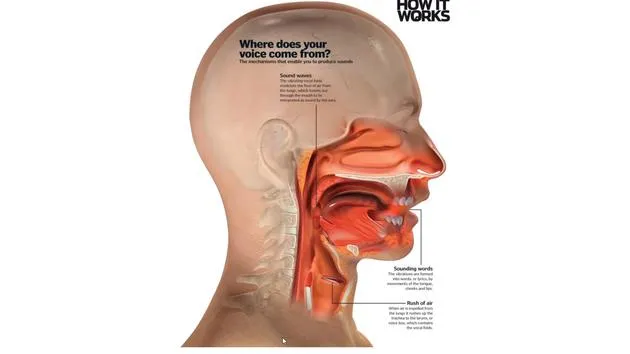
Now, I'd like you to become a little bit more acquainted with this notch in your neck. This notch is the top of your larynx. Right behind your larynx is where your vocal cords are housed. They exist in a V shape in your throat behind that little notch.
Observing Your Larynx
With your finger lightly resting on your larynx, I'd like you to swallow.
- What happened when you swallowed? Your larynx should have jumped up and come right back down. This is exactly what happens when we swallow.
Now, I'd like you to try yawning.
- Try to give a really big yawn and feel where your larynx goes.
As you heard in my demonstration of yawning, the sound of your voice when you try to speak while yawning changes quite significantly.
Tonal Changes
These are the tonal changes that happen when we yawn or when we swallow.
- If my larynx jumps up in my neck, then I get a really brittle, high, and squeezed type of sound.
- Kind of like Steve Urkel: "Did I do that?"
When we yawn or lower the larynx in our throat, we actually get a much dumber, dopier sound.
Mastering Your Tone
Knowing this arms you with the ability to change your tone at will. You can make adjustments when you notice that your tone is getting too nasal or too dopey.
24 lessons
1h 9m of structured video lessons
Advanced video features
Slow down, loop a passage, follow along
Mobile, tablet & desktop
Practise wherever you are
100% satisfaction guarantee
30-day money-back guarantee
Meet your guru
Meet your guru
Adam Mishan is a vocal coach who taught himself to sing. His videos document the journey from not being able to hold a pitch to singing with real control, and that path now shapes how he teaches - over 200,000 people follow along on YouTube. In his courses you'll work on pitch, breath support, tone and range in small, repeatable steps, the same way he built his own voice.