How your voice works

With
Adam MishanIn this video, Adam explores where your voice comes from and the mechanics that enable you to produce sounds.
What's in the course
24 lessons (1h 9m) · 4 free






Lesson transcript
Understanding the Anatomy of the Voice
Alright, so this is going to give you a little bit of insight on how the voice works.
The Basic Mechanism
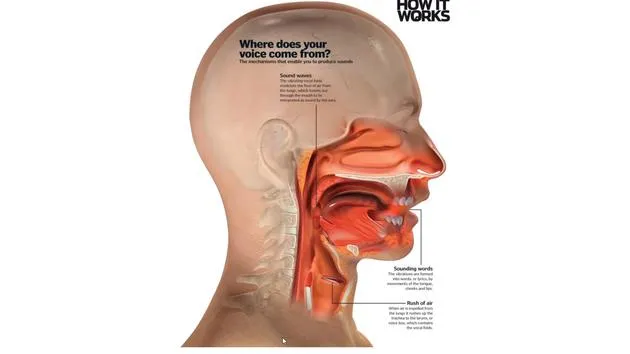
- Down below, we have our lungs. They fill up with air when we breathe in.
- When we breathe in, the air comes through this tube right here: the trachea.
- As you breathe out and you actually try to create sound, the airflow comes up through your larynx.
Key Structures
- Right here is your Adam's apple for men.
- For women, they don't have an Adam's apple, but it's still the same sort of mechanism.
- Believe it or not, this area right here is about the size of your thumbnail for men and a pinky nail for women, very, very small.
Sound Production
This is the place where the vibration happens. This is where the sound starts to occur, and then it travels up through this passageway.
- This right here is called your epiglottis.
- The sound can then travel out of the mouth or into the head cavity where it comes through the nose.
The Path of Sound
Sound splits right around this back area, where your uvula is (the dangly thing in the back of your throat).
- This is your soft palate right here,
- and your hard palate here (the roof of your mouth).
Singing Techniques
When we're singing, it's important to know how the air is traveling and what the different parts of your body are doing.
- When we sing the "ah" sound, the tongue sits a little bit further back and opens up wide in the mouth.
- For the "E" sound, the tongue sits high and out of the throat.
So, it's kind of important to know how that works.
Now you've got an idea of what the mechanisms are involved as you're singing.
- The vibration happens here, and the sounds are projected through your head.
- This is where you would have head voice and where here, the chest voice.
"Ah, that's your chest voice."
I hope this clarifies the anatomy of the voice for you.
24 lessons
1h 9m of structured video lessons
Advanced video features
Slow down, loop a passage, follow along
Mobile, tablet & desktop
Practise wherever you are
100% satisfaction guarantee
30-day money-back guarantee
Meet your guru
Meet your guru
Adam Mishan is a vocal coach who taught himself to sing. His videos document the journey from not being able to hold a pitch to singing with real control, and that path now shapes how he teaches - over 200,000 people follow along on YouTube. In his courses you'll work on pitch, breath support, tone and range in small, repeatable steps, the same way he built his own voice.