



Exercice de quintes et quartes
Lesson time: (5min 46sec)
Un exercice de trompette de Gerard Presencer utilisant des quintes justes ascendantes et des quartes justes descendantes pour développer ton contrôle des intervalles.
Course preview
This lesson is part of the course Approche intérieure de la trompette
Watch a preview of the full course below.
Lesson transcript:
Music Lesson: Intervallic Exercises
In this next exercise, we're going to use the technical and physical approaches that we've been developing in previous lessons on something which is perhaps a little bit more intervallically interesting. This is something maybe I've taken and used in composition or in improvisation.
The Pattern
- We will use:
- Perfect fifths to ascend
- Perfect fourths to descend
What I'm going to do is put a series of Fermatas over notes at the bottom. (That's pauses for people in the UK, but fermatas for everyone else.)
Airspeed Warm-Up
What I'm doing here is crescendoing to speed up the air:
- My tongue position goes forward.
- As I ascend, the intervals will be different. They will be part of the same finger pattern as in the flexibility exercises we've done.
As I descend, I'm going to try to:
- Crescendo down my perfect fourths.
- Maintain the airstream.
- Pitch the notes accurately, rather than just hoping for the best, which is the normal way that jazz trumpet players seem to descend (sorry to say).
Rubato and Breathing
This is rubato. Anytime I need to:
- It's legato and rubato.
- Take a breath through your nose, not too quickly.
Important:
- Not so that anyone else can hear you breathe.
- Carry on as if you were starting the exercise from that point.
Tongue Position and Articulation
What hopefully I've done are a few little splits there.
- I've breathed the exercise and got my tongue position working for me.
- My tongue position will be in the right place when I start to use any kind of articulation, whether it be my jazz articulation or just a staccato.
Now let's use a short staccato that we worked on earlier. Let's say it, then play it like this:
- Remember to look at the center part of your bell and sing it (without pitch) to keep the air flowing.
Optimistic Development
In a way, I tongue faster when I play it on the trumpet, which is quite an optimistic development!
- I will keep going at that.
- I really feel saying it before playing helps get the flow.
Since we did it legato with labored fermatas to ensure proper breathing:
- By the time I play staccato and light, it should actually feel liberating and easier to play the trumpet.
Practicing Staccato
Let's do that one more time because it felt nice.
- It's almost so short that I'm not taking it seriously enough.
- And that's how short it needs to be.
Application in Music
Later, we'll look at how short staccato can be placed in music, which is very useful in:
- Pop music
- Jazz
Short Notes Example
The short eighth notes we practiced were those short notes.
Generally, what happens is when people play those short notes, they sound more like this:
- So I don't know: Which one do you prefer?
- I know which one hurts less, and that's probably the one I want to do.
Okay, good luck!
About the instructor
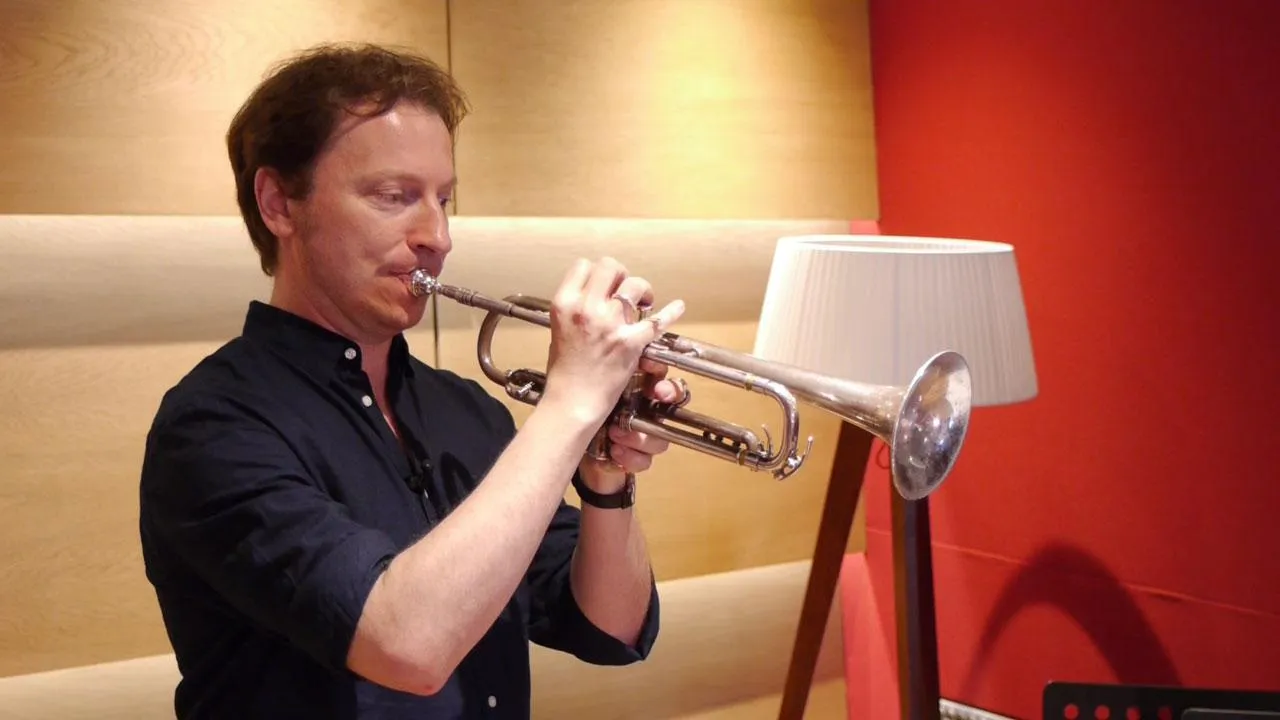
Au cours des 25 dernières années, Gerard Presencer s'est forgé une formidable réputation comme l'un des trompettistes les plus respectés de la scène européenne. Il a fait irruption sur la scène internationale à 18 ans, lorsque US3 lui a demandé de jouer la partie solo sur Cantaloupe Island de Blue Note (réinventée en Cantaloop Flip-Fantasia), qui est devenu l'un des disques de jazz les plus vendus des années 1990. Depuis, il s'est produit avec un who's who des artistes de jazz internationaux, et continue de se pousser lui-même et son instrument, sortant de sa zone de confort afin d'évoluer comme instrumentiste et comme compositeur. Dans d'autres genres, Gerard a enregistré comme musicien de studio avec des artistes tels que Sting, Jamiroquai, Zero 7, James Brown, Ray Charles, Joni Mitchell et Jonny Greenwood. Gerard a également été un membre essentiel des différents groupes de jazz de Charlie Watts au cours des 25 dernières années, tournant à travers le monde et publiant plusieurs albums avec ce Stone amoureux du jazz. En tant que pédagogue, Gerard a été responsable des études de jazz à la Royal Academy of Music de Londres de 1999 à 2010, et il est actuellement responsable du département des cuivres au Jazz Institut de Berlin. Dans ce cours, il partage son approche intérieure du jeu de la trompette - les habitudes mentales et physiques qui se cachent derrière une belle sonorité - afin que tu puisses développer la sonorité, le contrôle et la musicalité de l'intérieur. read more