



Stems et réverbération
Le contenu du cours
16 leçons (1h 36min) · 1 gratuites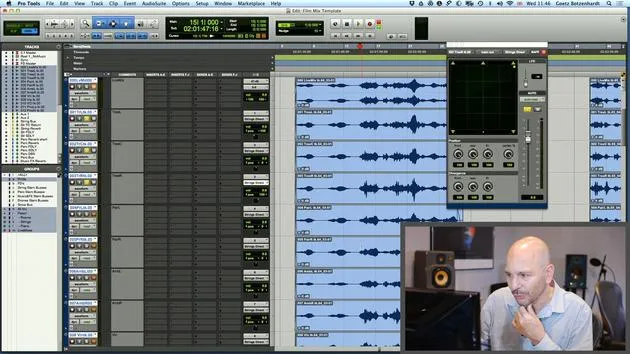
01. Comment utiliser à la fois des images de film et de l'audio dans Pro Tools
19:52
02. Importer un enregistrement orchestral - concepts clés
8:10
03. Stems et réverbération
Tu es ici8:51
04. Ajouter plus d'éléments au mix - éléments percussifs
4:33
05. Le processus de mixage
6:35
06. Dynamique et rides de fader
3:08
07. Passage en revue de tout le mixage de Goetz sur cette partition
5:02
08. DEVOIR #2 : CRÉER UN MIX
0:40
09. CHALLENGE #1 : MIXER À L'IMAGE
0:55
Transcription de la leçon
Music Lesson: Stemming and Reverb Techniques
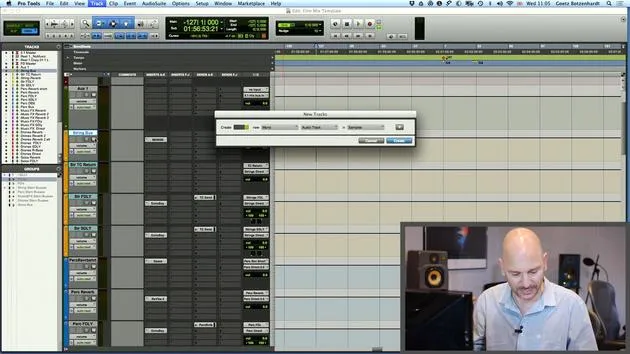
Now, I'm going to talk about the stemming a little bit more again, because now we can see we've got:
- An orchestra
- A piano
- The solo string players (violin, viola, and cello)
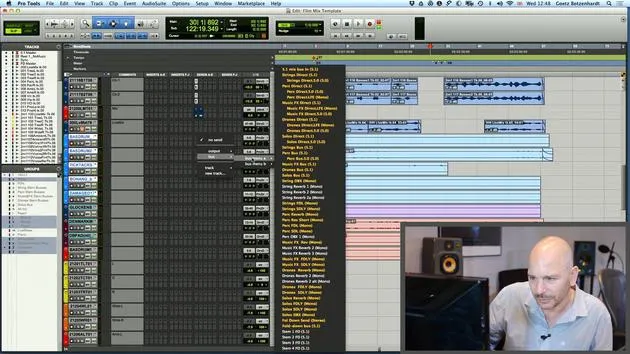
It would actually be quite nice to have all those on separate stems. So I'm just going to change my mind up here and:
- Put our solo strings onto my soloist stems.
- Root them to "solos direct."
- Root the piano to our music stem.
Adjusting Reverb for Solo Strings
I've already added a little bit of reverb here to the solo string players. This reverb is from the string orchestra stem. Therefore, I really don't want the reverb for my soloist now to send to that stem. If I did, the reverb of the soloist would crop up on the string stem, which is not right.
So, I'm going to have to change that and select the solos reverb down here.
- Checking the level again: There we go! That's a nice amount of reverb.
Key Thoughts on Reverb
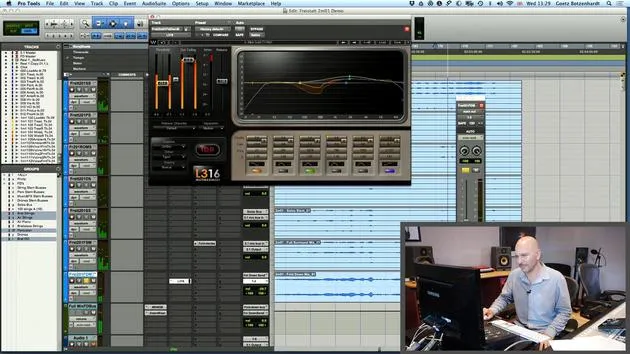
Generally, I'm a big fan of the TC6000, especially because it has a lovely program called Large Warm Hole. This program is considered an industry standard for orchestral reverb and is one of the favorite programs that many engineers around the world use, simply because it sounds really great.
Now, probably most people at home won't have a TC6000. However, what most people do have is a convolution reverb. I use A1, which is called Space, an Avid product. Another popular option is Ultiverb.
All these convolution reverbs will likely have, under different names, a copy/clone of what goes on in here.
On my Space reverb, there's a setting called Under European Sound that I can dial up, which gives me a similar sound.
- Large Wormholes: Select that, and it should sound very similar to what goes on in here.
Now I have my string reverb back, but this time it's actually down here on the solo stem.
Checking the Signal Flow
Let's double-check that:
- If I solo my strings up here, my solo strings should only show a signal on:
- Our solo stem buses
- Our solo stem track
- The full mix and fold down
Looking good! Silent everywhere else, that's what we want.
Adding Reverb to Spot Mics
We might want some reverb on the spot mics of the orchestral strings. I'm just going to put that there and send it to our TC, probably with a little bit less on the double basses.
Don't forget to put the follow main pan on!
I'm just going to create a group for these spot mics so I can control the reverb all in one go.
Fine-Tuning the Mix
If I play, we should see some action on our string bus and also on our string reverb.
- Checking down here: It's coming onto our string track and string stem record track and doesn't crop up anywhere else, that's crucial.
Blending the Mix
Now I'll quickly blend these two together. You may not have heard this, but I just noticed a little click. Many times, orchestral sessions are done in a hurry with a lot of material to get through.
Often, the recording engineer doesn't have time to edit the takes together the way we would like.
We can see there's a little edit that hasn't been faded, so I'm just going to pull that out and create a little crossfade. Hopefully, that will eliminate the click.
Using the Multi Tool in Pro Tools
I'd like to show how I did this. I actually like using the Multi Tool on Pro Tools. If you hit F6 and F7, this Multi Tool becomes active, allowing all three of these fields to turn blue.
This tool changes to suit what you need depending on where you place it.
- For example, if I start at the beginning, it allows me to adjust the length.
- If I go to the top, it allows me to create a crossfade.
If I go between two sections, the fade tool comes up again, and all I have to do is drag it across like this, it's very handy!
Final Thoughts
It's always worthwhile to look quickly at the editing of the recorded material.
- Make sure things are edited nicely, with no extra bits of noise at the end of takes or in between takes.
For instance, there's another edit here we can see.
Things like this do not belong in our mix, so just get busy and edit that out.
I'm going to quickly get rid of this and also check that the front is clean.
16 leçons
1h 36m de leçons vidéo structurées
Fonctions vidéo avancées
Ralentissez, bouclez un passage, suivez la partition
Mobile, tablette et ordinateur
Pratiquez où vous voulez
Satisfaction garantie à 100 %
Garantie remboursement 30 jours
Rencontrez votre guru
Rencontrez votre guru
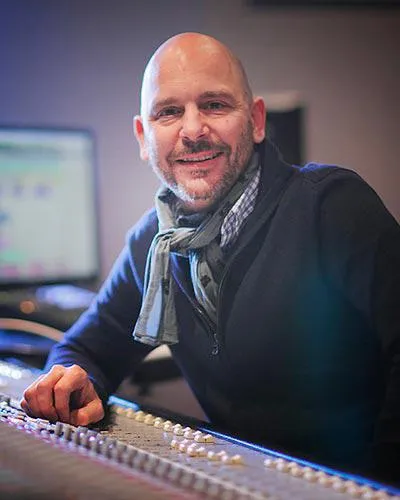
Au début des années quatre-vingt-dix, Goetz Botzenhardt s'est formé aux Swanyard Recording Studios, assistant des producteurs de premier plan comme Flood, Alan Moulder et Tom Lord-Alge, et a fait ses armes en enregistrant et en mixant les groupes de dance et d'acid jazz des années 90 : Incognito, Galliano, Soul II Soul et bien d'autres.
À Swanyard, il rencontre Rollo Armstrong et tous deux nouent rapidement un partenariat créatif, à l'origine de nombreux grands disques de dance et remixes et, peu après, de l'enregistrement et du mixage des deux premiers albums acclamés de Faithless et du multi-platine 'No Angel' de Dido.
Naviguant entre les genres, il a enregistré et mixé le premier album des Sugababes, 'One Touch', dont leur premier tube 'Overload', et a mixé pour The Cardigans, Bjork, The Cinematic Orchestra, Craig David, les Pet Shop Boys et Hikaru Utada, l'une des artistes les plus populaires du Japon.
Plus récemment, il s'est étendu au cinéma et à la télévision, collaborant étroitement avec les compositeurs Christian Henson, Martin Phipps et Anne Nikitin, et mixant la musique de Daniel Pemberton, nommée aux Golden Globes, pour 'Steve Jobs', réalisé par Danny Boyle. En dehors du cinéma, il a produit 'Closer to the People' de Tanita Tikaram, mixé des titres pour Sigala, Ella Eyre, Breton, Planet Funk et Tito Jackson, et en 2016 il a mixé l'album de Peabo Bryson avec Jimmy Jam et Terry Lewis. La liste complète de ses travaux figure sur ses pages de discographie et de filmographie sur goetz-botzenhardt.com.
Goetz travaille depuis son propre studio et sa salle de mixage, articulés autour d'une console SSL E4044, d'un monitoring surround Adam 5.1, d'un système Pro Tools HDX 48 canaux et d'un outboard de choix. Dans ses cours, il te fait entrer dans cette pièce pour montrer comment il mixe dans deux univers très différents : dans Mixing for Film & TV Score, comment il équilibre et façonne des musiques orchestrales et hybrides au service de l'image ; et dans Mixing Commercial Pop Music, comment il construit des mixes pop percutants et prêts pour la radio à partir du multipiste.







