



52nd Street Blues - Ajouter du chromatisme

Avec
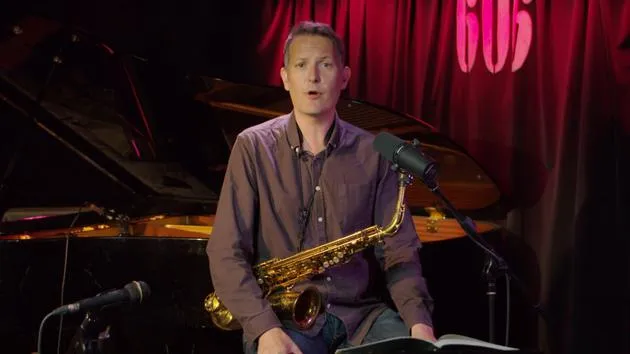
Ollie WestonDécore une mélodie de blues bebop au saxophone alto avec des notes de passage chromatiques - du genre de celles que Charlie Parker utilisait pour déguiser et embellir un morceau - avec Ollie Weston.
Le contenu du cours
47 leçons (1h 48min) · 1 gratuites
01. La cadence 'parfaite' V-I
3:28
02. Dominante 7 - exercice du cycle des quintes
1:24
03. Dominante 7 - Cycle des quintes avec les tierces et les septièmes
2:16
04. Variations rythmiques avec les 3ces et 7ces
2:02
05. "Rhythm Changes" avec des septièmes de dominante et le cycle des quintes
1:08
06. La progression II-V-I
1:20
07. Licks II-V-I dans le style de Parker, Coltrane et Adderley
Leçon gratuite4:15

08. Dancing With Duke (exercice II-V-I) - Introduction
1:15
09. Dancing With Duke (exercice II-V-I) - Interprétation
4:38

10. Conclusion de la progression II-V-I
0:42
01. Trouver le relatif mineur
1:41
02. Utiliser la gamme mineure harmonique sur l’accord de V
1:15

03. V-I en La mineur avec une b9
4:38

04. Exercice de V-I mineur dans les 12 tonalités
1:43

05. Phrase pour travailler les cadences mineures
1:17
06. II-V-I mineur dans une suite d'accords
5:04
07. Ajouter l'accord de II
1:20
08. Autumn Sun - Introduction et harmonie
3:03

09. Autumn Sun - Performance
4:44
01. Introduction aux standards
0:52
02. Introduction à Among the Stars
3:54

03. Interprétation de Among the Stars
4:23
04. Undying Love - Développer une grille d'accords
4:42

05. Undying Love - Interprétation
1:12
06. Undying love - Point de contrôle
0:47

07. Take the Express Train - Le turnaround
3:21
08. Exemples de lignes mélodiques pour les turnarounds
1:22
09. Take the Express Train - Introduction
1:28

10. Take the Express Train - Interprétation
1:12
11. Take The Express Train - Récapitulatif
0:39
01. Introduction au bebop
1:04
02. 52nd Street Blues - Introduction et thème
0:29
03. 52nd Street Blues - Head sur une progression I-IV-V
0:45

04. 52nd Street Blues - Ajouter du chromatisme
Tu es ici2:53
05. Ajouter de l'harmonie jazz au blues
2:39
06. 52nd Street Blues - Thème avec changements II-V-I
1:05
07. 52nd Street Blues - Performance
3:01


Transcription de la leçon
Understanding Bebop Blues
So hopefully you can hear some relationship between earlier blues tunes that we've played and this 52nd Street bebop blues. We're still centered around chords one, four, and five, although we will look at ways to expand that.
What's Different About Bebop?
Bebop introduces a few key differences:
- Rhythmic Emphasis: A little bit more rhythmic emphasis.
- Detail in the Head: A little bit more detail in the melody.
Chromaticism in the Melody
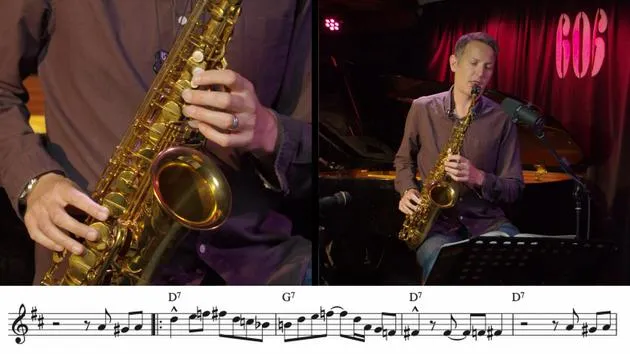
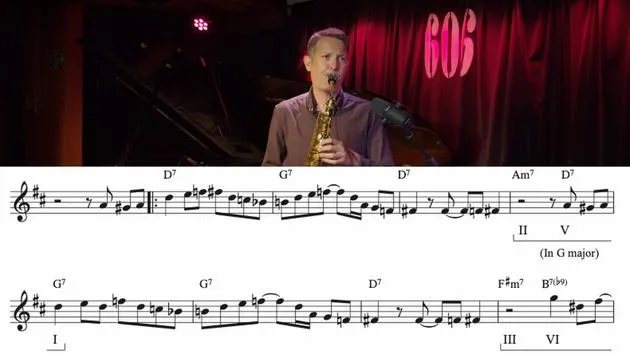
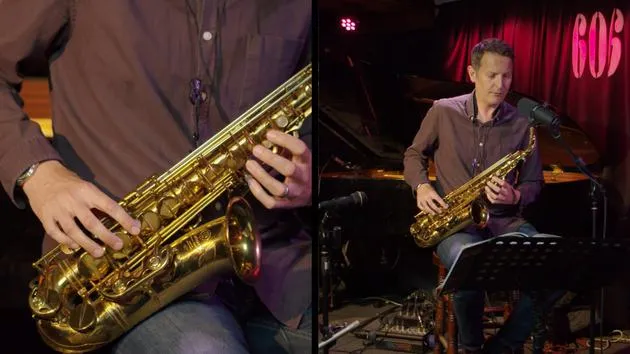
First, I'm going to look at the chromaticism in the melody. For example, when I play my first phrase:
An earlier musician might have just played three A's at that point, but Charlie Parker wanted to disguise the melody. He aimed to decorate it a little more and embellish it.
- The sharp 5, that G sharp, adds a little more detail to the melody.
The same concept applies to the next phrase. I've talked before about the contrast between the minor and major third within the blues:
- Minor third: A
- Major third: C#
Parker plays them both and then does exactly the same thing on the G7 chord, where I have a B flat resolving up to the third. So suddenly, you have familiar lines based on concepts that you will understand and have experienced before, but with an extra layer of detail.
The Effectiveness of Bebop
Our first phrase, instead of potentially sounding perfectly functional, sounds really effective. It resonates more in a bebop style than it did beforehand.
Rhythmic Ideas in Bebop
Rhythmically, a few ideas in bebop are:
- Keep the Music Short and Bouncy: The word "bebop" is an onomatopoeic expression of the phrasing and the language.
For my last phrase of the opening line, I want to make my last notes really short. If I play them too long, it loses some of its punch, some of its effectiveness.
Key Takeaway: Get your articulation really secure on these tunes:
- Really feel those offbeat notes.
- Aim for really nice, short phrase endings.
47 leçons
1h 48m de leçons vidéo structurées
Fonctions vidéo avancées
Ralentissez, bouclez un passage, suivez la partition
Mobile, tablette et ordinateur
Pratiquez où vous voulez
Satisfaction garantie à 100 %
Garantie remboursement 30 jours
Rencontrez votre guru
Rencontrez votre guru
Depuis l'obtention de son diplôme au Leeds College of Music (BA Hons) et à la Guildhall School of Music (Post Graduate Diploma in Performance), Ollie a bâti une carrière riche et variée dans la musique. En tant que saxophoniste, il s'est produit en concert et en studio avec des artistes aussi divers qu'Amy Winehouse, Tim Minchin, Bonobo, Frank Turner, le London Jazz Orchestra, le Hackney Colliery Band, l'Ambient Jazz Ensemble et le Nelson Riddle Orchestra. Il est également coleader du quartet de jazz 'Time Is Of The Essence', et compose et arrange du matériel pour cette formation et d'autres ensembles.
Ollie est actif dans l'éducation musicale, actuellement comme responsable de cours du département jazz de la Guildhall School of Music and Drama (école junior), où il dirige des ensembles de jazz, un big band et des cours de théorie. Il a écrit une série de livres 'Exploring Jazz' pour Schott Music, publiés dans le monde entier et inscrits aux programmes d'examen au Royaume-Uni. Ollie a également animé des ateliers pour l'Oxford University, Pro Corda Strings et BABSWE, ainsi que pour les écoles d'été de la Guildhall School of Music.
Dans ses cours Exploring Jazz Saxophone, Ollie te mène des tout premiers pas jusqu'à improviser en toute confiance sur des morceaux et des grilles d'accords, en développant les compétences d'improvisation qui mettent le vocabulaire d'un véritable jazzman à portée de tes doigts.







