



V-I en La mineur avec une b9

Lesson time: (4min 38sec)
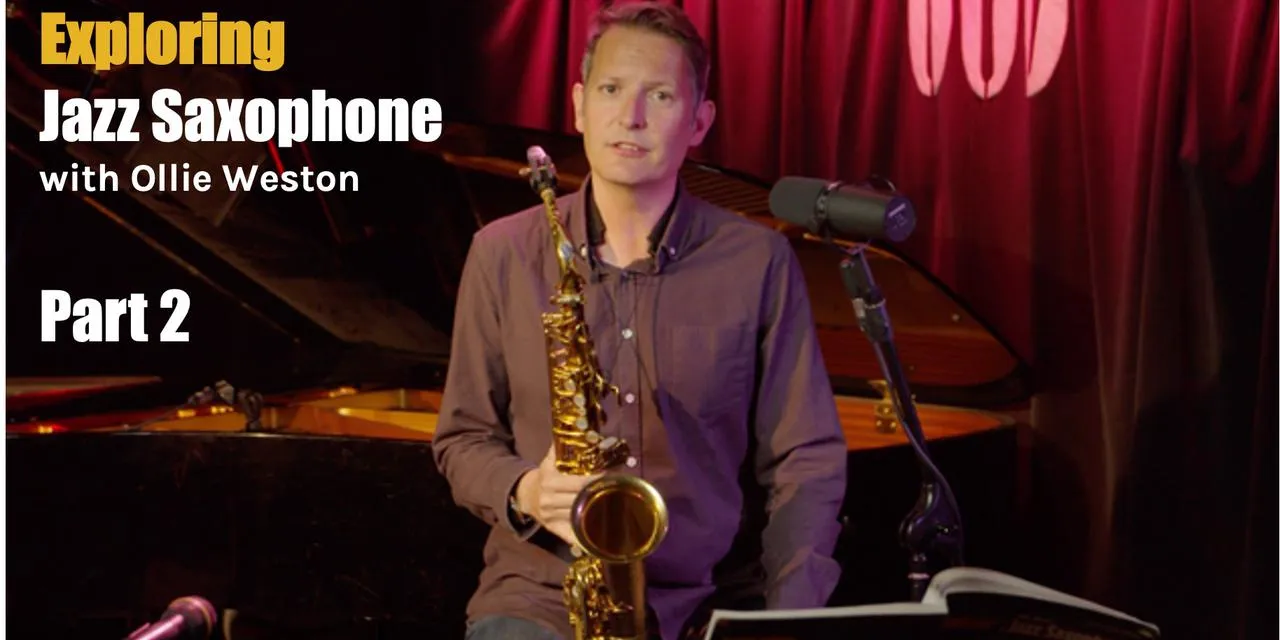
Ollie Weston démontre une cadence V-I en La mineur, en utilisant la gamme mineure harmonique et une b9 sur le E7 pour créer une tension qui se résout sur le La mineur.
Course preview
This lesson is part of the course Explorer le saxophone jazz : Partie 2 - Solos sur des chansons et des séquences d'accords
Watch a preview of the full course below.
Lesson transcript:
Understanding the Harmonic Minor Scale in Context
To put the harmonic minor scale into context, let's have a listen to a perfect cadence in A minor.
Chord Progression:
- E7 chord resolving down to A minor.
Playing the Chords:
- Here's the E7 and the A minor.
- In playing the root, third, fifth, and seventh of E7, I'm already playing a G sharp.
Our standout note, G sharp, is contained in the chord. This gives you a sense of resolving it to A minor.
Cadence and Tension
By adding a G sharp to my minor scale, I'm creating the familiar tritone interval between the G sharp and the D.
In the same way that we create tension and resolution in a major key, we're doing exactly the same in a minor key by taking advantage of the tension contained within a harmonic minor scale.
Key Points:
- The harmonic minor scale is a great resource for playing over minor cadences.
- The inclusion of G sharp provides the tension and release required for a perfect cadence.
- This scale is excellent for crafting good jazz lines.
A Harmonic Minor Scale Example
Here's an A harmonic minor scale over an E7 to A minor chord progression:
- The only note that doesn't really work for me is actually the A.
- If you play that over the E7 chord, it's almost like giving away the ending before the chord resolves.
To avoid this, I will start on E this time and play the scale, which fits much better with the E7 chord.
How It Should Sound:
- By not starting and finishing on the A, we prevent giving away the resolution of the cadence too early.
Unusual Notes and Modes
There's one other note in our E7 chord that sounds a little unusual.
- In the Mixolydian mode, we would start with an E to F sharp interval.
- However, the harmonic minor starts with a semitone interval, moving from E to F.
The reason for this is that the minor chord can be suggested already over the V chord.
- Having an F sharp and a C sharp from a Mixolydian scale is a bit too bright.
- The harmonic minor gives you that darkness and minor sound needed for the minor key.
Suggesting the Destination
By using the harmonic minor scale, I can suggest that the destination resolution chord is going to be minor.
Here's what E7 with a flattened 9 and an F natural sounds like.
Practice Opportunity
- Get used to playing your harmonic minor scale over V-i chords.
- This practice will really open up the sound of these cadences for you.
About the instructor
Depuis l'obtention de son diplôme au Leeds College of Music (BA Hons) et à la Guildhall School of Music (Post Graduate Diploma in Performance), Ollie a bâti une carrière riche et variée dans la musique. En tant que saxophoniste, il s'est produit en concert et en studio avec des artistes aussi divers qu'Amy Winehouse, Tim Minchin, Bonobo, Frank Turner, le London Jazz Orchestra, le Hackney Colliery Band, l'Ambient Jazz Ensemble et le Nelson Riddle Orchestra. Il est également coleader du quartet de jazz 'Time Is Of The Essence', et compose et arrange du matériel pour cette formation et d'autres ensembles. Ollie est actif dans l'éducation musicale, actuellement comme responsable de cours du département jazz de la Guildhall School of Music and Drama (école junior), où il dirige des ensembles de jazz, un big band et des cours de théorie. Il a écrit une série de livres 'Exploring Jazz' pour Schott Music, publiés dans le monde entier et inscrits aux programmes d'examen au Royaume-Uni. Ollie a également animé des ateliers pour l'Oxford University, Pro Corda Strings et BABSWE, ainsi que pour les écoles d'été de la Guildhall School of Music. Dans ses cours Exploring Jazz Saxophone, Ollie te mène des tout premiers pas jusqu'à improviser en toute confiance sur des morceaux et des grilles d'accords, en développant les compétences d'improvisation qui mettent le vocabulaire d'un véritable jazzman à portée de tes doigts. read more