



Extensiones y alteraciones de acordes

Lesson time: (17min 41sec)
Darius Brubeck explica las extensiones y alteraciones de acordes -añadir notas más allá de la tríada y cambiar notas diatónicas por vecinas cromáticas- usando «Maiden Voyage» y uno de sus propios temas.
Course preview
This lesson is part of the course Armonía 101 - llega rápido a 'lo bueno'
Watch a preview of the full course below.
Lesson transcript:
Chord Extensions and Alterations
I'm going to talk about chord extensions and alterations. And now you're going to say, "Okay, here we go. He's really a jazz guy. This is not for me." But it may be. There may be more here than you think.
I've really gone out of my way to make this accessible regardless of musical style. One of the reasons is that I think there are excellent jazz tutorials specifically aimed at people learning to be jazz musicians. However, there isn't much at this level that shows you how to get to the point where you might even feel you have that decision to make.
I believe music theory, or at least this kind of music theory based on harmony, is more universal than that. But it is true that jazz musicians use this information more frequently than others tend to. It is important to understand it just so that you have a vocabulary, enabling you to communicate with other musicians. It might fit the style you're working creatively, or it might not.
A Personal Anecdote
Case in point: many decades ago, when I was happy to gainful employment of any kind as a keyboard player, I went on a long tour as part of Don McLean's band, as in Bye Bye, Miss American Pie. At our very first rehearsal, the lead sheets came out. There were the chords; the music was set out pretty much as recorded.
I read the lead sheet down, not naively, but just being myself, I tended to harmonize it a little beyond what was appropriate for that style of music. At the end of the first run-through, he said, "I don't want chords with any numbers in them."
And that's exactly what we're talking about now: chords with numbers in them. If you look at the chart, you'll see 7, 9, and 11. These are extensions. Alterations are when these are modified by a symbol like a flat or a sharp or a natural. So, these are the chords with numbers in them.
Understanding the Extensions
Again, just turning to the keyboard, you can see that within the octave, you can go up to seven. Okay, again, that's like saying you have to score goals to win matches. But people do get confused at this point because you can make changes inside the octave.
I mentioned earlier that we're not really going to use augmented chords, but that's a change within the octave. That would be a sharp five, but you won't find that on the chord chart because we don't really think of it as an extension. It's not beyond the octave.
The Odd Number Extensions
Let's again use common sense. Every second note gets us to the ninth. The next note we get to, almost never, is the 11th, it's almost never used in major seventh and tonic harmony. But that's the 11th. You'll see where we use it a lot.
And then one more up is the 13th.
Look what's in my right hand now: a D minor triad. So a quick way to learn chord extensions and alterations, if you're fortunate enough to have access to a keyboard, is to look at putting chords on top of chords.
You can manipulate them in different ways; you can move voices around. But this is where you can find them. The first line of this worksheet, "Chords with Extensions," starts by adding the sixth. You'll see that symbol on lead sheets a lot, especially older standards, that will have an added sixth.
Common Chord Types
- Dominant Seventh: flat seventh
- Minor Sixth: This one gets people a lot of times because, logically, wouldn't you think a minor sixth is that? It's not, though. It's a minor chord with an added sixth.
Added Sixth Example
You can have a minor chord with a major, sometimes referred to as "good evening, Mr. Bond." It's that kind of sound. Then we get into the realm of actual extensions: major ninth.
Okay, we've gone beyond an octave: we've gone to nine. And this ninth can be altered. You can have a flat nine or a sharp nine. Those are different chords.
Continuing with the idea of building a triad above a triad, they are interlocking, overlapping. I have 1, 3, 5 and 5, 7, 9. This method is especially good if you spread it out a little bit to test possible chords and extensions.
Understanding Suspended Chords
The sus4 chord is a triad. So if you see the symbol C7, SUS4, a very convenient way to get to it is to think: a B flat chord, a B flat triad over a C root.
What does "sus" mean? It means suspended. It's a suspension. In classical music, you typically get this kind of four-three cadence. However, in a lot of jazz and pop music, you get these sus chords that don't resolve at all; it's just a nice sonority.
When you see that chord symbol, the quickest way to find the SUS chord is to think a second below the root, and you've got it. One of my tunes has consecutive SUS chords. So that's really a D flat major seventh chord, sandwiched between two E flats.
Chord Enhancements
On the chart that you can see on screen, you can build up the sus chord to not only be a sus4; it's got a 9 and it's got a 13th. This is the groovy sound. Herbie Hancock made it famous about 60 years ago.
Remembering Chord Associations
It's good to remember chords in terms of where you've heard them. Build up your associations with them. I don't think it's intellectually dishonest to just say, "Alright, it's the maiden voyage chord" or "the Raven Street chord" or whatever. That helps you remember it and the sound, and be able to transpose it and manipulate it in various ways.
Sharp Eleventh and Dominant Harmony
Let's move on from the SUS by increasing that 11th by a half step. We get to the sharp 11th. This becomes useful and has a quite modern sound, quite an open sound.
I think of it as the "majorest major chord," even though that's ungrammatical. It's the majorest major chord because it comprises two major triads on top of each other.
In major harmony, we typically don't have a natural 11th because that's a little raw. It doesn't sound good. But this is quite a pretty sound: very open, very major.
For a dominant harmony, I'm changing the chord below it to a flat seven. You hear that a lot in various kinds of modern music.
Extensions and Inversions
So the dominant seventh, sharp 11th sound, some people want to call that a flat five. I won't argue. There's no point in being pedantic about such things.
But I prefer thinking of it as a sharp 11th because it's not there; instead of the fifth, I haven't altered the fifth. The fifth is still below the octave, the fifth is still in my left hand, so to speak. I think of it as an extraordinary extension.
Understanding Other Extensions
If we have a flat five, it might be in minor. That becomes a sound within the octave, giving you a triad. I've been working up systematically, using an inversion, I'll tell you what an inversion is later.
If you don't know, you probably have an idea of what it means in the context of an E flat minor chord over a C. So it gives that flat five sound, an 11th.
Conclusion
C minor 11th on the chart is very useful; it's a pleasant harmony. You hear it a lot as a two chord. I'm going from an alphabetical symbol to function. The 11th is like the sus; it's the B flat chord over the C minor chord this time.
Flat 9 is a diminished triad; it's still a triad and has a flat five, but it's over a dominant seventh chord, interlocking or overlapping.
What other diminished chord occurs naturally in the major scale? The seven chord. So it has a very strong dominant effect.
Final Thoughts
The flat nine really enforces it.
And then we have the sharp nine chord. This is really a great chord because, okay, it's an E flat. Speaking the language of triads, it's an E flat triad over a C dominant seventh chord.
It's thought of as the Jimi Hendrix chord or the James Brown chord, it's that major-minor clash, which just, you know, when it's bare, doesn't have the other intervals. It's very gritty. Those intervals really grind against each other.
Experimentation is key! You can experiment a lot with just taking a root note and putting triads against it, seeing what they do. There are a lot of really groovy sounds, and you can find them very easily now that you know how to make triads.
Everything sounds good over a pedal. That's something many people might not want you to know because suddenly modern harmony becomes very accessible that way.
But that's a good thing to just try before we move on to the next lesson, which will be on chord voicing and inversion.
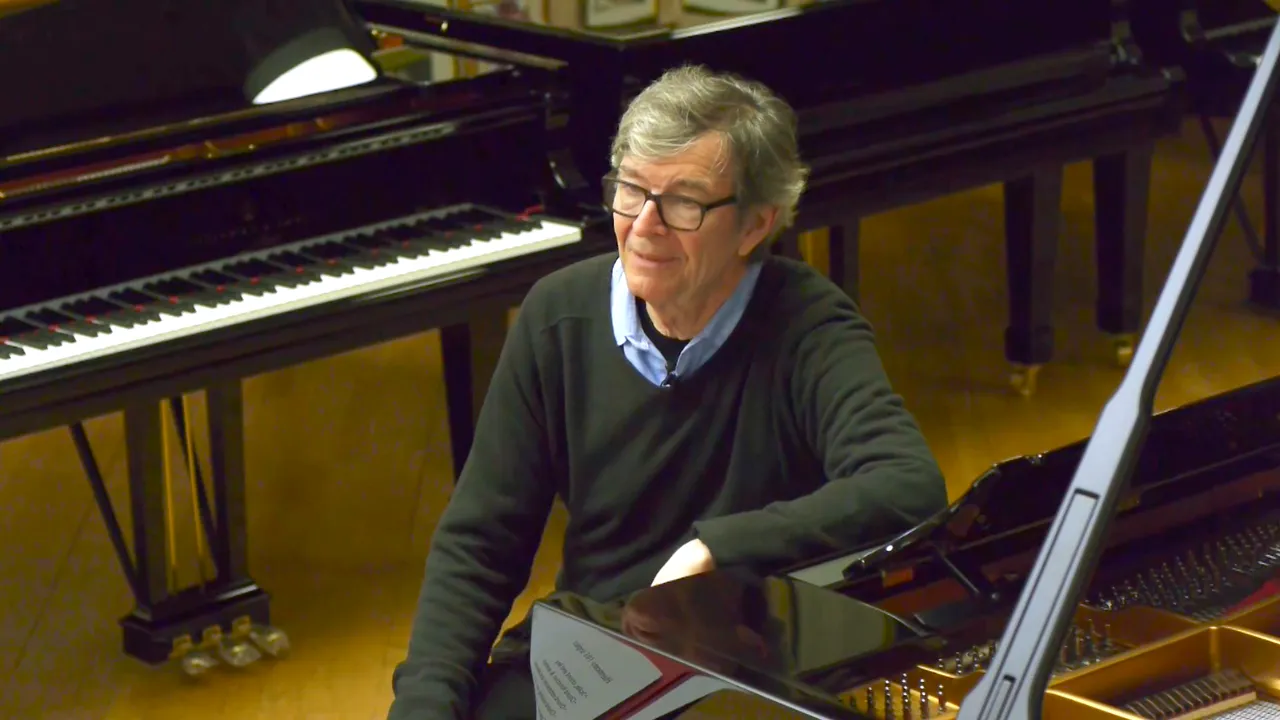
About the instructor
Darius Brubeck es un reconocido pianista de jazz y pedagogo. Ha publicado numerosos álbumes como líder, ha girado por todo el mundo con sus propias formaciones y ha colaborado con sus hermanos en Brubecks Play Brubeck. Darius ha sido profesor visitante Fulbright en Rumanía y Turquía. Puso en marcha el primer título en jazz ofrecido por una universidad africana, en la University of KwaZulu-Natal de Sudáfrica, donde enseñó hasta 2005. Darius colabora a menudo con Mike Rossi, saxofonista y profesor de música en la University of Cape Town. Entre los logros de Mike se cuentan numerosas grabaciones y apariciones en escenarios internacionales como líder, solista y acompañante junto a Tony Bennett, Dave Liebman, Winston Mankunku Ngozi, George Russell, Clark Terry y Alessio Menconi, entre otros. Con Darius como guía, irás directo a lo esencial. En Harmony 101 desmitifica la armonía del jazz para que puedas empezar a aplicarla rápidamente, y en Mastering Odd Times desglosa cómo tocar e improvisar con confianza en compases irregulares. read more