



Progresiones de acordes - Usando un lead sheet

Lesson time: (12min 7sec)
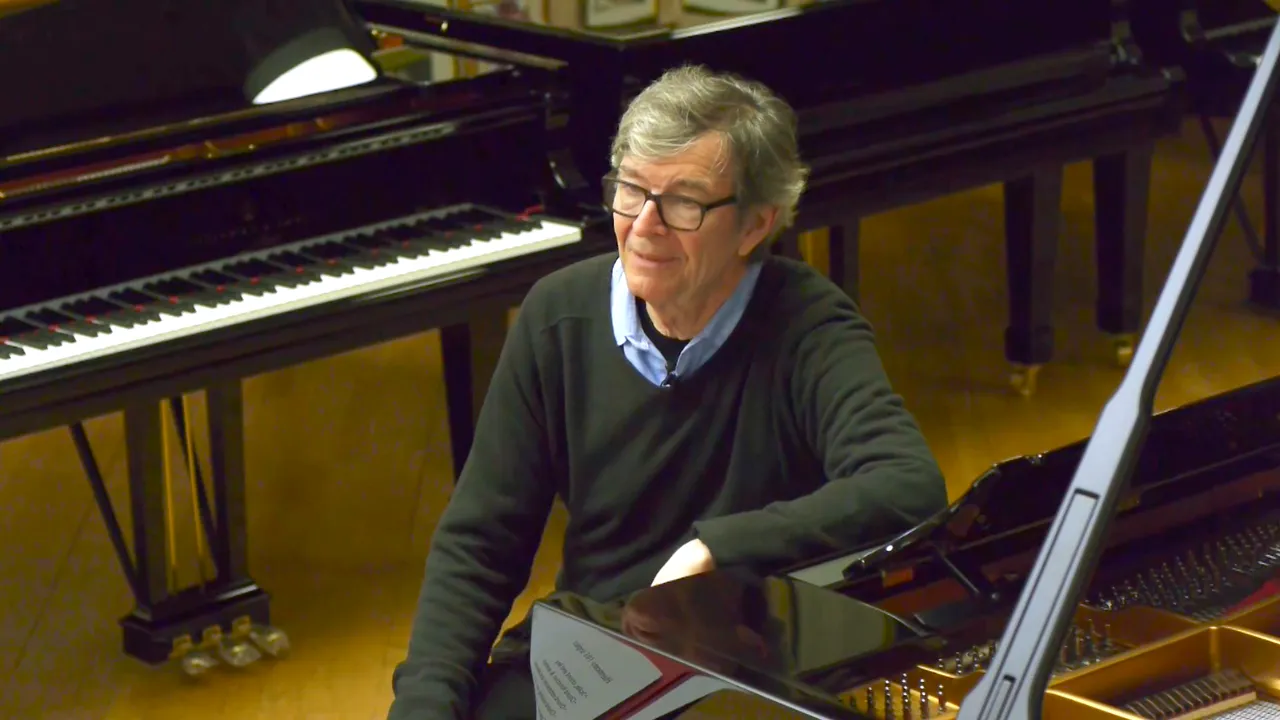
Darius Brubeck muestra cómo encadenar acordes en progresiones, usando un lead sheet de "Summertime" para ponerlo en práctica.
Course preview
This lesson is part of the course Armonía 101 - llega rápido a 'lo bueno'
Watch a preview of the full course below.
Lesson transcript:
Understanding Chord Progressions
You've learned how to build chords up vertically, but of course, music is more than piles of notes, no matter how groovy. Like, that's one of my favorite ones. But that in itself is just a static entity until it goes somewhere. So let's talk about chord progressions and how that works.
The Importance of Establishing Vocabulary
By being patient at the beginning and just establishing some vocabulary, we're now just on the verge of really getting into the good stuff. It could have taken a very long time to reach here by a standard academic route. But provided you've absorbed each point, which I hope I've presented clearly enough for you to do, we can see how chord progressions basically work within the harmonic system, within the tonal system.
Transitioning from Major to Minor
I mentioned, too, that we haven't paid much attention to minor. So in contrast to "Summer Song," let's look at "Summertime" and talk about how you read a lead sheet.
What Is a Lead Sheet?
A proper lead sheet, not one that's just made for illustrative purposes, but one you might find in one of the publications of standards like the Real Book, will give you:
- A line at the top, which is the melody
- Rhythmically approximate phrasing
You're usually encouraged to feel free about how you phrase the exact melodic rhythms. But what a lead sheet shows you is:
- The harmonic duration: how long each chord lasts
- The alphabetical chord symbol
It doesn't necessarily tell you the chord function; you have to work that out for yourself. Very often, you don't really need to do that step, but I would encourage you to do it. Unless you know the chord function, you will find it very difficult to transpose.
Why Transpose?
Why would you want to transpose? Well, suppose you're accompanying a singer, and A minor is an uncomfortable key for that singer. Then you would have to move it to a different key. So, you'd need to know that:
- The chord, A minor, is the one chord
- The chord that follows it is the 2 chord
- The chord that follows that is the V chord
So now we're talking the language of chord function again.
Transposing Example
Let's say we're transposing it into F. Then we'd say, well, A minor, we're going to go down a major third. So that will be:
- F minor (1)
- G minor 7, flat 5 (2)
- C7, flat 9 (V), and so on.
Figured Bass
The easiest way to figure that out, or really to know it, is to understand the figured bass. So that's two important pieces of information about what you see on a lead sheet.
What You Won't See on a Lead Sheet
What you don't see on a lead sheet is important to understand too. I mentioned how the rhythmic values are really approximate.
- No decent singer is really going to sing "one to summertime" like that.
- It will probably be more like a variation of it, with those two notes in that order and near the end of the pickup bar.
But what is accurate is that the chord, unless you're going to do a lot of tricks and interpolate chords, will last for that bar.
Chord Relationships
Let's look at what that was. That was a 2 because counting from a B is 2. It gets to be this rather interesting chord of minor 7, flat 5. Then it says E7, flat 9.
I didn't play that, but I played E7 sharp 9. Let me give you the flat 9:
- Both options are valid.
The reason I chose the sharp nine is just what my hand wanted to do from decades of experience. I saw that C coming up in the melody and I like that sound, which is a flat 13.
Chord Function and Progression
In terms of a chord progression, you have a lot of latitude. However, pay attention to the chord function because:
- You can change the extensions.
- You can change the alterations to some extent.
- You shouldn't change the chord function.
If it's going 1, 2, 5, 1, there are different ways of getting back to 1, but you ought to get back to 1 in the subsequent variation.
Look what happens at the end of that line:
- You're back to 1 and then quite dissonant.
But what? I didn't write this lead sheet, by the way. I would have put different changes, but that's great, everyone works with their own changes.
The Importance of the Seventh
The most important thing that's happened is that it changed to a seventh. That means that the third in the basic triad has changed from a minor third to a major third.
So you have a:
- 5 chord
You might say, "Well, hold on, we're in A."
- A minor.
- A major, how's that a 5?
It's just a different scale on the same root. Fair enough. But you do find often that when you take a minor chord, a minor seventh chord, and turn it into a dominant seventh chord, you're shifting a fourth above, going from a seventh to D.
Functional Terms
In functional terms, you could say:
- "Well, that's 5 of 4" and that's a pivot.
You'll find this device, whether in major or minor, is used a lot in songwriting. It can be interpolated in or just often there.
In classical harmony, you refer to this as a secondary dominant. Musicians basically just understand these as pivots that create a new plateau.
Temporarily, that's a kind of one, and then we're getting II V pivoting back to the A minor.
Relating Symbols to Function
The point of doing this kind of analysis is just to try to get you familiar with relating alphabetical symbols to function. Because once you do that:
- You can transpose easily.
- You get an idea of how the music works, where its real skeletal structure lies, which is in the root progression.
Not the voicings, not the things you put on top, but where the music wants to go.
Conclusion: How to Read a Lead Sheet
We have an idea from this of how to read a lead sheet. This is not a particularly busy one.
- Most of the chords are assumed to last until the next chord.
- They're deliberately not precise rhythmically because you have the freedom to interpolate other chords into it.
It's deliberately an open-ended system, not nailed down.
Information About Playing
If you think of playing this on the piano, it gives you no information about the voicing or spacing. The best you can get out of an alphabetical chord symbol is a list of possible pitches.
It doesn't tell you what octave to play it in, nor does it provide guidance on spacing or voicing. For instance, it might say A minor seventh, but should I play it this way?
There's nothing on this paper that says not to do that; it's just common sense!
Think about what you learned before about voicing and spacing. You're going to put your chords below the melody because the purpose of playing chords in the first place is to support the melody.
Harmonic Rhythm
Chord progressions provide what's called harmonic rhythm. So rhythm isn't just a beat; there's also a sense of motion progression.
About the instructor
Darius Brubeck es un reconocido pianista de jazz y pedagogo. Ha publicado numerosos álbumes como líder, ha girado por todo el mundo con sus propias formaciones y ha colaborado con sus hermanos en Brubecks Play Brubeck. Darius ha sido profesor visitante Fulbright en Rumanía y Turquía. Puso en marcha el primer título en jazz ofrecido por una universidad africana, en la University of KwaZulu-Natal de Sudáfrica, donde enseñó hasta 2005. Darius colabora a menudo con Mike Rossi, saxofonista y profesor de música en la University of Cape Town. Entre los logros de Mike se cuentan numerosas grabaciones y apariciones en escenarios internacionales como líder, solista y acompañante junto a Tony Bennett, Dave Liebman, Winston Mankunku Ngozi, George Russell, Clark Terry y Alessio Menconi, entre otros. Con Darius como guía, irás directo a lo esencial. En Harmony 101 desmitifica la armonía del jazz para que puedas empezar a aplicarla rápidamente, y en Mastering Odd Times desglosa cómo tocar e improvisar con confianza en compases irregulares. read more