



Símbolos y funciones de acordes
Darius Brubeck presenta los tres sistemas que los músicos usan para nombrar la armonía: números romanos, números de intervalo y símbolos de acordes, usando 'Swing Low, Sweet Chariot' y 'Summer Song' para mostrar la función de los acordes en acción.
Qué incluye el curso
11 lecciones (1h 48m) · 1 gratis
Transcripción de la lección
Music Lesson: Understanding Chord Functions
Okay, well, I hope you've been practicing scales and transposing chords to various key signatures and know your way around the keyboard a little bit. This lesson is going to refer to chord functions and chord C.
Now we're beginning to use the vocabulary that professional musicians use. So I said, be patient. This is already the second lesson, and we're already talking about real-life stuff here.
Three Symbolic Systems
There are three symbolic systems operating simultaneously when it comes to describing musical phenomena. This does give the impression of a high degree of complexity, but I think it's usually because people don't tell you in the first place that there are three different interacting, very organically related symbolic systems:
-
Roman Numerals: Used in academic music. You won't find Roman numerals on a real book lead sheet, for example, but they are used in figured bass realizations. Roman numerals refer to scale degree and describe chord function.
-
Arabic Numerals: Refer to intervals. For example, when talking about scales, I talked about thirds, fifths, sevenths, and so forth. Those are symbolized by our common everyday numbers.
-
Alphabetical Symbols: Refer to the root of the chord. For instance, a chord called an A minor seventh is represented as an A minor triad with a seventh.
So, you have these three interrelated systems. Chords are described in terms of their function or in terms of where they're built, how they're made on the piano.
Chord Functions
Chord function refers to primary chords, technically called:
- Tonic
- Dominant (V)
- Subdominant (IV)
If the Dominant is the V chord, the Subdominant is just below it. You could also understand it literally in terms of strength, the dominant chord is stronger, while the subdominant is a bit less dominating.
In the primary chords, we can think of them as follows:
- I (Tonic)
- IV (Subdominant)
- V (Dominant)
A lot of music, a lot of songs, can be harmonized using these primary chords. Think of them as like primary colors: tonic, dominant, subdominant.
Example: Swing Low, Sweet Chariot
For example, "Swing Low, Sweet Chariot" actually sounds quite good using these chords.
- Progression: 1, 4, 5, 4, 1
- That's three major chords, no extensions, no alterations.
It's surprising how many melodies you can reduce to just harmonizing with three chords.
Application: Summer Song
I'm going to be working with a song that my parents, Dave and Iola Brubeck, wrote. Starting with simpler versions, we'll gradually expand through the series. The song is called Summer Song.
On Worksheet 1, I've put Roman numerals underneath the treble clef and alphabetical chord symbols above the music so you can follow what it is. The first line will remain very basic.
Harmonization Details
The primary chords work because the melody is mainly scale-wise. You'll notice there are no accidentals in the melody.
Below that, I'm going to harmonize the same line using every scale degree. I will enrich the sound while staying completely within the F major scale, just giving it a little more color.
I used one chromatic device called a diminished chord. The chart shows:
- Major sevenths
- Minor sevenths
- A diminished chord for completeness
- An augmented chord (though we won't be focusing on this)
Relationship Between Chords
Now, let's explore the language between 1, 4, and 5, the tonic, dominant, and subdominant. There are slightly weaker chords that have the same function as the stronger chords they're related to.
So we have not only primary colors but colors that blend.
For example:
-
The A minor chord (the first chord) has two notes in common with the tonic chord, making it interesting without veering too far from the starting point.
-
The G minor 7th chord (the 2 chord) is closely related to both the V and IV chords.
Thus, the chords in between can be viewed as variations or replacements for each other:
-
The VI and III chords have two common tones with the I chord, making them similar.
-
The II chord behaves like the IV chord and often precedes a dominant chord.
Diminished Chord
The VII chord is a diminished chord and functions similarly to a V chord, wanting to resolve to the I chord.
In summary, there's quite a lot here, but there aren't many different concepts to learn. The key is understanding how these functions interrelate.
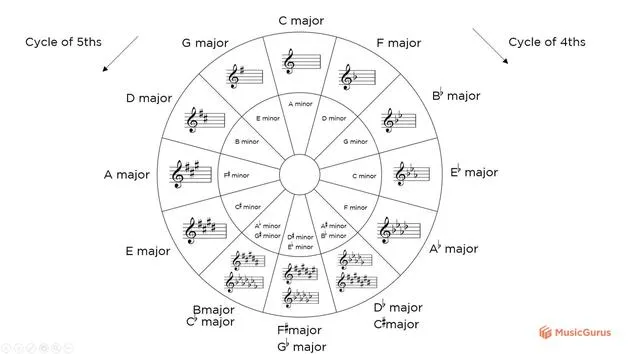
Let's go back to the key of C to illustrate:
- The primary chords (I and IV) are major sevenths.
- The dominant seventh is distinct and contains a tritone interval, which naturally wants to resolve.
Thus, the in-between chords are considered weaker versions of the primary chords, which illustrates how chord function operates.
11 lecciones
1h 48m de lecciones en vídeo estructuradas
Funciones de vídeo avanzadas
Ralentiza, repite un pasaje, sigue la partitura
Móvil, tablet y ordenador
Practica donde quieras
Garantía de satisfacción 100%
30 días de garantía de devolución
Conoce a tu gurú

Conoce a tu gurú
Darius Brubeck es un reconocido pianista de jazz y pedagogo. Ha publicado numerosos álbumes como líder, ha girado por todo el mundo con sus propias formaciones y ha colaborado con sus hermanos en Brubecks Play Brubeck.
Darius ha sido profesor visitante Fulbright en Rumanía y Turquía. Puso en marcha el primer título en jazz ofrecido por una universidad africana, en la University of KwaZulu-Natal de Sudáfrica, donde enseñó hasta 2005.
Darius colabora a menudo con Mike Rossi, saxofonista y profesor de música en la University of Cape Town. Entre los logros de Mike se cuentan numerosas grabaciones y apariciones en escenarios internacionales como líder, solista y acompañante junto a Tony Bennett, Dave Liebman, Winston Mankunku Ngozi, George Russell, Clark Terry y Alessio Menconi, entre otros.
Con Darius como guía, irás directo a lo esencial. En Harmony 101 desmitifica la armonía del jazz para que puedas empezar a aplicarla rápidamente, y en Mastering Odd Times desglosa cómo tocar e improvisar con confianza en compases irregulares.







