



Progresiones de acordes: ejemplo de blues

Lesson time: (16min 0sec)
Darius Brubeck explica y demuestra la progresión de acordes de blues, y por qué su sonido de séptima dominante funciona aunque rompa las reglas de la armonía clásica.
Course preview
This lesson is part of the course Armonía 101 - llega rápido a 'lo bueno'
Watch a preview of the full course below.
Lesson transcript:
Common Chord Progressions
Introduction to Chord Progressions
Let me talk about some common chord progressions and I'll get back to some of the principles of analysis. I like to bring up the blues progression because it is so contrary to classical common practice harmony and it is so instinctive. It sounds completely right, but it completely undermines a lot of what we're taught about the harmonic system because it doesn't presuppose a major scale, not completely.
The Blues Progression
The reason I say that is like blues. You'll hear excellent examples in this series performed by Paddy Milner in his Blues Lessons. The one is voiced as a dominant seventh, usually in basic blues.
Basic Blues Structure
- In three-chord blues:
- The tonic (1) → Subdominant (4) → Tonic (1) again.
- The four, which is normally a major seventh, is also a dominant.
- So, we have all seventh chords.
That's a very common progression. The bass still follows the logic of the harmonic system.
Common Three-Chord Blues
- Starting on a tonic
- Moving up to the subdominant
- Then back to the tonic
- Subdominant → Dominant (5) → Subdominant (4) → Tonic (1)
As I said, all dominant seventh chords. So that's your common three-chord blues. I know some people will talk disparagingly about that, saying, "Oh, it's just a three-chord blues." However, it is really a very sophisticated form to try to master.
Mastering Blues
- Working with different kinds of scales
- Building melodies
- Convincingly resolving things
When everything's, in our Western theory, a dominant seventh, there's kind of no home base really. But we're helped by this blues scale, which is kind of an amalgam of Western and African scales in the vocabulary of jazz.
Jazz Harmony and Standards
I said I'm going to try to stay away from making it too jazz-specific. But what really makes jazz harmony something that is thought of as a particular branch of music theory is that the blues is the backbone of jazz and other improvised music.
There's a lot of improvisation in rock too, just not as much harmonic density usually. The other side of what feeds into jazz, though, is the whole tradition of standards known as American songbook songs, songs originally composed for Broadway in New York or Hollywood musicals, roughly from the 20s up to the 60s.
The Influence of George Gershwin
George Gershwin comes to mind as a total master of that, as a composer.
Rhythm Changes
Another common chord progression talked about in basic blues is what is referred to as rhythm changes. This is so-called not because it has to do with rhythm changing but because of the song "I Got Rhythm," which follows a 1-6-2-5 progression, using a completely diatonic system.
- 1-6-2-5 Progression: Look for that chord progression to turn up all over the place, not just in tunes that use the same chords to back a different melody.
- Turnaround: This 1-6-2-5 is often used as a turnaround, typically found in the last two bars of a song or even of a blues.
Now we get them combining. You could have a blues going.
Introducing Two-Fives
Now I've brought in a lot more scale degrees and I've been using another technique that I've been hinting at, using two-fives.
- A minor seventh and a dominant seventh is referred to as a 2-5.
- The roots of these chords are a fourth apart.
If you go another fourth and land on a major or minor chord that's very stable, you've created a new key center.
Navigating Chord Progressions
I know that we've gone from saying how a C scale works to pretty advanced stuff pretty fast. But you can replay these lessons and pick up bits and pieces if you're finding this hard to follow.
Understanding chord progressions is pretty easy if you understand chord function.
Expanding the Blues
Let's stay with blues. Instead of doing three chords, I'll add some two-fives.
- I'm going 1 → 6 → 2 → 5.
- I added rhythm changes.
Actually, stylistically, to me, it sounded like a mistake. I was trying to stick with 1-6-2-5 as rhythm changes.
Tonal Adjustments
I really should have gone... What did I do differently? I made the sixth chord a dominant seventh because that just sounds bluesier. Dominant sevenths kind of belong there more.
When we get up to bebop, we remember in Summer Song, I reharmonized it to use every scale degree.
The Parker Blues
This leads us to the beginning of modern jazz. The blues form was maintained, but there was a strong tendency to add more chords, more root movement, more scale degrees. So, you get a Parker blues which would go like this:
- Starting with a major seventh
- Ending up on the subdominant after passing through a number of places along the way, which have all been two-fives.
- You can think of a minor chord as where you land, or just on the way, as it could in itself be a 2 to another 5.
I've landed on the subdominant. Using almost as many chords as possible, you could probably insert some chromatic things.
Chord Progressions in Jazz
Now we're getting kind of into the jazz stratosphere, that's not really where we have to go with this. I'm just showing you how chord progressions work.
- Think of cycles like 1-6-2-5, or just take the 2-5 from that or the 2-5-1.
- You've got cycles of fourths, just like moving from key center to key center.
If you change the chord functions as you go along, which you can do, you can imply a two or a five.
Application for Songwriters
So, that can lead you to really rich, wonderful, fascinating, tricky harmony that can move from key to key with great facility. Maybe that's more than you need to know.
If you're not interested in music on a professional level, but if you're a songwriter, for instance, it's important to know how to get to, say, the end of your 16-bar chorus.
Creating Musical Relief
Instead of just repeating it, kick it up a fourth or a minor third, some other interval, to have a bridge in a different key. That gives it a kind of relief and special lift.
Conclusion
We've taken a very rapid journey. From seeing the intervals in an octave to building some chords, and adding to them all along. You're encouraged to experiment with them and then put them into context.
Chords in motion, chord progressions, the blues, they're all over the place. You could play along with records, for example, and see where you're going with the blues.
I'm not giving you a practical lesson about how to do each thing, but I'm just trying to show you how music works. I hope this bridges what I perceive to be a big gap between formally trained musicians and those who were not, allowing them to communicate better.
This is meant to make it easy for musicians to work together and be on the same page. And, of course, you can take things to a much higher level, rationalizing things more.
Final Thoughts
Don't forget the easy shortcuts, like playing triads over pedal tones to discover interesting voicings that might be unique. Remember to make chords sonorous, make them good-sounding by spacing them nicely.
Remember: You can use inversions.
Thank you for your time, and I hope you continue to enjoy working out some of these concepts on a keyboard!
About the instructor
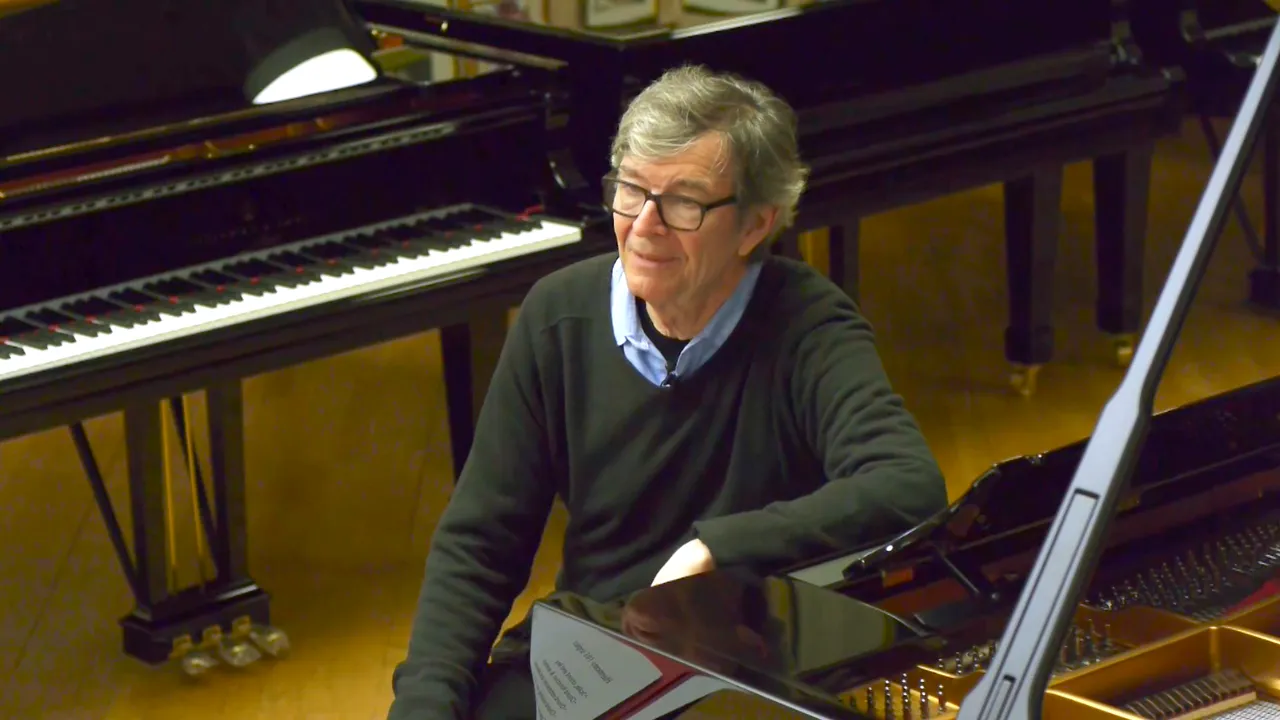
Darius Brubeck es un reconocido pianista de jazz y pedagogo. Ha publicado numerosos álbumes como líder, ha girado por todo el mundo con sus propias formaciones y ha colaborado con sus hermanos en Brubecks Play Brubeck. Darius ha sido profesor visitante Fulbright en Rumanía y Turquía. Puso en marcha el primer título en jazz ofrecido por una universidad africana, en la University of KwaZulu-Natal de Sudáfrica, donde enseñó hasta 2005. Darius colabora a menudo con Mike Rossi, saxofonista y profesor de música en la University of Cape Town. Entre los logros de Mike se cuentan numerosas grabaciones y apariciones en escenarios internacionales como líder, solista y acompañante junto a Tony Bennett, Dave Liebman, Winston Mankunku Ngozi, George Russell, Clark Terry y Alessio Menconi, entre otros. Con Darius como guía, irás directo a lo esencial. En Harmony 101 desmitifica la armonía del jazz para que puedas empezar a aplicarla rápidamente, y en Mastering Odd Times desglosa cómo tocar e improvisar con confianza en compases irregulares. read more