



Ejemplo de inversiones de acordes - My Funny Valentine
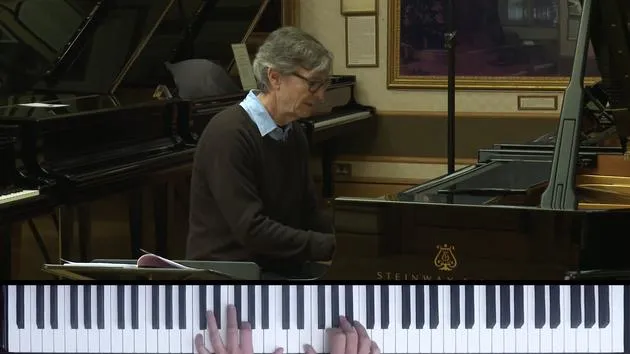
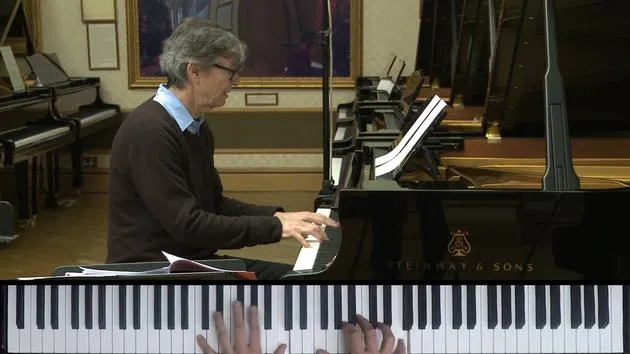
La conclusión más importante de la lección sobre inversiones de acordes es que la nota más grave que oyes no es necesariamente la fundamental del acorde. Darius lo ilustra con el clásico tema My Funny Valentine.
Qué incluye el curso
11 lecciones (1h 48m) · 1 gratis
Transcripción de la lección
Understanding Inversions in Chord Progression
Perhaps the single most important piece of information you can take away from just this brief look at inversions is that the lowest note you play or hear may not, in fact, be the root of the chord.
Next Lesson Overview
That's why in the next lesson, we're going to talk about chord progression and understand a little more about how it works.
Illustrating Inversions
To illustrate this point further, besides the B section of Summer Song, which you can see written out, I've thought of a couple of other examples where the commonly applied descending line underneath implies inversions.
- My Funny Valentine
- This song has received scant attention to minor, something that we'll pick up in the next lesson.
- It's a familiar ballad.
- Usually, you hear it with a descending bass line.
- This means that even though it can be over a pedal C the whole time (since we're in C minor in passing), you can make some nice voicings that don't disturb the overall C minor quality.
- However, that's really an inversion of a G triad: E flat, A minor, half diminished.
- And then to the subdominant.
- Finally, you're at a root position chord, and so on.
Movement Within Chords
You can see how this works: you can have chord changes within chords that come just from using the lowest note to build another chord, which might be an inversion that adds more richness to the progression.
- An Example in Major
- An example in major would be going from C minor to E flat major, like the song Someone in Love.
- "So what?" you may ask, this could imply that the lowest note is not the root of the chord (3, 6).
Conclusion
So, even though the important aspect is the root progression, inversions give you a way to build up movement even within that. We'll talk about that a lot more in the context of chord progression, but I just thought I might stick that in before discussing voicings that omit the root altogether.
11 lecciones
1h 48m de lecciones en vídeo estructuradas
Funciones de vídeo avanzadas
Ralentiza, repite un pasaje, sigue la partitura
Móvil, tablet y ordenador
Practica donde quieras
Garantía de satisfacción 100%
30 días de garantía de devolución
Conoce a tu gurú

Conoce a tu gurú
Darius Brubeck es un reconocido pianista de jazz y pedagogo. Ha publicado numerosos álbumes como líder, ha girado por todo el mundo con sus propias formaciones y ha colaborado con sus hermanos en Brubecks Play Brubeck.
Darius ha sido profesor visitante Fulbright en Rumanía y Turquía. Puso en marcha el primer título en jazz ofrecido por una universidad africana, en la University of KwaZulu-Natal de Sudáfrica, donde enseñó hasta 2005.
Darius colabora a menudo con Mike Rossi, saxofonista y profesor de música en la University of Cape Town. Entre los logros de Mike se cuentan numerosas grabaciones y apariciones en escenarios internacionales como líder, solista y acompañante junto a Tony Bennett, Dave Liebman, Winston Mankunku Ngozi, George Russell, Clark Terry y Alessio Menconi, entre otros.
Con Darius como guía, irás directo a lo esencial. En Harmony 101 desmitifica la armonía del jazz para que puedas empezar a aplicarla rápidamente, y en Mastering Odd Times desglosa cómo tocar e improvisar con confianza en compases irregulares.







