



Los acordes más comunes
Lesson time: (5min 41sec)
Course preview
This lesson is part of the course Mandolina para principiantes con Tom Bekeny
Watch a preview of the full course below.
Lesson transcript:
Understanding Chords for Bluegrass
The next thing I want to talk to you about is chords. Chords are really important to know when playing in a bluegrass band.
When you're not playing a solo or a lead, and when you're not playing countermelodies or what's called backup behind a vocalist, you'll be chopping chords and helping to keep time for the band. You'll actually be playing chords more than you're doing anything else in a band context.
Chord Basics
I won't get too much into the theory of how chords are constructed, but here's the short version:
- A chord (specifically, a major chord) is three notes sounded together, forming a major triad.
- Additionally, a minor triad is built on top of the major triad.
In a lot of bluegrass music, early country, and folk music, you can play many songs just by knowing three chords. Let's focus on the key of A and the three basic chords:
- A major
- D
- E
I'll have chord diagrams available on the website.
You can often play what's called an E dominant seventh, which looks like this:
- Start with an E chord (E note of the E chord).
- Take that down two frets (or a whole step) to get the flatted seventh.
This creates the tension that wants to resolve back to A.
Basic Bluegrass Chop
Now, let's get into more detail about how to make this chord. The chord I'm going to show you is the basic bluegrass chop, which produces a very percussive sound. In a bluegrass band, you'll be the closest thing they have to a drum, especially in a traditional context.
A Chord
To play an A chord:
- Middle finger: Place it on the fifth fret of the E string (A note).
- Index finger: Put it on the fourth fret of the A string.
- Ring finger: Goes to the seventh fret of the D string.
- Pinky: Reach all the way down to the ninth fret on the G string.
This combination creates the shape for the basic bluegrass major chord (A chord). It may be quite a stretch for you when you're learning it, but if you stick with it, you'll get the hang of it. Initially, you might feel some fatigue, but it will become easier over time.
D Chord
Now, to get the D chord, follow this process:
- Move everything up in the same relationship.
- Take the current shape off and retain the three fingers in the same formation.
For the D chord:
- Middle finger: On the fifth fret of the A string.
- Index finger: On the fourth fret of the D string.
- Ring finger: On the seventh fret of the G string.
E Chord
To form your E chord:
- Simply move your D shape up two frets.
So now you have:
- D
- E
By following these steps, you'll be well on your way to playing chords in a bluegrass band!
About the instructor
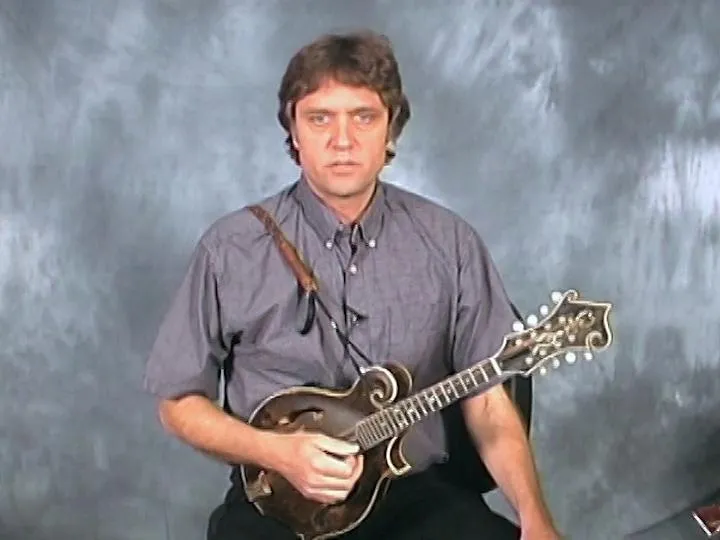
Tom Bekeny es mandolinista, violinista de fiddle y experimentado profesor de mandolina que ha actuado y enseñado en Estados Unidos y en el extranjero durante más de 40 años, así que cuando desglosa cómo tocar, estás aprendiendo de alguien que ha pasado toda una vida tanto sobre el escenario como en el aula. Fue el mandolinista de bandas de la zona de la bahía de San Francisco como Done Gone, Tenbrooks y una versión temprana de la Grant Street String Band con Laurie Lewis. Ha aparecido con Peter Rowan, los Rowan Brothers, David Grisman, George Cole, la vocalista Lua Hadar y Jerry Garcia. Tom ha tocado la mandolina con la muy aclamada Kathy Kallick Band durante casi 20 años y ha ocupado el puesto de fiddle en High Country, la banda de bluegrass tradicional por excelencia de California, desde 1988. Ha grabado con muchos de estos grupos y apareció en el número de verano de 2009 de Mandolin Magazine. Tom también toca en la enormemente popular banda de "jam" de bluegrass tradicional Bangers and Grass, junto a luminarias del bluegrass de la Costa Oeste como Jim Nunally, Steve Pottier, Bill Evans y Chad Manning. Más allá del bluegrass, Tom toca mandolina de jazz con su trío The Missing Man Quartet (MM4), que interpreta jazz directo con arreglos originales que toman material del mundo del jazz y de los estándares del Great American Songbook. En 2013 publicó un proyecto de CD en solitario ("Jazzolin"), en el que toca la mandolina y el fiddle acompañado de batería y bajo. read more