



Posiciones de acordes
Lesson time: (4min 48sec)
Tom Bekeny te muestra las posiciones de acordes habituales de la mandolina y cómo deslizarlas por el mástil para tocar los mismos acordes en cualquier tonalidad.
Course preview
This lesson is part of the course Mandolina para principiantes con Tom Bekeny
Watch a preview of the full course below.
Lesson transcript:
Understanding Chord Movements
Another thing I wanted to tell you about making chords is this: once you've got that shape down, to play in other keys, you just move the chord up and down as needed.
Importance of Knowing Scale Notes
It helps to know the notes of a scale, and this information will also be available on the website. Here are the notes:
- G
- G sharp
- A
- A sharp
- B
- C
- C sharp
- D
- D sharp
- E
- F
- F sharp
- G
Changing Keys: Example with A and B
Let's say you're in the key of A, and the singer says, "Ah, that's too low for me. I want to sing it in B."
To adjust, you'll need to:
- Identify the A note.
- Locate the B note:
- It goes: A, A sharp, B.
- The distance from A to B is two frets (1, 2).
This means you need to move your chord up two frets to play in B.
Visual Representation
Actually, this will be easier to understand with a visual representation, so refer to the diagram if available.
Playing Chords in Bluegrass
Now, regarding the basic major chord used in bluegrass, let's focus on the key of A.
To play a D chord from A:
- Keep the shape you see in A with your three fingers in their relative positions.
- Move it up in the direction needed.
If you don't have a place to put a finger:
- You generally don't want to play the open E, as it won't sound good in a bluegrass context. Instead, just play the bottom three notes.
Playing All Four Strings
If you want to play all four strings, take the D note and switch your finger positions.
- Use your bottom three fingers instead of the initial three.
- This gives you the same notes but allows for finger flexibility.
Now you can fret the second fret of the E string with the freed finger, enabling you to play all the notes.
Before, if you hit all the notes with the original position, you'd get an E, which is not part of a D or D major chord. The shape with F sharp on top looks like this.
Moving to E Chord
To play an E chord, do the same thing you did for the D chord:
- Move it up two frets.
Quick Chord Changes
A lot of times, when playing some tunes, you'll only need to switch between an A and an E chord.
Instead of going through the process of lifting all fingers, do this:
- Keep a finger planted: This note (E) is common to both the A chord and the E chord.
- Change only the three fingers that are needed.
At first, this switch will be difficult and will require thought. However, with practice, it becomes an economical way of changing chords without lifting everything up.
About the instructor
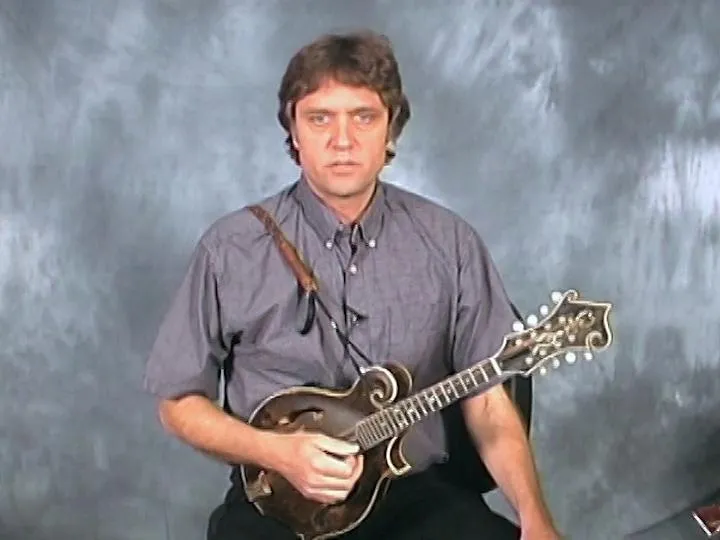
Tom Bekeny es mandolinista, violinista de fiddle y experimentado profesor de mandolina que ha actuado y enseñado en Estados Unidos y en el extranjero durante más de 40 años, así que cuando desglosa cómo tocar, estás aprendiendo de alguien que ha pasado toda una vida tanto sobre el escenario como en el aula. Fue el mandolinista de bandas de la zona de la bahía de San Francisco como Done Gone, Tenbrooks y una versión temprana de la Grant Street String Band con Laurie Lewis. Ha aparecido con Peter Rowan, los Rowan Brothers, David Grisman, George Cole, la vocalista Lua Hadar y Jerry Garcia. Tom ha tocado la mandolina con la muy aclamada Kathy Kallick Band durante casi 20 años y ha ocupado el puesto de fiddle en High Country, la banda de bluegrass tradicional por excelencia de California, desde 1988. Ha grabado con muchos de estos grupos y apareció en el número de verano de 2009 de Mandolin Magazine. Tom también toca en la enormemente popular banda de "jam" de bluegrass tradicional Bangers and Grass, junto a luminarias del bluegrass de la Costa Oeste como Jim Nunally, Steve Pottier, Bill Evans y Chad Manning. Más allá del bluegrass, Tom toca mandolina de jazz con su trío The Missing Man Quartet (MM4), que interpreta jazz directo con arreglos originales que toman material del mundo del jazz y de los estándares del Great American Songbook. En 2013 publicó un proyecto de CD en solitario ("Jazzolin"), en el que toca la mandolina y el fiddle acompañado de batería y bajo. read more