



Formas de acordes
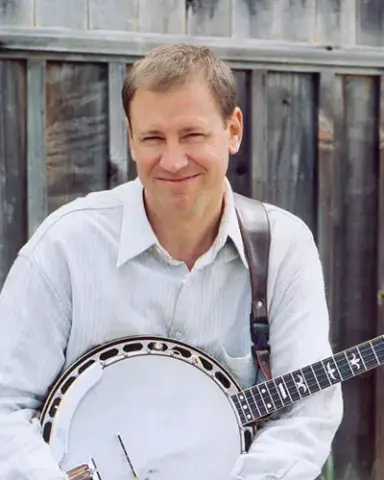
Lesson time: (4min 43sec)
Course preview
This lesson is part of the course Banjo para principiantes con Avram Siegel
Watch a preview of the full course below.
Lesson transcript:
Chords on the Banjo: Understanding Closed Shapes
Okay, before we go any further on songs, let's learn something about chords on the banjo.
Open and Closed Chords
We've learned some open chords so far, which have open strings in them. But since all the strings on the banjo are in the G chord, there are only so many chords that have open strings.
Let's learn about closed shapes on the banjo.
What is a Closed Shape?
A closed shape is a shape that doesn't have any open strings. On the banjo, there are three basic chord shapes, and those are:
- The Bar Chord: This is the simplest and is just like the open chord shape.
- The F Shape: Named because that's the lowest chord where you typically find this shape.
- The D Shape: Looks similar to the F shape.
Practicing the F and D Shapes
The F shape and the D shape are actually very similar. A good way to learn them is to practice going back and forth between them without lifting your pinky or ring finger. You'll find that your ring finger or pinky wants to follow along when you start moving those other fingers.
If you can get those two to move independently, it will make changing the chords very easy.
Chord Groupings
Let's learn a couple of places where we're going to find those chords:
- Most of the songs we're playing so far have G, C, and D in them.
- G is shaped like this: ![G Shape]
- C is shaped like this: ![C Shape]
Often, I'll just smudge my ring finger down to get those chords quickly. A D is right here. So, there's a really good grouping of chords that we need a lot, right in one area.
Another Grouping
There's a G up here. From there:
- A C is right here.
- A D is up here.
That's a good grouping, very practical, as they sound good together and are in close proximity.
Vamping Technique
Oftentimes, when you play just chords, you do something called vamping, which is playing three strings at once and then dampening the chord by lifting your fingers up.
You do this on the backbeat, with the basic bluegrass rhythm being:
Boom, Chick, Boom, Chick.
- Chick part: Boom, chick, boom, chick, boom, chick, boom, chick.
Notice I shifted from the high area to the low area there. For now, the main thing you want to do is just learn those chord shapes.
Unlocking All Chords
Another thing to learn about chords is that once you're playing these closed shapes, you can play any chord there is:
- G, G sharp, A, A sharp (or B flat), B, C, C sharp, D, E flat, E, F, and so on.
Anytime you know a closed chord, you can do that. All you have to know is where the sharps and flats are.
Understanding Sharps and Flats
Between most of the letter name notes, there's a sharp or flat:
- The sharp being the note higher.
- The flat being the note lower.
For example:
- If this is a G, this is a G sharp, and this is an A.
- G sharp is also an A flat.
There's no sharp or flat between E and F, and B and C.
Example Sequence:
- G, A, B, C, D, E, F.
- If this is D, then you can move through the sequence: D, E, F, G, A, B, C.
Happy practicing!
About the instructor
Avram Siegel es banjista y un pilar de la escena del bluegrass de California. Ha tocado con la Kathy Kallick Band y True Blue, entre muchos otros, y ha enseñado durante décadas: su método paso a paso ha formado a algunos de los jóvenes intérpretes más respetados del estado. En sus cursos desglosa los rolls de tres dedos al estilo Scruggs, el acompañamiento y el estilo melódico para que puedas desarrollar un timing y un tono limpios a tu propio ritmo. read more