



Struktur und Übetechniken

Lesson time: (7min 34sec)
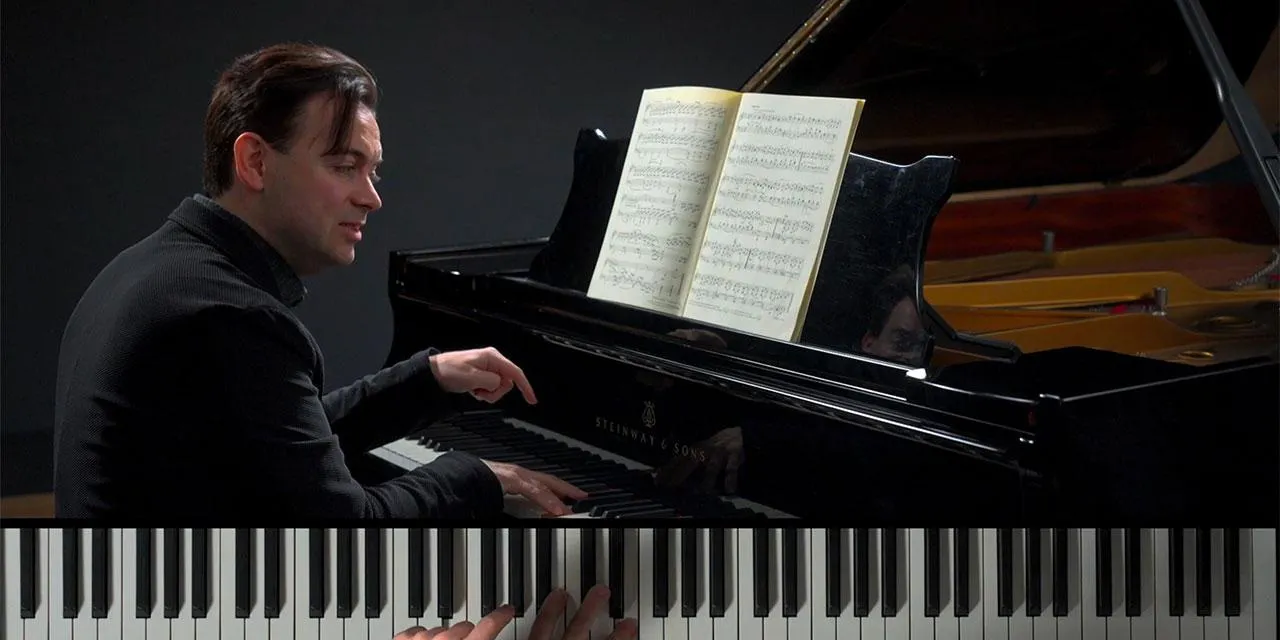
Dejan Lazić zerlegt die Form des virtuosen dritten Satzes und zeigt, wie man die schnellen Figuren der rechten Hand übt - Fingersatz, Handposition und Energiesparen durch den schwierigsten der drei Sätze.
Course preview
This lesson is part of the course Meistere Beethovens Mondscheinsonate: Sätze I, II und III
Watch a preview of the full course below.
Lesson transcript:
Beethoven's Moonlight Sonata: Third Movement
Hi, everyone! We're back with Beethoven and his Moonlight Sonata. Let's dive immediately into the opening of the third movement, which is the most virtuosic one. In a sense, virtuosity here does mean fast; you need fast fingers.
Practicing Fast Passages
I'll try to show you how to:
- Practice those passages
- Use proper hand position
- Manage finger interconnection between 3 and 4
This is very important because, for these passages, you will always need fingers 1, 2, and 5. But for the third note in a row, you will have to decide between three or four.
Look here:
- First broken chord
- Second broken chord
These are all inversions of C sharp minor.
Fingerings to Remember
- With an upper octave, I use 3,
- Then again 3, now 4,
- And then we repeat the whole thing again: 3, 3, 4.
So, it's essential to practice slowly, regardless of whether you're a beginner or an advanced student, whether you're already a concert pianist.
I started playing this piece back in the 80s, and I still feel challenged by it every time anew. Whenever you come back to it, always remember to practice slowly because every figure matters.
For instance, here we have the broken C sharp minor chord right at the beginning.
Then we go to the dominant:
- For this one, I'm using third in the middle, fourth, fourth, and then again: 3, 4, 4 (the other way around).
- Next, we reach C sharp major, which acts here as A dominant to F sharp minor.
Structure of the Piece
We have groups of two bars, two bars, two bars. The first six bars are divided into pairs:
- Once you get those three figures right and repeat them, you're set.
- And again, the same principle for the third time around.
So, this is how you practice:
- Know the exact chord.
- Break that chord.
Bar Seven
In bar seven, we have only one bar, meaning we have just that one position. We also have repeats and a new harmony with A in the bass.
This is very important, and it recurs throughout the piece.
Whenever this motif returns, think of it as an engine. The tempo indication is presto agitato, meaning it's very fast and agitated.
Left Hand Technique
When you have the left hand really short, imagine a bassoon player. Everything is in piano except for this very last outburst of sforzando.
Then again, piano outburst and repeat the same.
We are really here agitated yet very soft.
Practicing Dynamics
- Remember to practice slowly, and you can increase the tempo.
- You can even practice with accents to emphasize crucial moments.
Over time, once you've sorted out all:
- Fingering issues
- Balance issues
- Proper harmonies
You can then increase the tempo.
Key Dynamics to Remember
- Stay in piano,
- Transition to sforzando, piano, sforzando, piano,
- In bar seven, we have a crescendo that spans two bars, bringing us finally to forte.
I will play this first beat until the fermata. Here, you finally reach forte!
Remember that pedal tone issue from the first movement with the low bass line G sharp? It comes up again here.
So listen:
- I didn't play forte the rest so you can concentrate.
Again, it's the same thematic material that Beethoven uses, connecting movements 1 and 3.
Finally, when we reach this G sharp, we start a new french piano.
Looking Ahead
In the next lesson, we'll explore:
- Alberti basses
- The return of this famous Neapolitan chord
- Much more!
I look forward to welcoming you back then!
About the instructor
Dejan Lazićs frische Interpretationen des Repertoires haben ihn als einen der eigenständigsten und ungewöhnlichsten Solisten seiner Generation etabliert. Er tritt regelmäßig mit den führenden Orchestern der Welt auf, darunter die Boston und Chicago Symphony Orchestras, das Budapest Festival Orchestra, das Royal Concertgebouw Orchestra, das London Philharmonic, das Philharmonia Orchestra, das NDR Elbphilharmonie Orchester sowie die Kammerorchester Australiens, Basels und der Niederlande, und hat enge Zusammenarbeiten mit Dirigenten wie Giovanni Antonini, Iván Fischer, Michael Francis, Andris Nelsons, Ivan Repušić, Thomas Søndergård, Robert Spano, John Storgårds, Krzysztof Urbański und Jan Willem de Vriend aufgebaut. Dejan Lazić hat zahlreiche CDs bei Channel Classics und Onyx Classics sowie eine Einspielung von Beethovens Tripelkonzert für Sony Classical veröffentlicht. Seine Live-Aufnahme von Rachmaninows Klavierkonzert Nr. 2 mit dem London Philharmonic Orchestra und Kirill Petrenko wurde mit dem deutschen "Echo Klassik"-Preis ausgezeichnet. Er hat zudem eine große Anhängerschaft im Fernen Osten und ist rege als Rezitalist und Kammermusiker tätig, mit regelmäßigen Auftritten bei bedeutenden internationalen Festivals. Dejan Lazićs Kompositionen finden zunehmende Anerkennung, und 2015 wurde er als Komponist von der Sikorski Music Publishing Group unter Vertrag genommen. Seine Bearbeitung von Brahms' Violinkonzert als Klavierkonzert "Nr. 3" wurde 2009 mit dem Atlanta Symphony Orchestra und Robert Spano uraufgeführt und aufgenommen und erfreut sich seither anhaltend großen Erfolgs, bei den BBC Proms, im Concertgebouw Amsterdam, beim Hamburger Osterfestival und beim Chopin-Festival Warschau, auf beiden amerikanischen Kontinenten und in Japan. Sein Klavierkonzert im istrischen Stil (Op. 18) wurde 2014 beim Aspen Music Festival uraufgeführt und ist seitdem in ganz Europa und in den USA aufgeführt worden. Zu weiteren Werken zählen verschiedene Orchester-, Kammer- und Klaviermusik, Kadenzen sowie mehrere Bearbeitungen von Werken von Mozart, Schubert, R. Strauss, Wagner und Debussy. Dejan Lazić wurde in Zagreb, Kroatien, in eine Musikerfamilie hineingeboren. Er wuchs in Salzburg, Österreich, auf, wo er am Mozarteum studierte (Klavier, Klarinette und Komposition). Seine frühen Begegnungen mit Zoltán Kocsis und Imre Rohmann beim Bartók-Festival in Ungarn waren für seine künstlerische Laufbahn ebenso entscheidend wie der bedeutende Einfluss von Peter Eötvös. Dejan Lazić lebt in Amsterdam. In Master Moonlight Sonata by Beethoven teilt Dejan die Einsicht hinter diesen gefeierten Interpretationen und führt dich durch alle drei Sätze eines der beliebtesten Werke des Klavierrepertoires, damit du es mit echtem Verständnis statt durch Nachahmung gestalten kannst. www.dejanlazic.com read more