



Alberti-Bass (Begleitung)

Lesson time: (10min 30sec)
Dejan Lazic erklärt die Alberti-Bass-Begleitfiguren im dritten Satz der Moonlight Sonata, wie man sie gegen die Melodie ausbalanciert und wie man sie übt.
Course preview
This lesson is part of the course Meistere Beethovens Mondscheinsonate: Sätze I, II und III
Watch a preview of the full course below.
Lesson transcript:
Beethoven's Moonlight Sonata: Third Movement
Hi everyone, we are back with Beethoven and the Moonlight Sonata, third movement, the most virtuosic one.
Contrasts in the Sonata
We were talking about the great contrasts Beethoven included when composing this sonata:
- First Movement: Very intimate, soft, and slow.
- Second Movement: Cheerful and dance-like, described as a "flower between the two Abbesses," as Lis called it, in D flat major.
- Third Movement: Back to C sharp minor with incredible broken chords passages.
Rhapsodic Movement
This movement doesn't start with a clear theme or subject. Instead, it begins with broken chords, similar to how we started the first movement. Later, we discover that there is indeed a motivic subject, a theme worthy of singing.
Theme Introduction
The thematic material appears a bit later, in Bar 21, after we encounter a fermata. Do you remember the pedal note: G sharp fermata?
Fermata Timing
- Importance of Timing: No one really knows how long this fermata should be.
- Repetition: Since you are likely repeating this first section multiple times, you can experiment with timing.
- Consider making it dramatically longer the first time and a bit shorter another time.
- Beethoven's Improvisation: Beethoven was a great improviser. Performers noted that he often played the same piece differently in repeats.
Transitioning from Second Movement
After the second movement, which ends in B flat major, we transition immediately to C sharp minor, setting up the "engine" for the third movement.
Fingering Recommendations
For fingering, I recommend:
- Not the usual: Octave 1:5.
- Consider 1-4 for certain sections since the fourth finger is positioned between the black keys and doesn't project as well.
Accentuation and Dynamics
- Use piano sforzando and prepare for novelty.
- In Bar 19, we see a crescendo for the first time with the same figure (broken chords), but it's done with slurs, meaning it should be played legato and more expressively.
Alberti Bass
We encounter the Alberti bass, a familiar accompaniment figure used extensively by the Italian composer Alberti, a singer and harpsichordist.
- This figure appears frequently in Beethoven's writing and is a mix of humor and irony.
- It's essential to play it with minimal pedal to ensure clarity since it belongs more to the 18th century than to a 19th-century piece.
Variations of Alberti Bass
- The figure appears in various forms:
- In the left hand during the middle section,
- In the right hand from Bar 75.
Practicing Tips
Pay attention to the thumb:
- We discussed the importance of the thumb's flexibility earlier.
- For G sharp minor, your thumb should be very flexible:
- In the left hand, use G sharp 5-3-1 for the first inversion.
- Then, try 4 to 1 to maintain a natural hand position.
Additional Considerations
- Avoid practicing too fast, focusing instead on maintaining proper technique to avoid strain.
- Ensure that you take care of your thumbs throughout the practice.
See you next time!
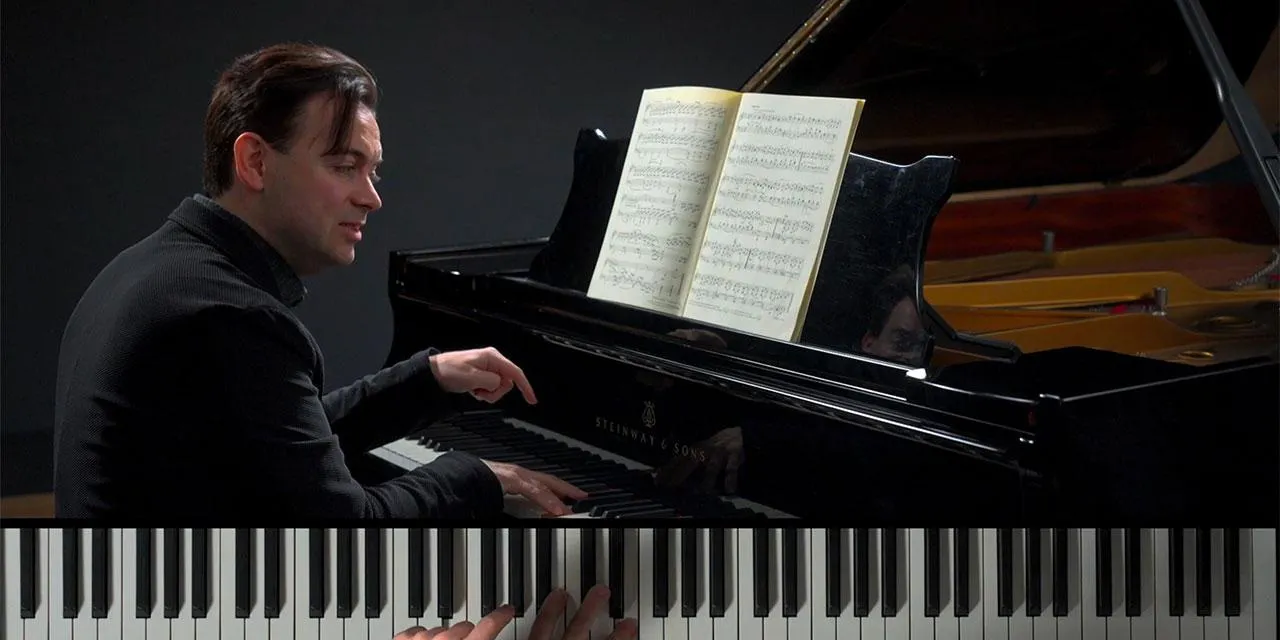
About the instructor
Dejan Lazićs frische Interpretationen des Repertoires haben ihn als einen der eigenständigsten und ungewöhnlichsten Solisten seiner Generation etabliert. Er tritt regelmäßig mit den führenden Orchestern der Welt auf, darunter die Boston und Chicago Symphony Orchestras, das Budapest Festival Orchestra, das Royal Concertgebouw Orchestra, das London Philharmonic, das Philharmonia Orchestra, das NDR Elbphilharmonie Orchester sowie die Kammerorchester Australiens, Basels und der Niederlande, und hat enge Zusammenarbeiten mit Dirigenten wie Giovanni Antonini, Iván Fischer, Michael Francis, Andris Nelsons, Ivan Repušić, Thomas Søndergård, Robert Spano, John Storgårds, Krzysztof Urbański und Jan Willem de Vriend aufgebaut. Dejan Lazić hat zahlreiche CDs bei Channel Classics und Onyx Classics sowie eine Einspielung von Beethovens Tripelkonzert für Sony Classical veröffentlicht. Seine Live-Aufnahme von Rachmaninows Klavierkonzert Nr. 2 mit dem London Philharmonic Orchestra und Kirill Petrenko wurde mit dem deutschen "Echo Klassik"-Preis ausgezeichnet. Er hat zudem eine große Anhängerschaft im Fernen Osten und ist rege als Rezitalist und Kammermusiker tätig, mit regelmäßigen Auftritten bei bedeutenden internationalen Festivals. Dejan Lazićs Kompositionen finden zunehmende Anerkennung, und 2015 wurde er als Komponist von der Sikorski Music Publishing Group unter Vertrag genommen. Seine Bearbeitung von Brahms' Violinkonzert als Klavierkonzert "Nr. 3" wurde 2009 mit dem Atlanta Symphony Orchestra und Robert Spano uraufgeführt und aufgenommen und erfreut sich seither anhaltend großen Erfolgs, bei den BBC Proms, im Concertgebouw Amsterdam, beim Hamburger Osterfestival und beim Chopin-Festival Warschau, auf beiden amerikanischen Kontinenten und in Japan. Sein Klavierkonzert im istrischen Stil (Op. 18) wurde 2014 beim Aspen Music Festival uraufgeführt und ist seitdem in ganz Europa und in den USA aufgeführt worden. Zu weiteren Werken zählen verschiedene Orchester-, Kammer- und Klaviermusik, Kadenzen sowie mehrere Bearbeitungen von Werken von Mozart, Schubert, R. Strauss, Wagner und Debussy. Dejan Lazić wurde in Zagreb, Kroatien, in eine Musikerfamilie hineingeboren. Er wuchs in Salzburg, Österreich, auf, wo er am Mozarteum studierte (Klavier, Klarinette und Komposition). Seine frühen Begegnungen mit Zoltán Kocsis und Imre Rohmann beim Bartók-Festival in Ungarn waren für seine künstlerische Laufbahn ebenso entscheidend wie der bedeutende Einfluss von Peter Eötvös. Dejan Lazić lebt in Amsterdam. In Master Moonlight Sonata by Beethoven teilt Dejan die Einsicht hinter diesen gefeierten Interpretationen und führt dich durch alle drei Sätze eines der beliebtesten Werke des Klavierrepertoires, damit du es mit echtem Verständnis statt durch Nachahmung gestalten kannst. www.dejanlazic.com read more