



Pedal und das Ausbalancieren der drei Hauptelemente

Lesson time: (5min 27sec)
Lerne, das Pedal richtig einzusetzen (historische vs. harmonische Praxis). Entdecke außerdem, wie Dejan Bass, Triolen und Melodie ausbalanciert: drei Elemente in zwei Händen.
Course preview
This lesson is part of the course Meistere Beethovens Mondscheinsonate: Sätze I, II und III
Watch a preview of the full course below.
Lesson transcript:
Welcome Back to Our Course on Beethoven's Moonlight Sonata
In previous lessons, we've discussed:
- Sound production
- Structure and pace of the piece
- Three main features:
- The bass in the left hand
- The triplets in the right hand
- The famous motif, the melody in the right hand
The Role of Triplets
The triplets are often seen as accompaniment, but they are actually much more than that. One shouldn't take a passive approach towards them.
Exploring the Pedal
Before we dive into the world of pedal, it's important to note that there are many different views on how this piece should be performed and pedalized.
Beethoven's Pedal Marking
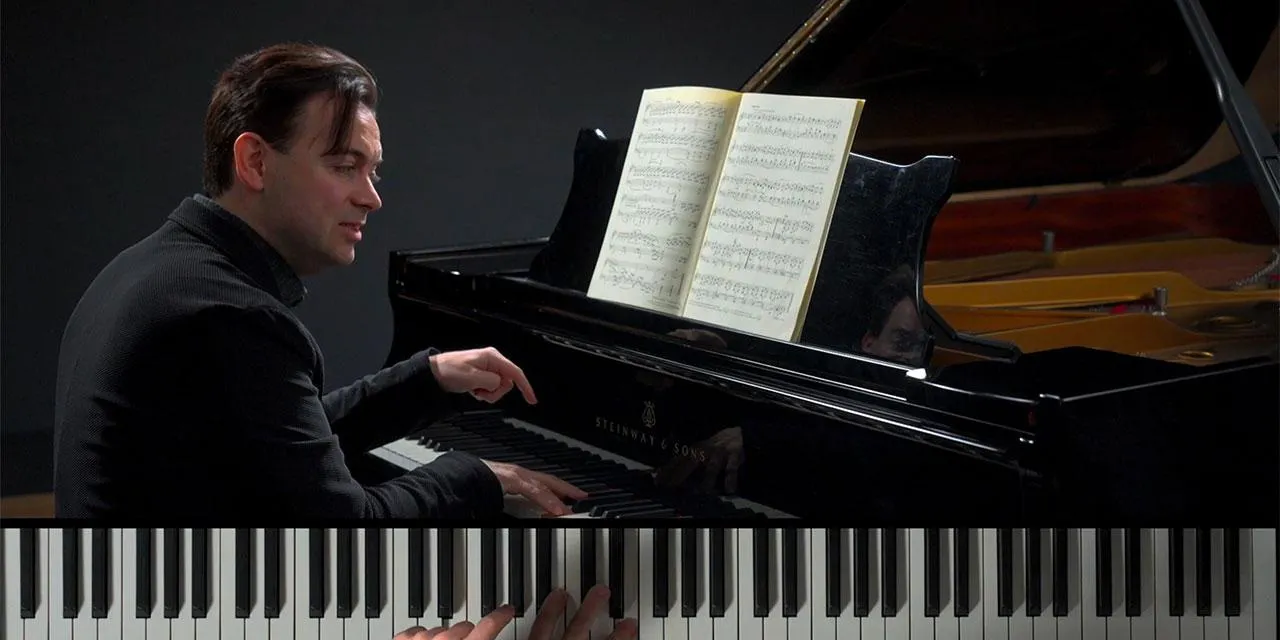
Beethoven's mark for the first movement instructs performers to use one sustained pedal throughout. On a modern instrument, like the Steinway we have here in Amsterdam tonight, sound production is much more robust.
- The piano is not only louder but also more massive than the instruments used in Beethoven's time when this sonata was written (i.e., 1801).
- The range is bigger, and the pedal catches those tones, allowing them to resonate for a much longer time.
The Concern for Pianists
This can be a worrying circumstance for many pianists. Let me show you how it sounds if I simply follow Beethoven's instruction and push down the pedal throughout the piece.
Although I won't play the whole movement, I will demonstrate the beginning:
[Plays the beginning of the movement]
Notice how those harmonies already clash, which can be interesting, but one might wonder, Is it too much?
Authentic Sound
I don't believe this is how Beethoven intended the piece to sound. Having played on a few instruments from Beethoven's time, I think we should respect his remarks from 220 years ago but also adapt them to our modern instruments to capture the essence of what he wanted.
Adapting the Pedal Technique
Half Pedaling
One approach is to change the pedal here and there, or to use half-pedaling.
- Half pedaling means that for certain chords, instead of changing the pedal entirely, you can lift and push down partially, creating a blend that isn't too clean.
For instance, consider this chord:
If I completely lift the pedal, it might sound too crisp.
Now, if I simply leave the pedal down, you would still distinctly hear the initial bass note, which may be too loud. Beethoven's original pianos did not sustain tones as long, allowing harmonies to dissolve more quickly.
Suggested Pedal Usage
What I propose, and this is not a new idea, is to manage the pedal in a way that is not overly explicit.
For example, when you encounter similar harmonies, such as:
- The notes G sharp, C sharp, and E in C sharp minor
- A subsequent change in the bass while the other notes remain the same
You could use the same pedal for these two harmonies, allowing for a smoother transition without needing to change the pedal constantly.
"This approach creates a more authentic sound that resonates more closely with what Beethoven intended."
About the instructor
Dejan Lazićs frische Interpretationen des Repertoires haben ihn als einen der eigenständigsten und ungewöhnlichsten Solisten seiner Generation etabliert. Er tritt regelmäßig mit den führenden Orchestern der Welt auf, darunter die Boston und Chicago Symphony Orchestras, das Budapest Festival Orchestra, das Royal Concertgebouw Orchestra, das London Philharmonic, das Philharmonia Orchestra, das NDR Elbphilharmonie Orchester sowie die Kammerorchester Australiens, Basels und der Niederlande, und hat enge Zusammenarbeiten mit Dirigenten wie Giovanni Antonini, Iván Fischer, Michael Francis, Andris Nelsons, Ivan Repušić, Thomas Søndergård, Robert Spano, John Storgårds, Krzysztof Urbański und Jan Willem de Vriend aufgebaut. Dejan Lazić hat zahlreiche CDs bei Channel Classics und Onyx Classics sowie eine Einspielung von Beethovens Tripelkonzert für Sony Classical veröffentlicht. Seine Live-Aufnahme von Rachmaninows Klavierkonzert Nr. 2 mit dem London Philharmonic Orchestra und Kirill Petrenko wurde mit dem deutschen "Echo Klassik"-Preis ausgezeichnet. Er hat zudem eine große Anhängerschaft im Fernen Osten und ist rege als Rezitalist und Kammermusiker tätig, mit regelmäßigen Auftritten bei bedeutenden internationalen Festivals. Dejan Lazićs Kompositionen finden zunehmende Anerkennung, und 2015 wurde er als Komponist von der Sikorski Music Publishing Group unter Vertrag genommen. Seine Bearbeitung von Brahms' Violinkonzert als Klavierkonzert "Nr. 3" wurde 2009 mit dem Atlanta Symphony Orchestra und Robert Spano uraufgeführt und aufgenommen und erfreut sich seither anhaltend großen Erfolgs, bei den BBC Proms, im Concertgebouw Amsterdam, beim Hamburger Osterfestival und beim Chopin-Festival Warschau, auf beiden amerikanischen Kontinenten und in Japan. Sein Klavierkonzert im istrischen Stil (Op. 18) wurde 2014 beim Aspen Music Festival uraufgeführt und ist seitdem in ganz Europa und in den USA aufgeführt worden. Zu weiteren Werken zählen verschiedene Orchester-, Kammer- und Klaviermusik, Kadenzen sowie mehrere Bearbeitungen von Werken von Mozart, Schubert, R. Strauss, Wagner und Debussy. Dejan Lazić wurde in Zagreb, Kroatien, in eine Musikerfamilie hineingeboren. Er wuchs in Salzburg, Österreich, auf, wo er am Mozarteum studierte (Klavier, Klarinette und Komposition). Seine frühen Begegnungen mit Zoltán Kocsis und Imre Rohmann beim Bartók-Festival in Ungarn waren für seine künstlerische Laufbahn ebenso entscheidend wie der bedeutende Einfluss von Peter Eötvös. Dejan Lazić lebt in Amsterdam. In Master Moonlight Sonata by Beethoven teilt Dejan die Einsicht hinter diesen gefeierten Interpretationen und führt dich durch alle drei Sätze eines der beliebtesten Werke des Klavierrepertoires, damit du es mit echtem Verständnis statt durch Nachahmung gestalten kannst. www.dejanlazic.com read more