



Dynamik und technische Herausforderungen

Lesson time: (14min 30sec)
Dejan bringt dir bei, wie du in diesem Satz durchgehend ein “sempre pianissimo” & Legato erreichst und wie du technische Herausforderungen meisterst, die nicht unbedingt virtuos sind.
Course preview
This lesson is part of the course Meistere Beethovens Mondscheinsonate: Sätze I, II und III
Watch a preview of the full course below.
Lesson transcript:
Proper Pedalization in Beethoven's First Movement
Introduction
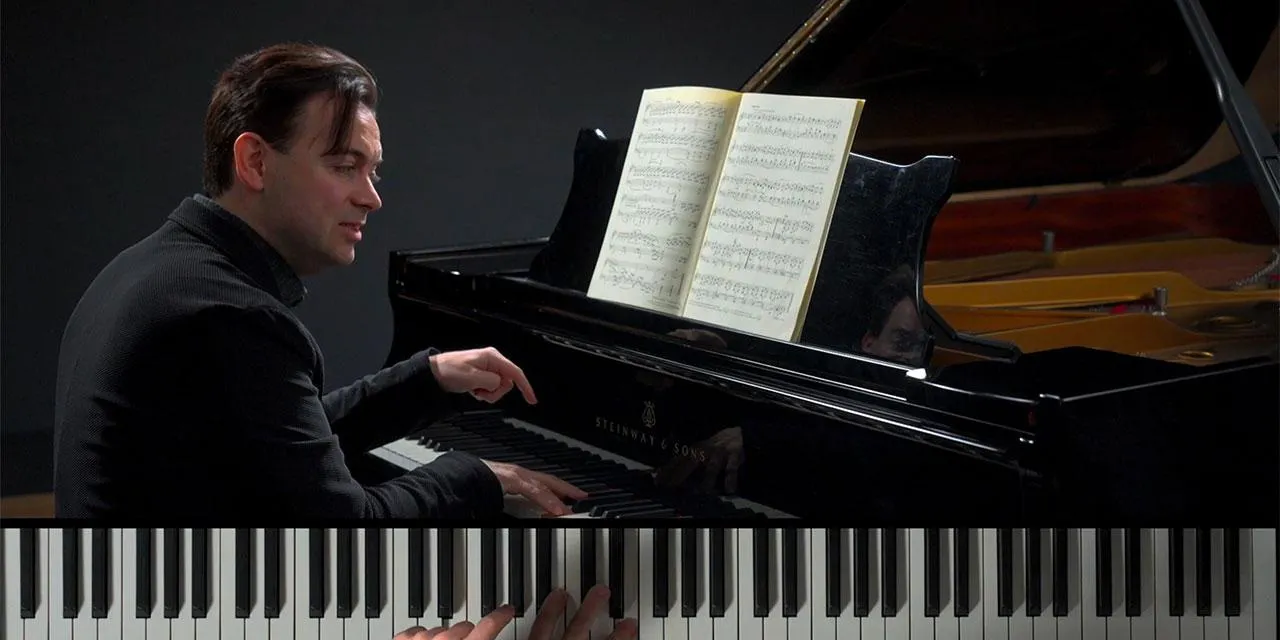
Today, we will delve deeper into the topic of pedal usage in Beethoven's first movement. Beethoven clearly indicates that this piece should be played throughout with the pedal lying down. The term senza sordino means the pedal should not be pushed down, sordino meaning mute. So, senza translates to without mute, which means we play with the pedal down.
The Challenge of Modern Instruments
Using the pedal on a modern instrument, such as a Steinway, can be problematic. Modern pianos tend to sustain the bass, especially in the low register, for too long, resulting in a mushy sound. This can make it difficult to distinguish different harmonies, sounds, and phrases.
In this movement, Beethoven frequently shifts between minor and major keys, specifically from B minor to B major (starting at B15). It's essential to consider how Beethoven might have heard his piano in 1801, 220 years ago. His piano did not sustain notes for as long as modern instruments.
Recommendations for Pedal Usage
Pedal Techniques
- Half Pedal: Experiment with using a half pedal to adapt to modern acoustics.
- Lift the Pedal: Occasionally lift the pedal entirely to create clarity and distinction in the harmonies.
Analyzing Bar Changes
Let's examine a specific segment:
- Beginning from Bar 15, where Beethoven explores minor and major harmonies.
- The Neapolitan chord appears in Bar 21, leading to F-sharp minor, a completely different sound world.
Using one pedal here would result in unclear sounds, which definitely isn't what Beethoven intended. He wanted listeners to be able to "see through the cloud" of harmonies.
Connecting to Other Composers
This exploration may remind us of Debussy and Ravel, who represent French impressionism, a century ahead of Beethoven. Despite Beethoven's genius, he was remarkably forward-thinking with this 1801 piece.
Right Hand Technique
- Remember those triplets with a calm hand.
- Be careful with your thumb and ensure the left hand doesn't overpower the sound.
Further Pedal Applications
Bars One and Two
In Bars 1 and 2, you can leave the pedal down. As the A changes, you might gently create a tremolando effect without fully releasing the pedal. This allows for a smoother sound transition.
Acoustical Considerations
- If you play in a church (which has a lot of acoustics), use less pedal.
- In a drier space, you can afford to use more pedal.
Middle Pedal Technique
A more radical approach involves using your left foot on the sustained middle pedal:
- Press down C-sharps, G-sharps, and F-sharps as these represent the tonic, subdominant, and dominant chords, recurring pedal tones in the bass.
- Press down these notes quietly before starting the piece and then engage the middle pedal.
This allows you to sustain critical harmonic tones while keeping others from sounding, helping to achieve a clearer articulation and helping you get closer to Beethoven's intended sound.
Additional Considerations
In Bar 28, you can fully utilize the right pedal, allowing for vibrato since you have a new harmony after two bars of the dominant chord. Pay attention to crescendo and decrescendo markings in bars 28-31 and obey every minor detail in the score, from sudden pianos to subtle fluctuations in expression.
Conclusion
As you play, think like a conductor, always questioning the significance of each note. Remember:
- Approach every movement with calm hands, avoiding any accents.
- Observe voicing fluctuations as they guide you through the piece.
- Tailor your pedal technique to the specific piano and environment you're in, there are no fixed rules; it's about what makes sense musically.
In your journey to connect with Beethoven's spirit, focus on enjoying the process. As long as it fits with the score and feels convincing, you will be well on your way to capturing the essence of this magnificent work. Enjoy!
About the instructor
Dejan Lazićs frische Interpretationen des Repertoires haben ihn als einen der eigenständigsten und ungewöhnlichsten Solisten seiner Generation etabliert. Er tritt regelmäßig mit den führenden Orchestern der Welt auf, darunter die Boston und Chicago Symphony Orchestras, das Budapest Festival Orchestra, das Royal Concertgebouw Orchestra, das London Philharmonic, das Philharmonia Orchestra, das NDR Elbphilharmonie Orchester sowie die Kammerorchester Australiens, Basels und der Niederlande, und hat enge Zusammenarbeiten mit Dirigenten wie Giovanni Antonini, Iván Fischer, Michael Francis, Andris Nelsons, Ivan Repušić, Thomas Søndergård, Robert Spano, John Storgårds, Krzysztof Urbański und Jan Willem de Vriend aufgebaut. Dejan Lazić hat zahlreiche CDs bei Channel Classics und Onyx Classics sowie eine Einspielung von Beethovens Tripelkonzert für Sony Classical veröffentlicht. Seine Live-Aufnahme von Rachmaninows Klavierkonzert Nr. 2 mit dem London Philharmonic Orchestra und Kirill Petrenko wurde mit dem deutschen "Echo Klassik"-Preis ausgezeichnet. Er hat zudem eine große Anhängerschaft im Fernen Osten und ist rege als Rezitalist und Kammermusiker tätig, mit regelmäßigen Auftritten bei bedeutenden internationalen Festivals. Dejan Lazićs Kompositionen finden zunehmende Anerkennung, und 2015 wurde er als Komponist von der Sikorski Music Publishing Group unter Vertrag genommen. Seine Bearbeitung von Brahms' Violinkonzert als Klavierkonzert "Nr. 3" wurde 2009 mit dem Atlanta Symphony Orchestra und Robert Spano uraufgeführt und aufgenommen und erfreut sich seither anhaltend großen Erfolgs, bei den BBC Proms, im Concertgebouw Amsterdam, beim Hamburger Osterfestival und beim Chopin-Festival Warschau, auf beiden amerikanischen Kontinenten und in Japan. Sein Klavierkonzert im istrischen Stil (Op. 18) wurde 2014 beim Aspen Music Festival uraufgeführt und ist seitdem in ganz Europa und in den USA aufgeführt worden. Zu weiteren Werken zählen verschiedene Orchester-, Kammer- und Klaviermusik, Kadenzen sowie mehrere Bearbeitungen von Werken von Mozart, Schubert, R. Strauss, Wagner und Debussy. Dejan Lazić wurde in Zagreb, Kroatien, in eine Musikerfamilie hineingeboren. Er wuchs in Salzburg, Österreich, auf, wo er am Mozarteum studierte (Klavier, Klarinette und Komposition). Seine frühen Begegnungen mit Zoltán Kocsis und Imre Rohmann beim Bartók-Festival in Ungarn waren für seine künstlerische Laufbahn ebenso entscheidend wie der bedeutende Einfluss von Peter Eötvös. Dejan Lazić lebt in Amsterdam. In Master Moonlight Sonata by Beethoven teilt Dejan die Einsicht hinter diesen gefeierten Interpretationen und führt dich durch alle drei Sätze eines der beliebtesten Werke des Klavierrepertoires, damit du es mit echtem Verständnis statt durch Nachahmung gestalten kannst. www.dejanlazic.com read more