



Akkorde und Sprünge
Mit
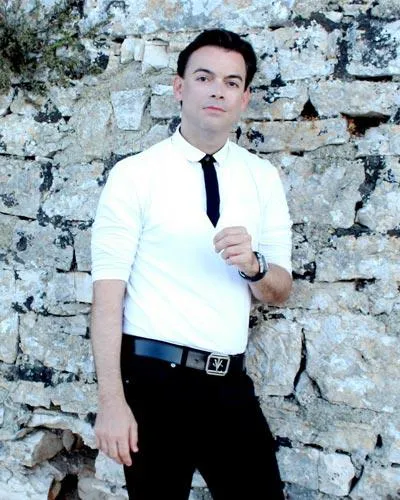
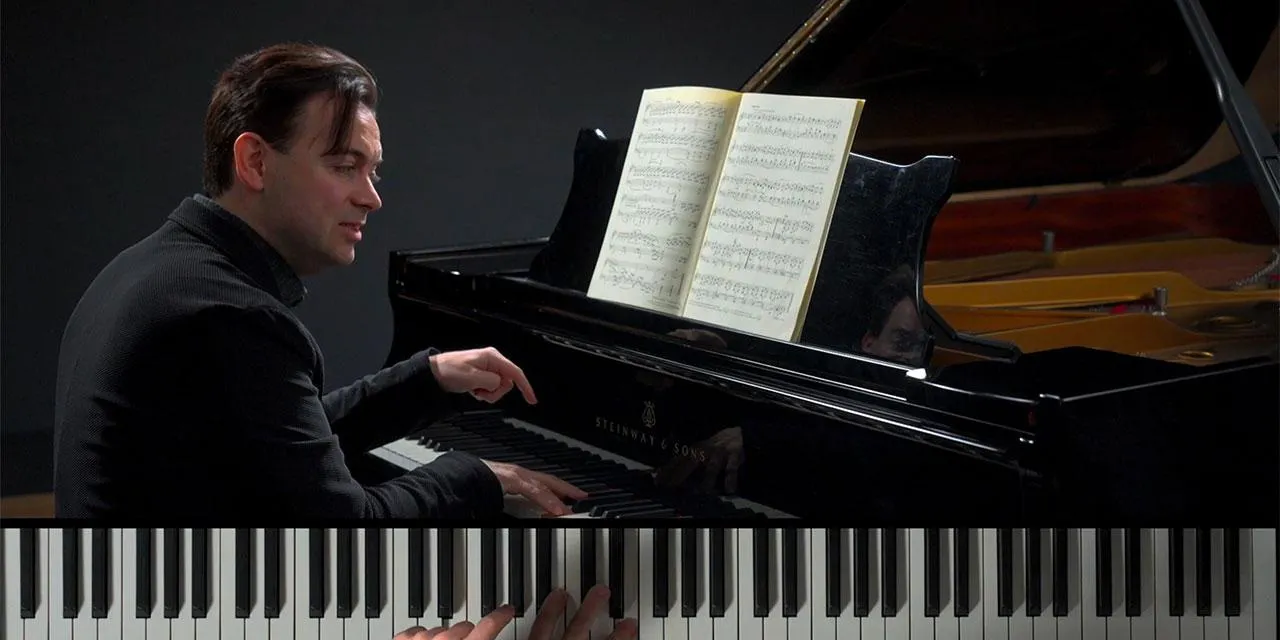
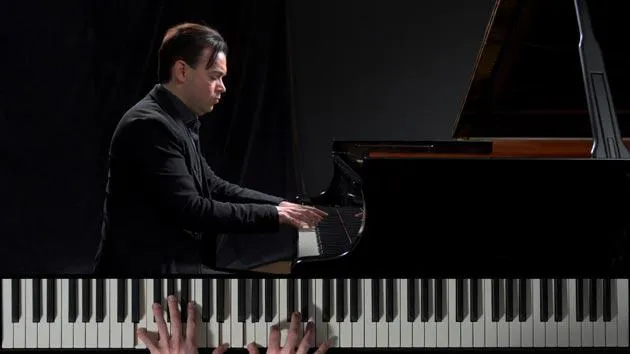
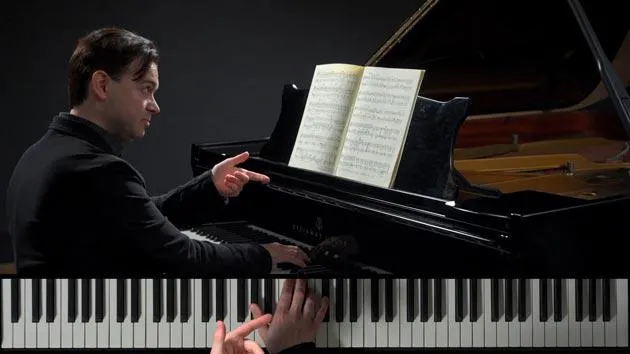
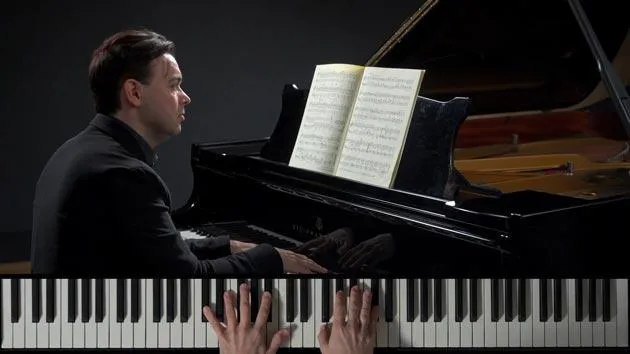
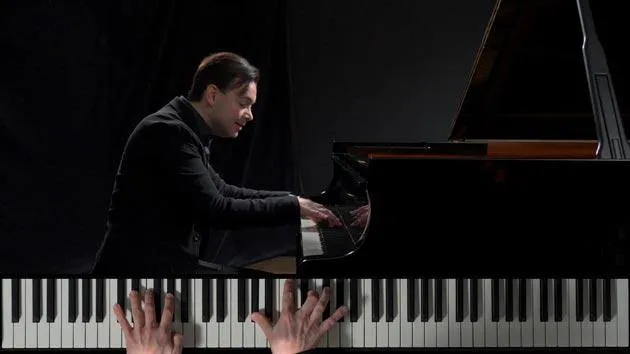
Dejan LazićIn diesem Video lernst du, die wiederholten Akkorde in beiden Händen zu spielen, im Piano, im Forte und als „Crescendo", begleitet von größeren Sprüngen in beiden Händen.
Das steckt im Kurs
20 Lektionen (2h 4m) · 1 gratis
Transkript der Lektion
Moonlight Sonata: Exploring the Third Movement
Hello, everyone!
So let's talk about another feature this great third movement of the Moonlight Sonata has to offer.
Recap of Previous Features
- We discussed the broken arpeggio right at the beginning.
- We covered the Alberti bass, in both right hand and left hand.
Dynamic Changes in Bar 43
Now, in Bar 43, there's another feature:
- Beethoven indicates FFF (forte fortissimo) four times.
- See the indications in Bars 41 and 42? He emphasizes four times forte for all these harmonic changes.
This is crucial!
Importance of the Urtext Edition
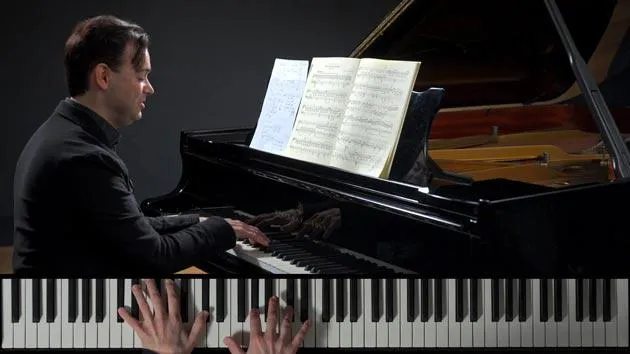
- It's essential to have the urtext edition, where these features stand out.
- Beethoven clearly wanted a forte and attack on every single harmonic change.
Alberti Bass and Dissonance
In the left hand, we can see:
- We have the Alberti bass repeating again and again, but with a twist.
- There's a bit of dissonance right there that we should emphasize.
Practicing Chords and Jumps
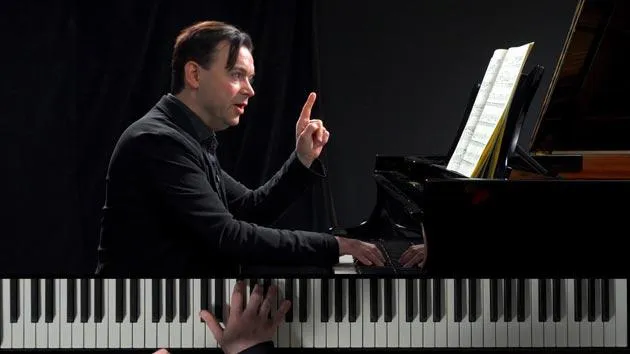
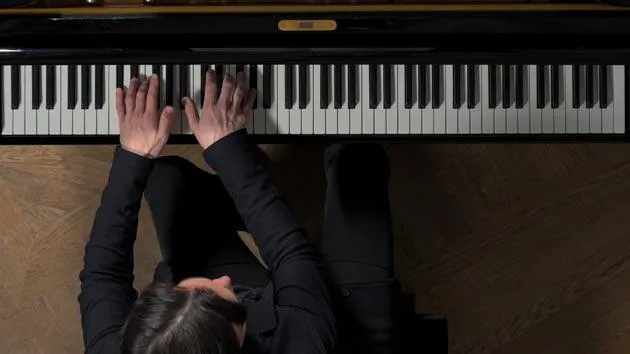
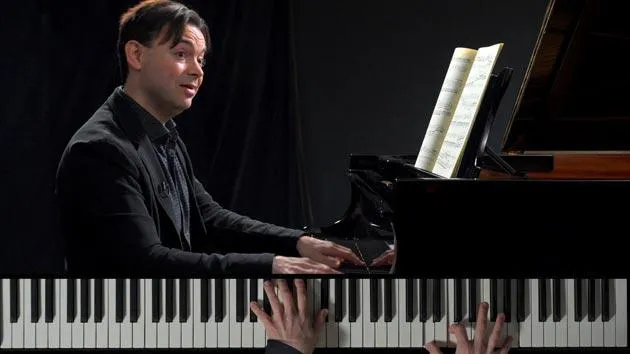
Now, we come to the jumps:
- These chords and jumps in the piano are not that big, but then we have crescendo.
- This is the biggest leap.
For this incredible dominant knife:
- We need not only space, but sometimes even time.
- We really need to hit it properly.
Practice just this:
- Stall, and then do it again.
Music First
This is very important. With all great music, I always say:
- Music first and not the technical difficulty.
- Sometimes a passage doesn't work for a musical reason.
Once you truly feel this incredible harmony, practicing and analyzing these turns become much more enjoyable.
Exploring Discoveries
You'll have incredible fun when you start exploring.
- For instance, we don't have this E until later; it comes here with the seventh and the ninth.
- There's joy in discovering and exploring, transforming it from mere practice into music-making.
Similar Cases Later in the Piece
We have a similar case later in the piece after we had our four fortes.
- We then move to C sharp minor.
- Here, the piano stays, and there is no crescendo, unlike the first time.
Practice Slowly
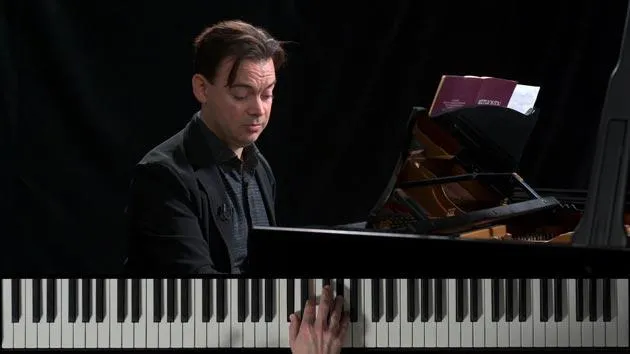
Practice it really slowly:
- Focus on this jump.
- It's different here, and you might want more declamato, more freedom.
Predictable Patterns
However, there's no crescendo, and there's no discord, only sevenths.
- Beethoven introduces the non-chord right at the beginning, but later on, he doesn't use it as we might expect.
Understanding Neapolitan Chords
Consider this famous Neapolitan chord:
- We encountered it in the first movement several times.
- In Fortissimo during Bar 33, we see it against Forzanti.
Left Hand Rhythmic Figure
This is the first fortissimo in the piece and follows the Alberti bass again with the Neapolitan.
- Pay attention to the rhythmic figure in the left hand.
Changes Over Time
The next time it appears in Bar 128, we notice:
- The Neapolitan is different; this is not a mistake.
- It's a slight change that brings a whole new world of expressivity to the passage.
Syncopated Rhythm Comparison
After that, we have another Neapolitan.
- If you compare it to the first instance, the syncopated rhythm in the left hand occurs earlier.
- The repetition in the first instance spans two bars, but here it's shorter, only one bar, making it more compressed and faster.
Conclusion
This is one of many reasons why Beethoven is such a great composer, if not the greatest of all.
I wish you luck practicing this great piece, and I'll see you in the next lesson where we'll delve into the coda, arpeggi, and the amazing ending over the last two pages of this piece.
See you there!
20 Lektionen
2 Std. 4 Min. strukturierte Videolektionen
Erweiterte Videofunktionen
Verlangsamen, Passagen loopen, mitlesen
Handy, Tablet & Desktop
Üben, wo du willst
100 % Zufriedenheitsgarantie
30 Tage Geld-zurück-Garantie
Lern deinen Guru kennen
Lern deinen Guru kennen
Dejan Lazićs frische Interpretationen des Repertoires haben ihn als einen der eigenständigsten und ungewöhnlichsten Solisten seiner Generation etabliert. Er tritt regelmäßig mit den führenden Orchestern der Welt auf, darunter die Boston und Chicago Symphony Orchestras, das Budapest Festival Orchestra, das Royal Concertgebouw Orchestra, das London Philharmonic, das Philharmonia Orchestra, das NDR Elbphilharmonie Orchester sowie die Kammerorchester Australiens, Basels und der Niederlande, und hat enge Zusammenarbeiten mit Dirigenten wie Giovanni Antonini, Iván Fischer, Michael Francis, Andris Nelsons, Ivan Repušić, Thomas Søndergård, Robert Spano, John Storgårds, Krzysztof Urbański und Jan Willem de Vriend aufgebaut.
Dejan Lazić hat zahlreiche CDs bei Channel Classics und Onyx Classics sowie eine Einspielung von Beethovens Tripelkonzert für Sony Classical veröffentlicht. Seine Live-Aufnahme von Rachmaninows Klavierkonzert Nr. 2 mit dem London Philharmonic Orchestra und Kirill Petrenko wurde mit dem deutschen "Echo Klassik"-Preis ausgezeichnet. Er hat zudem eine große Anhängerschaft im Fernen Osten und ist rege als Rezitalist und Kammermusiker tätig, mit regelmäßigen Auftritten bei bedeutenden internationalen Festivals.
Dejan Lazićs Kompositionen finden zunehmende Anerkennung, und 2015 wurde er als Komponist von der Sikorski Music Publishing Group unter Vertrag genommen. Seine Bearbeitung von Brahms' Violinkonzert als Klavierkonzert "Nr. 3" wurde 2009 mit dem Atlanta Symphony Orchestra und Robert Spano uraufgeführt und aufgenommen und erfreut sich seither anhaltend großen Erfolgs, bei den BBC Proms, im Concertgebouw Amsterdam, beim Hamburger Osterfestival und beim Chopin-Festival Warschau, auf beiden amerikanischen Kontinenten und in Japan. Sein Klavierkonzert im istrischen Stil (Op. 18) wurde 2014 beim Aspen Music Festival uraufgeführt und ist seitdem in ganz Europa und in den USA aufgeführt worden. Zu weiteren Werken zählen verschiedene Orchester-, Kammer- und Klaviermusik, Kadenzen sowie mehrere Bearbeitungen von Werken von Mozart, Schubert, R. Strauss, Wagner und Debussy.
Dejan Lazić wurde in Zagreb, Kroatien, in eine Musikerfamilie hineingeboren. Er wuchs in Salzburg, Österreich, auf, wo er am Mozarteum studierte (Klavier, Klarinette und Komposition). Seine frühen Begegnungen mit Zoltán Kocsis und Imre Rohmann beim Bartók-Festival in Ungarn waren für seine künstlerische Laufbahn ebenso entscheidend wie der bedeutende Einfluss von Peter Eötvös. Dejan Lazić lebt in Amsterdam.
In Master Moonlight Sonata by Beethoven teilt Dejan die Einsicht hinter diesen gefeierten Interpretationen und führt dich durch alle drei Sätze eines der beliebtesten Werke des Klavierrepertoires, damit du es mit echtem Verständnis statt durch Nachahmung gestalten kannst. www.dejanlazic.com







