



Klangerzeugung

Lesson time: (14min 3sec)
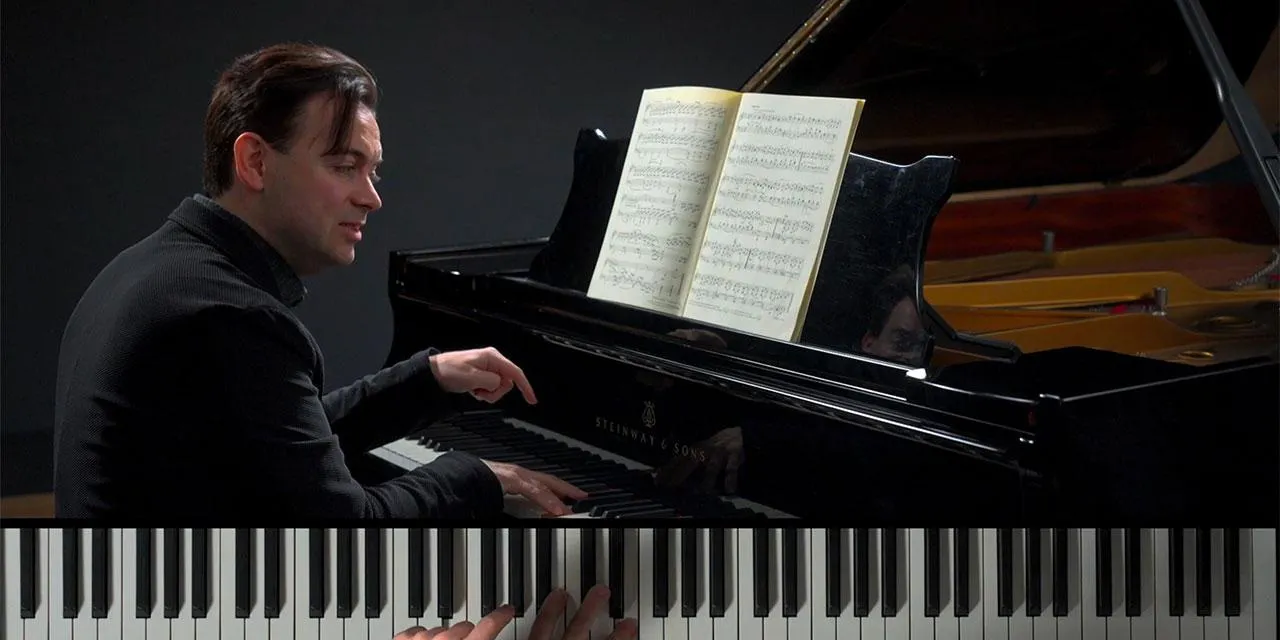
Dejan Lazić zeigt, wie man den Sempre-pianissimo-Klang erzeugt, den der erste Satz braucht, indem man den Daumen leicht hält, die Triolen gleichmäßig ausspielt und das Pedal handhabt.
Course preview
This lesson is part of the course Meistere Beethovens Mondscheinsonate: Sätze I, II und III
Watch a preview of the full course below.
Lesson transcript:
Beethoven's Moonlight Sonata: Opus 27, Number 2
Introduction
Hello, and welcome back to this course! Today, we will delve into Beethoven's famous Moonlight Sonata, Opus 27, Number 2.
This sonata is his 14th piano sonata and stands pretty much in the middle of his 32 sonatas, written in 1801.
First Movements and Sound Production
Sempre Pianissimo
Let's first talk about sound production.
- Beethoven's marking right at the beginning is sempre pianissimo, which means this whole movement should be played very, very quietly.
How can we achieve that?
Until bar five, where we introduce the famous motive in the right hand, we encounter:
- Triplets in the right hand
- Long bass notes in the left hand, also in pianissimo.
The piano can sound like an entire orchestra, with a great range from very soft to very loud and many different colors. Today, I would like to address how to achieve this pianissimo throughout the movement and also touch upon the topic of pedalization.
Right Hand Technique
First, let's talk about the right hand.
- It should be played very calmly.
Key Points:
- Pay attention to your thumb.
- Our hand is not ideally constructed for playing the piano, the fifth finger is short, and the thumb is poorly positioned.
When playing black keys with your thumb, you might have to turn your hand inwards.
The Thumb Challenges:
- Since we place our other fingers naturally, the thumb often ends up sounding too loud, so it must be tamed.
Concentrate on making the thumb flexible and avoiding false accents. Focus more on fingers 2 and 4 while keeping the thumb light.
Left Hand Considerations
Now, regarding the left hand:
- The bass notes can be quite loud, especially on a modern Steinway piano, which has a massive and robust sound.
It is crucial to maintain balance so the left hand doesn't overpower the piece. Pay special attention to:
- The thumb in the right hand and octave in the left hand should be played very gently.
Additionally, when playing black keys, remember that while you could theoretically use your second finger, the thumb is needed for the lower octave when the motive appears.
The Challenge of Dynamics
It's vital to recognize that:
- The fifth finger, often the weakest, plays important musical material.
- The strongest finger (the thumb) should be played the softest.
This is what makes the movement particularly difficult. When I learned this sonata as a child, I thought it was relatively easy. However, as I matured and explored the harmonic structure, phrasing, and pacing, I realized how deep this music truly is.
Starting in Bar Five
Let's begin in bar five.
- Be cautious with your left hand, and only emphasize the right hand's fifth finger clearly on the motive.
The last note in this motif, which lasts for three beats, should be sustained.
Image This:
- If you were a horn player or singer, you would sustain the note, but on the piano, the sound declines once the hammer hits the string.
To enhance the G sharp, consider:
- Playing the triplets a bit loudly to emphasize its presence and sustain the tone in the air.
Creativity in Performance
When it comes to sound production, it's a multidimensional aspect, including timing.
- I took a little time between the major triplets in E major, slowing down slightly.
Although this isn't specified in the music, remember that Beethoven's Sonata Quasi Una Fantasia suggests a free improvisation style. Adapt your performance based on how you feel in the moment, making each performance unique.
Phrasing and Structure
As we discuss phrasing, pay attention to Beethoven's notations:
- In bars 7 and 8, the right hand has a slur over two bars, while the left hand only covers one bar.
This means the right hand continues the phrase, creating a more prominent emphasis there.
Concluding Thoughts
Geniuses like Beethoven didn't make decisions lightly; there's intent behind every marking.
We'll explore the following in our next lesson:
- The reasoning behind the structure and markings in his works.
- More on sound production, timing, and phrasing.
I look forward to welcoming you back!
About the instructor
Dejan Lazićs frische Interpretationen des Repertoires haben ihn als einen der eigenständigsten und ungewöhnlichsten Solisten seiner Generation etabliert. Er tritt regelmäßig mit den führenden Orchestern der Welt auf, darunter die Boston und Chicago Symphony Orchestras, das Budapest Festival Orchestra, das Royal Concertgebouw Orchestra, das London Philharmonic, das Philharmonia Orchestra, das NDR Elbphilharmonie Orchester sowie die Kammerorchester Australiens, Basels und der Niederlande, und hat enge Zusammenarbeiten mit Dirigenten wie Giovanni Antonini, Iván Fischer, Michael Francis, Andris Nelsons, Ivan Repušić, Thomas Søndergård, Robert Spano, John Storgårds, Krzysztof Urbański und Jan Willem de Vriend aufgebaut. Dejan Lazić hat zahlreiche CDs bei Channel Classics und Onyx Classics sowie eine Einspielung von Beethovens Tripelkonzert für Sony Classical veröffentlicht. Seine Live-Aufnahme von Rachmaninows Klavierkonzert Nr. 2 mit dem London Philharmonic Orchestra und Kirill Petrenko wurde mit dem deutschen "Echo Klassik"-Preis ausgezeichnet. Er hat zudem eine große Anhängerschaft im Fernen Osten und ist rege als Rezitalist und Kammermusiker tätig, mit regelmäßigen Auftritten bei bedeutenden internationalen Festivals. Dejan Lazićs Kompositionen finden zunehmende Anerkennung, und 2015 wurde er als Komponist von der Sikorski Music Publishing Group unter Vertrag genommen. Seine Bearbeitung von Brahms' Violinkonzert als Klavierkonzert "Nr. 3" wurde 2009 mit dem Atlanta Symphony Orchestra und Robert Spano uraufgeführt und aufgenommen und erfreut sich seither anhaltend großen Erfolgs, bei den BBC Proms, im Concertgebouw Amsterdam, beim Hamburger Osterfestival und beim Chopin-Festival Warschau, auf beiden amerikanischen Kontinenten und in Japan. Sein Klavierkonzert im istrischen Stil (Op. 18) wurde 2014 beim Aspen Music Festival uraufgeführt und ist seitdem in ganz Europa und in den USA aufgeführt worden. Zu weiteren Werken zählen verschiedene Orchester-, Kammer- und Klaviermusik, Kadenzen sowie mehrere Bearbeitungen von Werken von Mozart, Schubert, R. Strauss, Wagner und Debussy. Dejan Lazić wurde in Zagreb, Kroatien, in eine Musikerfamilie hineingeboren. Er wuchs in Salzburg, Österreich, auf, wo er am Mozarteum studierte (Klavier, Klarinette und Komposition). Seine frühen Begegnungen mit Zoltán Kocsis und Imre Rohmann beim Bartók-Festival in Ungarn waren für seine künstlerische Laufbahn ebenso entscheidend wie der bedeutende Einfluss von Peter Eötvös. Dejan Lazić lebt in Amsterdam. In Master Moonlight Sonata by Beethoven teilt Dejan die Einsicht hinter diesen gefeierten Interpretationen und führt dich durch alle drei Sätze eines der beliebtesten Werke des Klavierrepertoires, damit du es mit echtem Verständnis statt durch Nachahmung gestalten kannst. www.dejanlazic.com read more