



Petite Waltz - Unterricht
Lesson time: (4min 14sec)
Course preview
This lesson is part of the course Die Gitarre von Chet Atkins
Watch a preview of the full course below.
Lesson transcript:
Music Lesson: Petite Waltz
Okay. That was a tune titled Petite Waltz. And that came out right after the Third Man Theme. You young people won't remember that, but I think probably it was played originally on the zither, which is a great German instrument that I love.
Love to hear it but can't play.
Importance of Technique
It's fun to play, of course, and I guess you should. It's important to:
- Keep a finger anchored when you can.
- Ensure that the first finger is ready to grab that A chord from a six to an A in the first position with an alternate bass there.
Techniques to Practice
I do a half bar with my little finger, comes in handy. Just grab an A minor and slide it up to an A major with the first finger.
- Then proceed to:
- F sharp seventh
- A flat nine
- B minor
- Another B minor
You got a high melody there to a D minor. That's an A with a third in the bass, it's an important chord there to a C diminished.
The Bridge
And then the bridge is:
- I sometimes play that diminished there, F diminished.
- Then you play triplets.
I'll do that again slowly to an open D.
Progression to the Ending
And then you're ready to go back here to:
- B seventh
- E minor
- G minor
Where is it? That's a D with a third in the bass. It's an E minor.
Final Thoughts
The ending:
This has been so long since I recorded this; I don't remember making the arrangement or anything. But the ending is very simple. Just, and the melody goes in.
Yeah, so it's simple. Just takes a little practice.
About the instructor
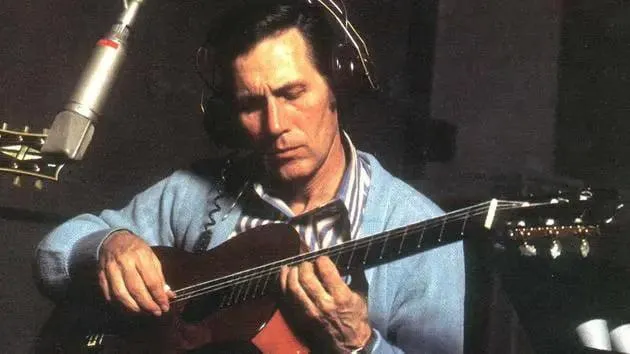
Bekannt als „Mr. Guitar“, ist Chet Atkins der meistaufgenommene Soloinstrumentalist der Musikgeschichte. Sein unverkennbarer Picking-Stil wurde von Merle Travis inspiriert, weitere große Einflüsse waren Django Reinhardt, George Barnes, Les Paul und später Jerry Reed. Dieser markante Picking-Stil und seine Musikalität brachten ihm Bewunderer innerhalb und weit über die Country-Szene hinaus ein, in den Vereinigten Staaten wie international. Als Studiomusiker veredelte sein Spiel Platten von Elvis Presley, Kitty Wells, The Everly Brothers, Hank Williams und Dutzenden weiterer Nashville-Legenden. Sein Stil beeinflusste später Pop-Größen wie Mark Knopfler, Duane Eddy, George Harrison, The Ventures, George Benson und Eddie Cochran sowie Tausende von Country-Gitarristen. Er gewann neun CMA Awards als Musician of the Year, vier Auszeichnungen der Playboy-Jazz-Umfrage und dreizehn Grammys. Mit über 35 Millionen verkauften Exemplaren seiner mehr als 75 Originalveröffentlichungen war Atkins zudem Träger des Grammy Lifetime Achievement Award. Er half, den Nashville sound zu prägen, einen Stil der Country-Musik, der dem Pop fast ebenso viel verdankte wie den Honky Tonks – und ohne ihn wäre die Country-Musik in den 50er- und 60er-Jahren womöglich nie in die Pop-Charts vorgedrungen. Lerne vom Meister – klicke einfach auf einen der Kurse auf dieser Seite! read more