



Lover Come Back - Unterricht
Lesson time: (5min 51sec)
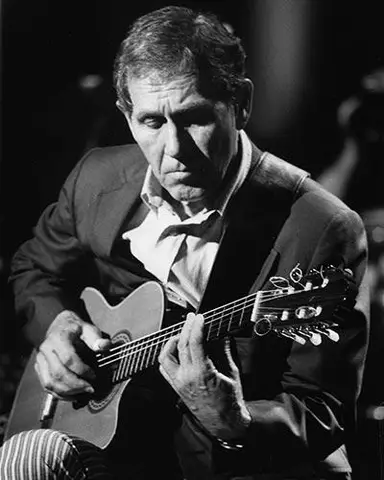
Chet Atkins unterrichtet sein Gitarrenarrangement von Lover Come Back, dem Stück von Sigmund Romberg, und führt dich durch seine Akkordfolge und die Bassbewegungen.
Course preview
This lesson is part of the course Die Gitarre von Chet Atkins
Watch a preview of the full course below.
Lesson transcript:
Music Lesson: Exploring a Classic Tune by Sigmund Romberg
That's a tune written by Sigmund Romberg, one of the greatest. One of the greatest writers this country has ever produced.
Why I Like This Tune
I like it because it's like Cheek to Cheek. It's long enough that you can play it all the way through twice. This length means you don't have to improvise too much.
Chord Progression
- E to D: I have to use a 3 in the bass there. I didn't do that on the record, but it's a pretty good idea.
- Then it goes: C, F, B flat.
- Finally, you get to G, and then you reach D in the bass.
- After that, you go to E, then E Sus.
Lyrics Insight
I remember every little thing, so it's:
- E
- I'm so F lonely
- Everyone I want no one
It's all right to go to the 3 in the bass there because you resolve to up a half tone. That sounds nice.
Tune Changes
Now here, the tune changes. This great composer doesn't repeat the same phrases. Instead, he goes to A seventh. That's beautiful!
Improvization Techniques
To improvise, I just do a little Jerry Reed or banjo playing roll here:
- 1, 2, 3, 4.
I go into rhythm there because I don't have my band with me, don't you know? I play just a roll, but I don't think I did that in that performance.
Personal Challenge
That's one of my problems: I can't play the same thing twice. It's an advantage, but sometimes it's a disadvantage.
Slow Playthrough
I'll do it slowly. One time I did the same lick, only I skipped a string each time.
Let's see, what else did I do? I went:
- Then I did a nice little Jerry Reed lick, one of the greatest ones he ever showed me.
- Two and a half: that's nice.
Changing the Melody
I changed the melody a little there. The melody goes:
- "I remember every little..."
On that, I deadened the strings with the heel of my hand. I haven't figured out a good ending for it if it's slow enough.
Sometimes I play Lover Come Back to Me, but it was too fast when I played it a while ago, and I couldn't do that, don't you know?
And because I'm not that quick.
About the instructor
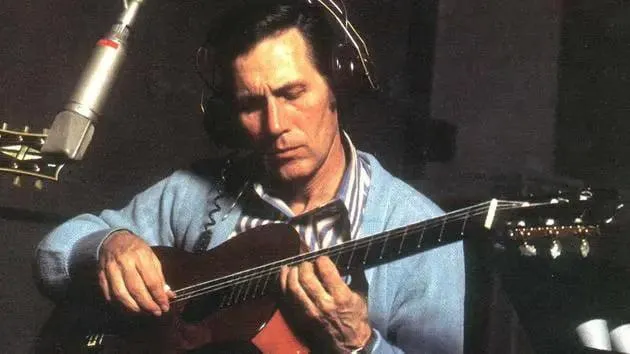
Bekannt als „Mr. Guitar“, ist Chet Atkins der meistaufgenommene Soloinstrumentalist der Musikgeschichte. Sein unverkennbarer Picking-Stil wurde von Merle Travis inspiriert, weitere große Einflüsse waren Django Reinhardt, George Barnes, Les Paul und später Jerry Reed. Dieser markante Picking-Stil und seine Musikalität brachten ihm Bewunderer innerhalb und weit über die Country-Szene hinaus ein, in den Vereinigten Staaten wie international. Als Studiomusiker veredelte sein Spiel Platten von Elvis Presley, Kitty Wells, The Everly Brothers, Hank Williams und Dutzenden weiterer Nashville-Legenden. Sein Stil beeinflusste später Pop-Größen wie Mark Knopfler, Duane Eddy, George Harrison, The Ventures, George Benson und Eddie Cochran sowie Tausende von Country-Gitarristen. Er gewann neun CMA Awards als Musician of the Year, vier Auszeichnungen der Playboy-Jazz-Umfrage und dreizehn Grammys. Mit über 35 Millionen verkauften Exemplaren seiner mehr als 75 Originalveröffentlichungen war Atkins zudem Träger des Grammy Lifetime Achievement Award. Er half, den Nashville sound zu prägen, einen Stil der Country-Musik, der dem Pop fast ebenso viel verdankte wie den Honky Tonks – und ohne ihn wäre die Country-Musik in den 50er- und 60er-Jahren womöglich nie in die Pop-Charts vorgedrungen. Lerne vom Meister – klicke einfach auf einen der Kurse auf dieser Seite! read more