



Bye Bye Blackbrid - Unterricht
Lesson time: (6min 33sec)
Chet Atkins unterrichtet sein Fingerstyle-Gitarrenarrangement von Bye Bye Blackbird und geht seine Substitutionsakkorde und das gleichmäßige Timing durch, das das Stück braucht.
Course preview
This lesson is part of the course Die Gitarre von Chet Atkins
Watch a preview of the full course below.
Lesson transcript:
Bye Bye Blackbeard Music Lesson
"One of my favorite tunes ever written."
In this lesson, I'll highlight some of the techniques and chords I use in the song "Bye Bye Blackbeard."
Chords and Timing
-
Substitute Chords: I like to incorporate substitute chords.
- You can play it faster too, which I usually do. However, I want you to learn this arrangement and spread it around, so I'll play it slower.
-
Steady Timing: Time is so important. Keep steady time.
- If you have a problem with that, use a metronome set to click like "1 and 2 and Tat Tat tat."
- When I'm recording on a slow tune, I'll have the metronome play in 16th notes.
Chord Progressions
-
Starting with:
- G sus to F 13 (with a G in the bass).
- C (with a G in the bass).
- F sharp diminished.
-
Move to:
- B flat (with a D in the bass).
- I love that harmony!
- B flat (with a D in the bass).
-
Transition to:
- F diminished to C (with a G in the bass).
- B flat with an A flat in the bass.
- Notice how nicely it resolves to an A flat.
- Then, I think I went to a B flat, and sometimes I go to an A flat.
Improvisation
-
"Blackbird, bye-bye."
- Play the scale starting on the upbeat, it works out nicely.
- I will do that again, even though I have trouble playing it every time.
-
You don't have to execute exactly what I did; you could play your own arrangements.
-
"What tune am I playing?"
- In this portion, I just improvise the melody while playing rhythm. It's simple, but effective.
Final Thoughts
-
"Bye bye, bye, bye."
- Then I go down to a C with a 3 in D minor.
- Followed by D minor again, A augmented, B flat, E, A, and then A flat.
-
I throw a little Beatles "Blackbird" on the end.
"Blackbird, bye."
If you're having trouble seeing what I did, back it up and watch it again. It's hard for me to explain!
About the instructor
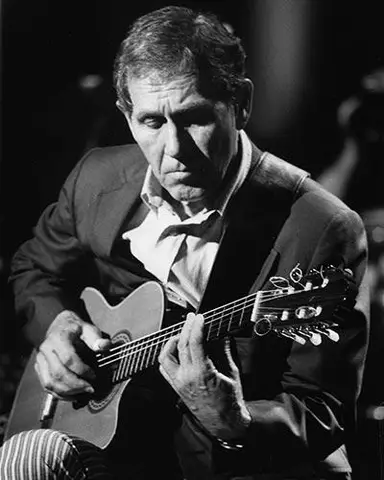
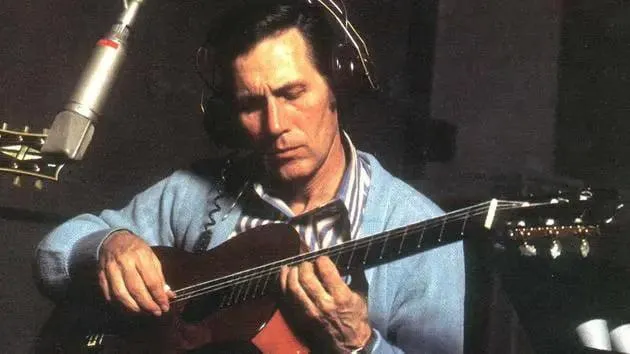
Bekannt als „Mr. Guitar“, ist Chet Atkins der meistaufgenommene Soloinstrumentalist der Musikgeschichte. Sein unverkennbarer Picking-Stil wurde von Merle Travis inspiriert, weitere große Einflüsse waren Django Reinhardt, George Barnes, Les Paul und später Jerry Reed. Dieser markante Picking-Stil und seine Musikalität brachten ihm Bewunderer innerhalb und weit über die Country-Szene hinaus ein, in den Vereinigten Staaten wie international. Als Studiomusiker veredelte sein Spiel Platten von Elvis Presley, Kitty Wells, The Everly Brothers, Hank Williams und Dutzenden weiterer Nashville-Legenden. Sein Stil beeinflusste später Pop-Größen wie Mark Knopfler, Duane Eddy, George Harrison, The Ventures, George Benson und Eddie Cochran sowie Tausende von Country-Gitarristen. Er gewann neun CMA Awards als Musician of the Year, vier Auszeichnungen der Playboy-Jazz-Umfrage und dreizehn Grammys. Mit über 35 Millionen verkauften Exemplaren seiner mehr als 75 Originalveröffentlichungen war Atkins zudem Träger des Grammy Lifetime Achievement Award. Er half, den Nashville sound zu prägen, einen Stil der Country-Musik, der dem Pop fast ebenso viel verdankte wie den Honky Tonks – und ohne ihn wäre die Country-Musik in den 50er- und 60er-Jahren womöglich nie in die Pop-Charts vorgedrungen. Lerne vom Meister – klicke einfach auf einen der Kurse auf dieser Seite! read more