



Double Stops in Wednesday Night Waltz
Mit
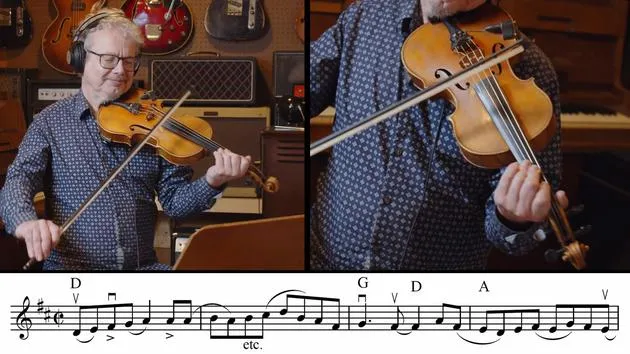
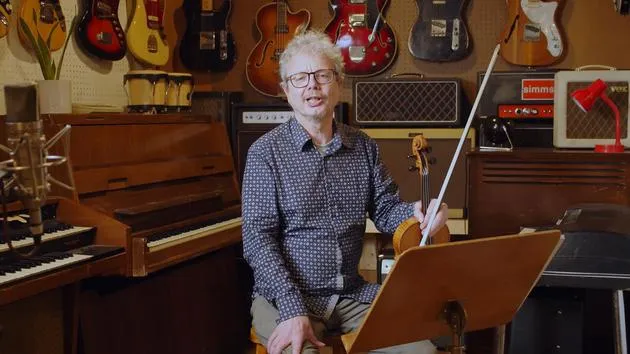
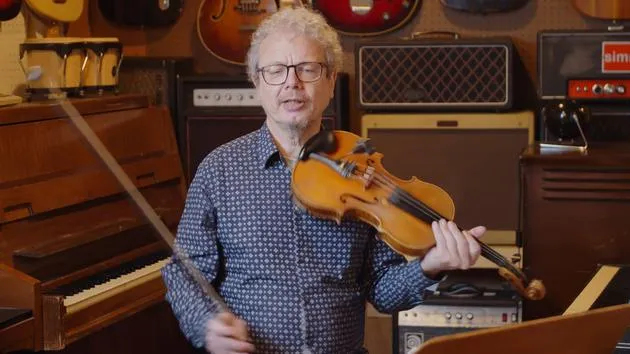
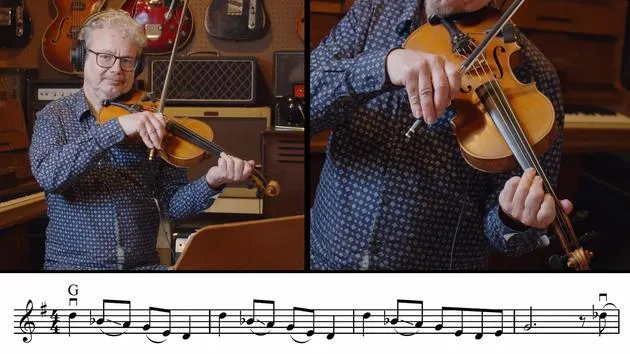
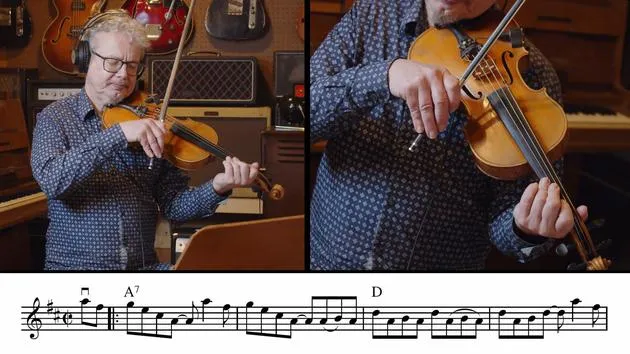
Chris HaighChris Haigh erklärt den Unterschied zwischen einem Bordun (einer leeren Saite) und einem gegriffenen Double Stop auf der Fiddle und setzt dann Double Stops in 'Wednesday Night Waltz' ein.
Das steckt im Kurs
25 Lektionen (1h 30m) · 1 gratis
01. Der Georgia Shuffle
5:42
02. Whiskey Before Breakfast (Performance)
0:44
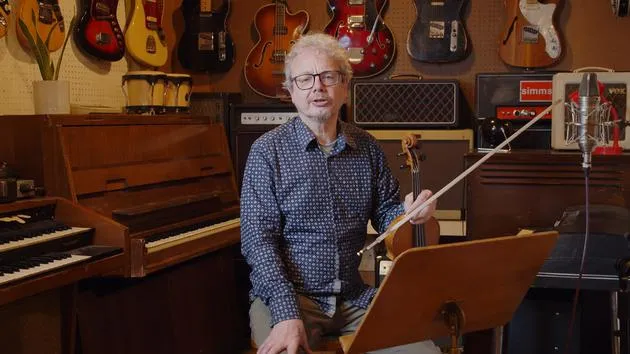
03. Double Stops in Wednesday Night Waltz
Du bist hier8:34
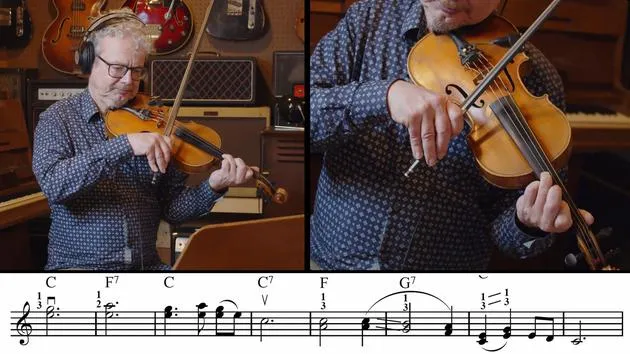
04. Wednesday Night Waltz (Performance)
0:54
05. Mehr Doppelgriffe: Cheatem County Breakdown
4:06
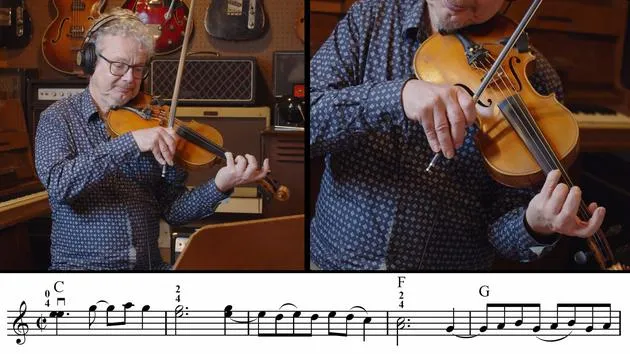
06. Cheatem County Breakdown (Darbietung)
0:44
07. Singende Cowboys: Yellow Rose of Texas
5:34
08. Yellow Rose of Texas (Vortrag)
0:22
01. Western Swing: Beaumont Rag
9:50
02. Beaumont Rag (Interpretation)
1:12
03. Bob Wills - Red River Valley
5:25
04. Red River Valley (Performance)
0:33
05. Twin Fiddling: Tonleiter, Goodbye Liza Jane
3:35
06. Western-Swing-Soli
5:06
07. Goodbye Liza Jane (Solo-Performance)
1:17
08. Western-Swing-Licks
9:19
09. Girl I Left Behind Me (Solo-Durchgang)
2:33
10. Girl I Left Behind Me (Solo-Performance)
0:28
Transkript der Lektion
Double Stops Lesson
Welcome to today's lesson on double stops. Let's clarify the distinction between a drone and a double stop:
- Drone: An open string extra note.
- Double Stop: A fingered extra note, which is slightly more difficult to play.
Understanding the Difference
-
Playing a Drone:
- Requires minimal effort; just angle the bow slightly.
-
Playing a Double Stop:
- Involves more thought and finger positioning.
Advantages of Double Stops
- Double stops provide greater flexibility in terms of keys and notes.
- Drones typically confine you to specific keys (D, A, or G), while fingered double stops can be played in almost any key.
Historical Context
- Double stops became more common in the 20th century.
- In the 1920s and 30s, several fiddle players started recording with a focus on double stops.
Example Tune: "Wednesday Night Waltz"
We will explore "Wednesday Night Waltz" by Clark Kessinger, one of the most sophisticated early players.
Basic Exercises
-
Melody Without Chords:
- The melody has two chords, which become evident only with double stops.
-
Melody With Drones:
- Playing with drones provides a hint of chord changes (E drone to D drone).
-
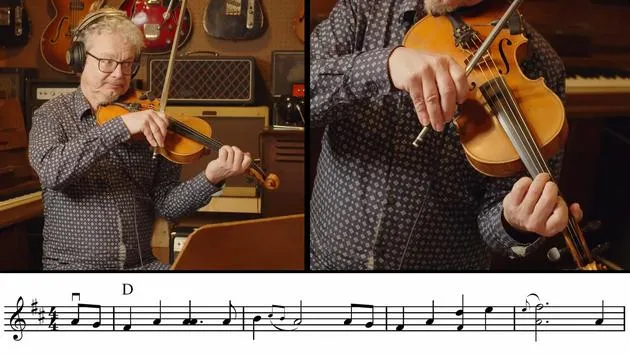
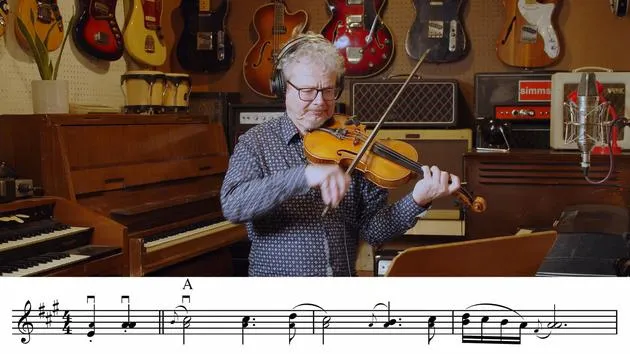
Melody With Fingered Double Stops:
- Fingering clarifies the chord structure:
- First Finger: Plays E (the fifth of A).
- Second Finger: Plays F# (the third note of the D chord).
- Fingering clarifies the chord structure:
Importance of Double Stops
- When playing solo, emphasizing chords helps to communicate the music clearly to the listener.
- While playing with backing is less critical, understanding the chords is still beneficial.
Clark Kessinger's Legacy
- Kessinger was a recording star in the 1920s, known for his tune "Wednesday Night Waltz," which features tricky fingering.
Technique Breakdown
-
Positioning: Start in second position; use your first finger for G:
- Move the whole hand up a half step.
- Place the third finger below, creating a G and an E.
-
Sliding Exercise:
- Slide your whole hand down and back up while keeping the first finger over the third.
-
Finger Placement:
- The second finger plays F# below the third finger on D.
-
Choice of Position:
- Options: Fourth, third, or returning to first position.
- Work with what is easier for you.
-
Final Bars:
- Use second over first and slide up to the third finger.
Practice Session
- We will do the complete exercise without backing, followed by practicing with backing.
1, 2, 3...
Final Thoughts
- If you find this challenging, especially if you're new to sliding double stops, remember it's a key part of American fiddling tradition, specifically the Double Stop Waltz.
- If you encounter difficult sections, simplify the tune as best you can, but keep practicing:
- Aim to master the difficult bits over time.
Assignment
- Try playing a simple major scale (D or G) and harmonize it in your own way.
- I will demonstrate a more structured approach to this exercise later in the course, but for now, experiment and see what you can create!
25 Lektionen
1 Std. 30 Min. strukturierte Videolektionen
Erweiterte Videofunktionen
Verlangsamen, Passagen loopen, mitlesen
Handy, Tablet & Desktop
Üben, wo du willst
100 % Zufriedenheitsgarantie
30 Tage Geld-zurück-Garantie
Lern deinen Guru kennen
Lern deinen Guru kennen
Chris Haigh ist seit 25 Jahren professioneller Fiddle-Spieler mit Erfahrung in vielen verschiedenen Genres. Er hat auf über 75 Alben gespielt und dabei mit Künstlern wie Alison Moyet, Bob Geldof, All About Eve, Michael Ball, David Soul, Oumou Sangare, The Quireboys, Riverdance, Morcheeba, James Galway und Steps zusammengearbeitet.
Er hat Swing-Jazz mit The Kimbara Brothers, Diz Disley, Le Jazz, The Hot Club of London und den Quecumbar Allstars gespielt und leitet die siebenköpfige sowjetische Swing-Band The Kremlinaires.
Chris gibt Unterricht und Workshops zur Jazzgeigen-Technik und hat Jazzgeige an den Universitäten Middlesex, Brunel und Newcastle sowie am Truro College unterrichtet. Zu seinen Veröffentlichungen zählen neun Fiddle-Bücher, darunter The Fiddle Handbook.
Außerdem betreibt er Fiddling Around (fiddlingaround.co.uk), vermutlich die umfassendste und meistbesuchte Quelle für Fiddle-Wissen im Netz.







