We use cookies to personalise content, serve ads, and analyse traffic.
Lesson time: (4min 41sec)
A look at jazz chord voicings for Rockschool Piano Grade 7, including the C dominant 7 flat 9 and how it relates to the diminished shape.
This lesson is part of the course Rockschool Piano Grade 7
Watch a preview of the full course below.
Lesson transcript:
So now we move on to voicings. We have the C dominant 7 flat 9. This is a really interesting sound. It's basically the sound that you hear before you go to resolve on the one.
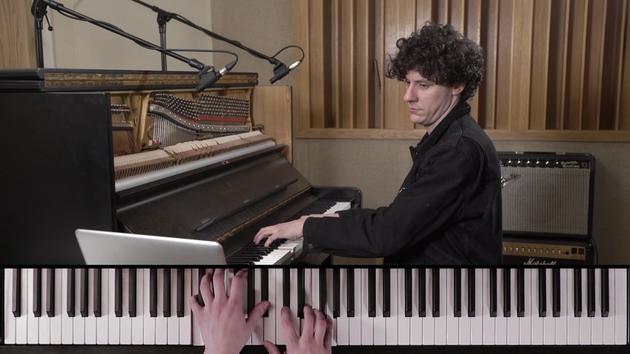
The voicing we've got written here is as follows:
A little trick when you're trying to learn these dominant 7 flat 9 voicings is to think of them as a diminished shape with a sub chord over the top. You're substituting the bass note, but in reality, you're playing the diminished a semitone higher.
These three are as follows. Now, this last one is particularly nice because it can be used in so many different ways; it's a classic jazz chord.
The same could be said with the left hand if we make the seventh the sixth.
So experiment with different sounds. You're hearing so many interesting combinations of voicings here. A great way of developing this skill is to take them into all 12 keys as well.
Next, I'm going to show you the C dominant 7 flat 5. Now, these are quite crunchy, quite abrasive sounding chords, particularly that last one.
Even though these things may sound slightly intimidating, like I've said before, you're only one step away from something you know quite well.
This last one is a similar chord to the second voicing: C dominant 9, sharp 5.
This will often come instead of the root, simply because you either don't have enough fingers to play all the notes, or you just want to get rid of the root. Playing the root in the right hand can sometimes make a chord sound slightly less hip and slightly less clean.
These are the C dominant 7 sharp 5 voicings.
These are quite open sounds, quite sparse. But sometimes, when we're playing voicings, as piano players, we want things to sound nice and dense, for example, the first chord of that series.
Other times we want them to sound lovely and open. Part of being a good piano player in a jazz, rock, or blues context is playing different voicings that suit different occasions.
So there's a real mix of things going on. I encourage you to take all these into all 12 keys. Even though these sounds are slightly more unusual than your standard C7 or minor 7 voicings, they're still really interesting sounds.
So you can be the fountain of knowledge for everyone else to base their music on.
Good luck!