



Using the piano as a big band

With
Tom SealsTom Seals shows how to turn one piano into its own big band, splitting your hands into bass, rhythm and horn-style stabs.

What's in the course
21 lessons (1h 47m) · 1 free




Lesson transcript
Transforming the Piano into a Big Band
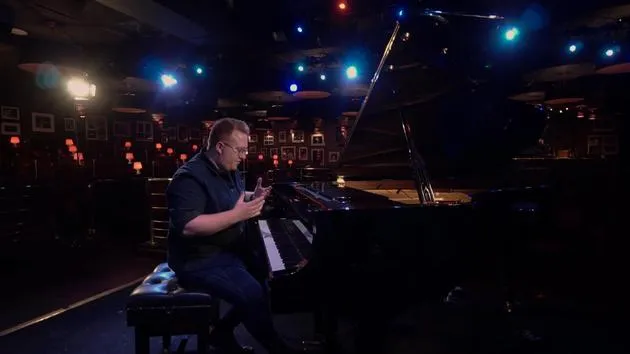
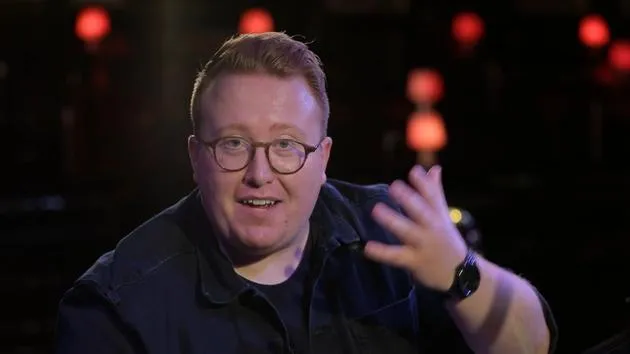
When Ray Charles recorded this incredible tune in 1956, he had a big band. Right now, I don't have the big band; we've just got the piano. So, we need to think of ways to make the piano become our very own big band.
Section Breakdown
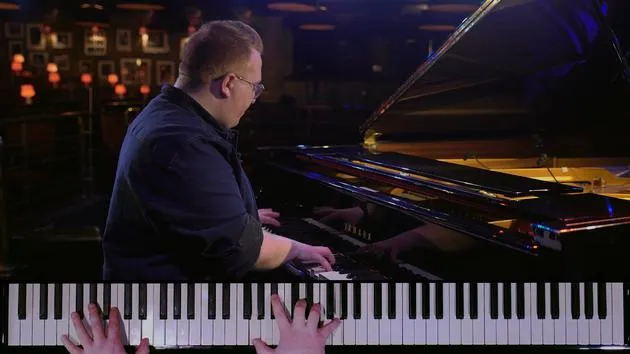
Now, we can break this up into various sections. To me, I see the piano being split:
- Middle Part: This represents the rhythm. Think of it as the piano or the guitar.
- Bottom End: Of course, this is going to be the bass.
- Right Hand: This represents the horn section.
Making the Bass
We can reinforce the bass in various ways:
- Always reinforcing the root note (the number one of the chord) gives it strength.
- The bass player will always do this.
- Consider walking bass patterns, we'll get to that.
The Horn Section
The right hand needs to emulate the stabs that the big band would do. The stabs and the space in this tune act as the drums, which contribute to the rhythm.
Starting Simple
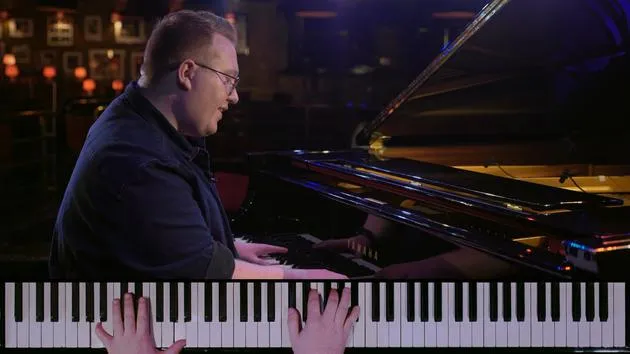
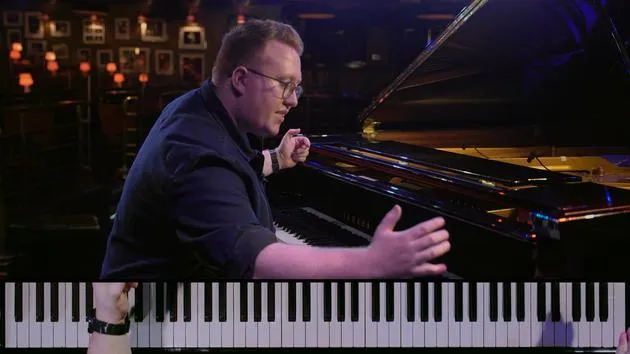
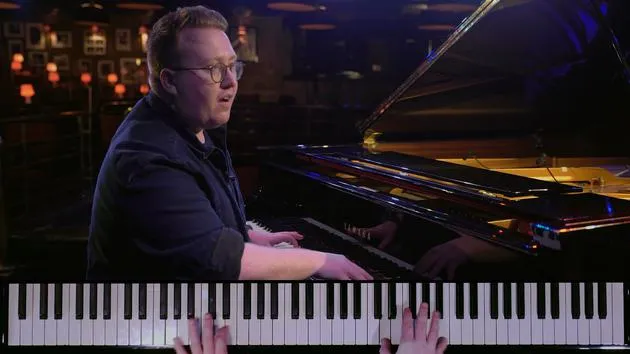
Let's start really simple and focus on the middle part of the piano here.
Picking Octaves
Let's just pick these two octaves. This is the guitar or the piano. Imagine we are just comping, playing along with a singer. This part needs to be:
- Simple
- Rhythmic
- Steady
It doesn't need to be anything fancy; just nice and steady.
Focus on the A Section
Let's take the A section and focus on my right hand. You'll have the chord chart there, so feel free to use your own ideas to add some sevenths, ninths, or other elements to make it bluesy.
But for now, focus on the rhythmic element. Here's an example of how you could play:
"Let me tell you about a girl I know."
The comping should be quite simple and repetitive. You can have space, and then stab back in with the chord.
Introducing the Walking Bass
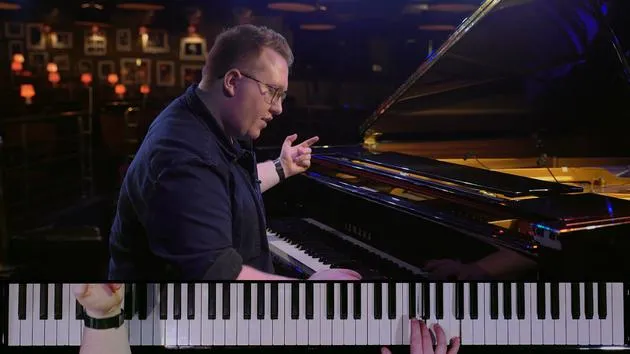
Now, let's look at the left hand as a walking bass. Let's take the first four chords:
- G
- G over B (G in the right hand and B in the left)
- C
- D
In this context, the left hand is the bass player, which means it can only play one note at a time.
Walking through Chords
To walk that, we want to create a note on every beat of the bar:
- 1, 2, 3, 4
This means splitting the bar into four beats, and we'll play one note on each beat.
Linking Chords
You need to find a way to link those first chords:
- G to G over B: How do we transition while hitting a note on every beat?
- The left hand must move and feel like it's constantly advancing.
Notes in the Walking Bass
We want notes that work diatonically, meaning notes that work within the chord. We know what works in G, which is the major scale. The minor seventh (F natural) will fit better here.
Here's a simple walking bass line for the left hand:
- G, A, Bb, B, C, C#, D (then down to octave D).
Now, the right hand can be really sparse. It doesn't have to play all the time, just adding little bits here and there, like a guitar.
Playing with the Melody
Here it is with the melody (left hand only):
"Let me tell you about a girl I know"
"And again, she's my baby; she lives next door."
Navigating More Complex Chords
Now, let's break that down with more complicated chords. Use a numerical approach to the chords:
- Chord one
- Chord two
- Chord three
- Chord four
A good strategy for walking in the left hand is to think about moving from chord one to chord two closely, then from chord two to chord three with a jump.
For instance:
- From G to E minor 7, walk it with close notes: G, A, G, F#, E.
- From E minor 7 to A minor 7, create more distance, e.g., jumping a seventh.
Exploring Movement
Use the pattern:
- Walk from this chord to this chord, jump to the next, and then walk again. There are endless possibilities, so explore this idea!
Incorporating Horn Stabs
As mentioned, there are many stabs in this tune, which are essential for rhythm:
"That's why I know."
"Oh yes, I know, Hallelujah, I love her so."
Give that stab strength; you're the drummer here, showing authority in the tune!
Big Band Influence
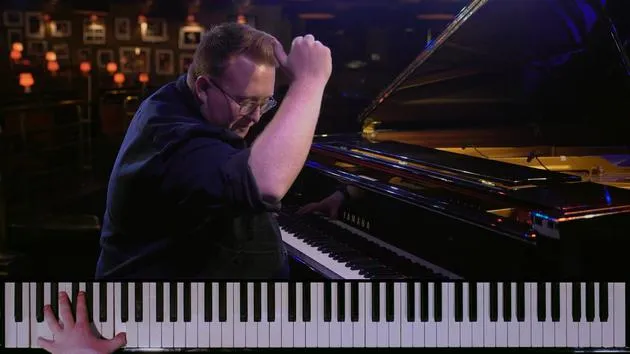
Having grown up with a big band, I understand how powerful a stab can be. Each member of the band hits a note and then stops. This is classic big band style, often celebrated with a brass line leading into that stab.
Using the right hand to create that lead-up:
- Think of how we can create those horn stabs, use the blues scale as your guiding tool.
Now that you have the basis of the blues scale, practice it, and explore creating your own horn stabs. You are your own horn section, and the piano can become your big band! Enjoy playing and experimenting with these ideas!
21 lessons
1h 47m of structured video lessons
Advanced video features
Slow down, loop a passage, follow along
Mobile, tablet & desktop
Practise wherever you are
100% satisfaction guarantee
30-day money-back guarantee
Meet your guru
Meet your guru
The mantle of UK Piano Man has long been held by Elton John, Jools Holland and Jamie Cullum. Over the past five decades no one else has come remotely close - until now!
Fresh from his sell-out "Let The Good Times Roll" tour, Tom Seals - "quite possibly the future of jazz and blues" - has the world at his fingertips. His virtuoso soloing, excellent improvisation skills and distinctive voice have led top industry figures to hail him as the UK's finest boogie woogie and blues pianist and vocalist.
Still in his mid-twenties, Seals has already played sold-out shows across the globe, including London's legendary Ronnie Scott's, a stunning performance at Birdland Jazz Club on Broadway in New York, and work alongside Jools Holland.
Notable appearances include:
- Cheltenham Jazz Festival's 'Gregory Porter & Friends'
- Jools Holland's 'Boogie Woogie & Blues Spectacular'
- Birdland Jazz Club, New York City
- British Summer Time - Hyde Park
- Ronnie Scott's Jazz Club
- Gisburne Park Pop-Up
- Montreux Jazz Festival
- Cropredy Festival
- The Steinway Two Pianos Festival
- Glastonbury
- Newark Showground "Drive-In"
- Blenheim Palace
In his course, Tom throws open the secrets behind his playing - showing you how to swing standards at the piano, build authentic boogie woogie and blues lines, and find the freedom to improvise, so you can become the ultimate Piano Man yourself.
You can read Tom's full biography at www.tomseals.co.uk.







