



Boogie-woogie breaks

With
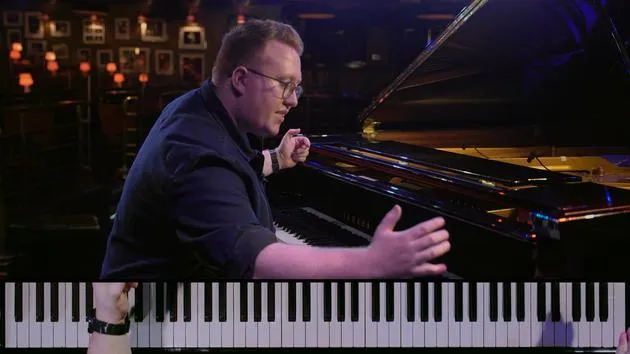
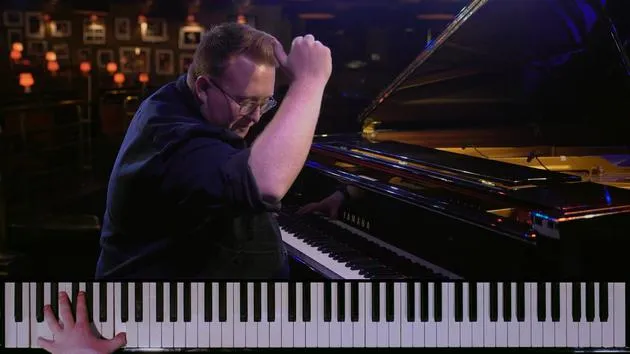
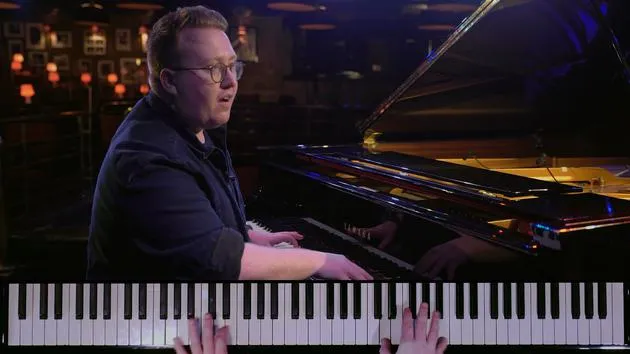
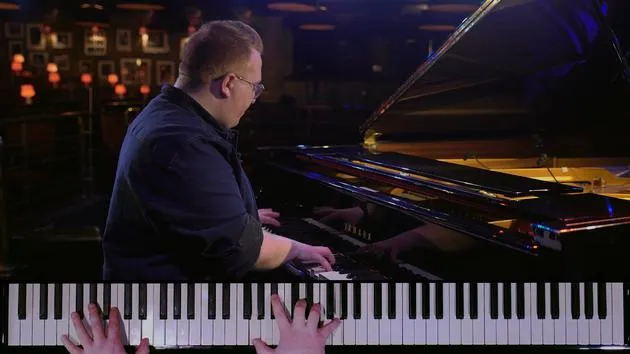
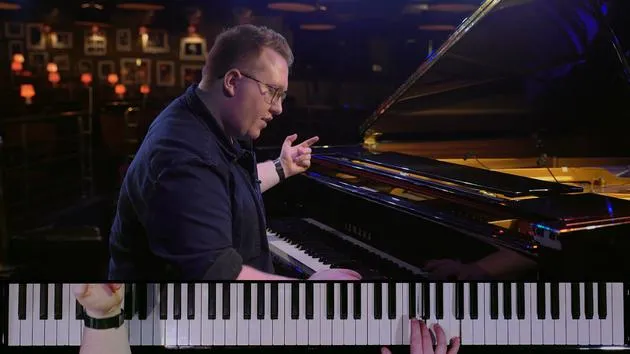
Tom SealsTom Seals breaks down the boogie-woogie "break" - stopping the left hand for a couple of bars on a C6 shape, then filling the gap with the right hand.

What's in the course
21 lessons (1h 47m) · 1 free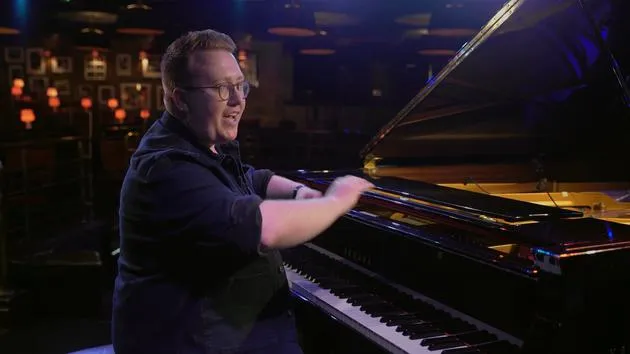









Lesson transcript
Boogie Woogie: Understanding the Brakes
One thing that is standard in boogie woogie is what we call brakes.
Now, I'll play it in context. I'll give you a nod when it happens so you can hear.
Here we go:
I'll start, of course, without the brake. I'll give you a nod when it happens. Okay, it's coming up now. And then we're back in.
The Concept of Brakes
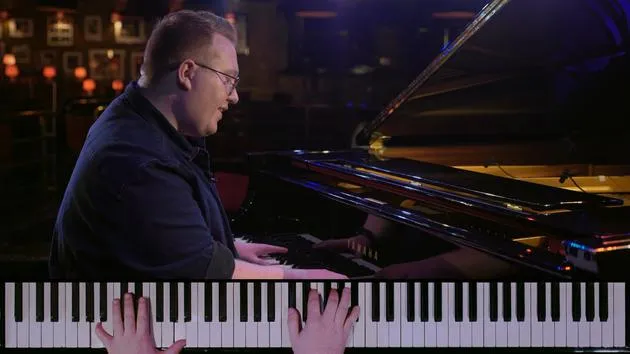
So, the brakes are, to me, they represent a real change, not in tempo or anything else, but it gives a bit of dynamic. It stops the left hand for a couple of bars, and then we get straight back into it.
Chord Breakdown
I'll show you what I played there:
- I started with a C6 chord.
- We're going to take a C and add the sixth, which is the A.
- It sounds like this: da da da da da da da.
So I did it in both hands:
- C, E, G, A
- C, E, G, A
- And I put a C at the top there.
We're nearly using every single finger there and playing all the notes at the same time.
Adjusting the Chord
Next, we're going to move the E and the G down by semitones:
- E becomes E flat
- G becomes F sharp
So in context, while playing every other note as well, you get this:
Adding a Glissando
I like to do a little glissando, a little run up the piano to this. Now, because that's so full on and a bit frantic, I like to take the left hand off and just do a two bar fill with the right hand.
Here's an example:
It could be any blues line, any riff, anything you like. What I played in that example was this:
- C and G at the same time
- C and F sharp at the same time
- C and F at the same time
So you get this melody:
- G, F sharp, F natural, E flat, E, C (always add the C in).
Practicing the Melody
Now, that's quite fast and you can do that all the way down the piano. Get that into your fingers.
Putting it Together
So let's add those things together:
- C6
In my mind, that replaces the first four bars of C in the 12-bar pattern. The 12-bar pattern is just on repeat:
- Repeat the 12 bars, repeat the 12 bars, repeat the 12 bars, but maybe once.
Only use this trick once throughout the whole piece, as you want it to be effective and have impact.
Transitioning Back into Boogie Woogie
This little passage here replaces the four bars of C. So when you come back into the boogie woogie, don't go back to C; you have to go straight back into F.
Here's how it would break down:
- Bar 1: C
- Bar 2: C
- Bar 3: C
- Bar 4: C
- Bar 5: F
Now I will play 12 bars: I'll play the little break for you and then come back in.
Here's the playthrough:
- Bar 1,
- Bar 2,
- Bar 5,
- And in on F.
Ending a Boogie Woogie
Now, of course, we need to end it.
The Standard Ending
How do we end a boogie woogie?
As soon as I play this ending, you'll say, "I have heard that ending on thousands of records."
Here it is at speed:
- C, E, F, F sharp, G, G, A, B natural, C.
- (Again, that's C down to the E, F, F sharp, G, A, B, C.)
You know the rhythm because everybody knows this.
Adding a Dramatic Finish
You can hold on that E and then end with a nice C7 chord:
- C in the bottom, E, G, B flat.
For the seventh, we love the seventh! Add the ninth and then run that up the piano. Give it your best dramatic ending.
Alternative Endings
That's one ending.
Let's look at an alternative ending.
Here's another option:
- C to E again,
- F, F sharp G.
All of that is the same as the first one. Instead of running up like we did before, we'll go:
- G, B flat up to E flat, which gives it a nice jump.
Crafting Your Unique Ending
You're working all the way back up to C. This gives it a nice jump, making it sound different to the ear.
Then you might end with a nice C7 at the end.
Another thing you could do, as you're playing solo piano, you've got freedom. If there's a little gap, make up your own ending.
For example:
It could sound like this, allowing you that space.
Using Blues Scale Variations
So give your right hand that freedom, take your left hand off, and just use the simple blues thing that we learned before to come up with your own.
As long as you end on a C with a big C7 chord to finish, the world is your oyster!
Conclusion
Use the blues scale to finish that. Incorporate little blues ideas, use the E flat as your grace note, use some repetition.
You could even mix it up:
- First half using the blues scale
- Second half making your own.
This could sound like this, or this, and everybody will know that you finished.
Final Thoughts
Hopefully, you will have just played a great boogie woogie. The audience will be standing on their feet!
I hope you enjoyed that little boogie trick. Remember, this doesn't just work for boogie woogie. These little right-hand tricks here will work over anything.
Pick any classic tune, for instance, Billy Joel's New State of Mind, these right-hand tricks will make your playing bluesy.
So enjoy them, get them into your fingers. And don't forget: sit on Facebook with your right hand, drill a boogie with your left hand. Once you've got the boogie, add the woogie, and there'll be no stopping you.
I can't wait to hear you play it!
21 lessons
1h 47m of structured video lessons
Advanced video features
Slow down, loop a passage, follow along
Mobile, tablet & desktop
Practise wherever you are
100% satisfaction guarantee
30-day money-back guarantee
Meet your guru
Meet your guru
The mantle of UK Piano Man has long been held by Elton John, Jools Holland and Jamie Cullum. Over the past five decades no one else has come remotely close - until now!
Fresh from his sell-out "Let The Good Times Roll" tour, Tom Seals - "quite possibly the future of jazz and blues" - has the world at his fingertips. His virtuoso soloing, excellent improvisation skills and distinctive voice have led top industry figures to hail him as the UK's finest boogie woogie and blues pianist and vocalist.
Still in his mid-twenties, Seals has already played sold-out shows across the globe, including London's legendary Ronnie Scott's, a stunning performance at Birdland Jazz Club on Broadway in New York, and work alongside Jools Holland.
Notable appearances include:
- Cheltenham Jazz Festival's 'Gregory Porter & Friends'
- Jools Holland's 'Boogie Woogie & Blues Spectacular'
- Birdland Jazz Club, New York City
- British Summer Time - Hyde Park
- Ronnie Scott's Jazz Club
- Gisburne Park Pop-Up
- Montreux Jazz Festival
- Cropredy Festival
- The Steinway Two Pianos Festival
- Glastonbury
- Newark Showground "Drive-In"
- Blenheim Palace
In his course, Tom throws open the secrets behind his playing - showing you how to swing standards at the piano, build authentic boogie woogie and blues lines, and find the freedom to improvise, so you can become the ultimate Piano Man yourself.
You can read Tom's full biography at www.tomseals.co.uk.







