



Advanced solo ideas

With
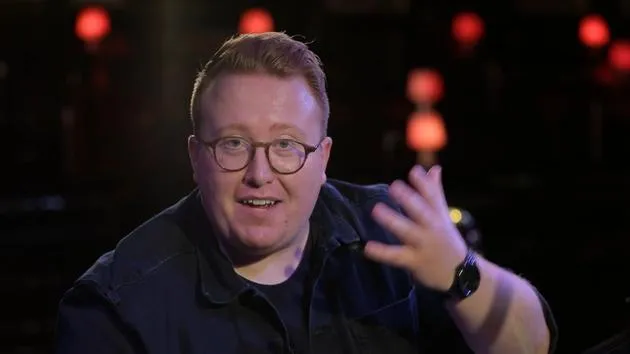
Tom SealsTom Seals shares his approach to piano soloing, building patterns from the chord and using moves like the minor-to-major third, octaves, fifths and thirds.

What's in the course
21 lessons (1h 47m) · 1 free
01. Intro to 'New York State of Mind'
3:05
02. Using thirds
Free lesson1:41
03. Making it ‘blues-y’
10:58
04. Making it ‘jazzy’
1:20
05. Building your confidence in soloing
3:05
06. Advanced solo ideas
You are here7:30
07. A classic ‘Billy’ ending
3:47

08. Tom Seals performs Billy Joel's 'New York State of Mind'
6:26



Lesson transcript
Music Lesson: Soloing Techniques
One thing I think that's key when we're looking at soloing is to pick a few patterns.
- Learn the patterns and then experiment with them to make them completely your own.
Starting with C Chord
Let's start with the first chord, C.
The Pattern
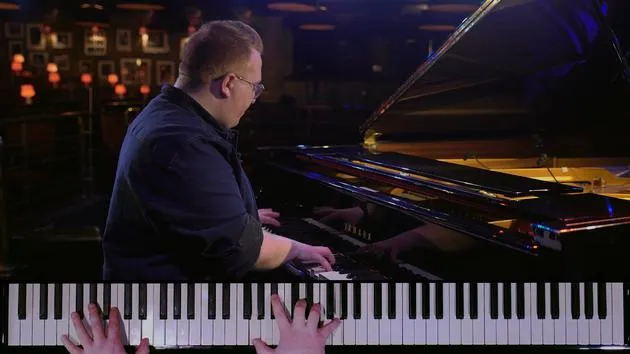
I'll play it to you at speed, and then we'll slow it down.
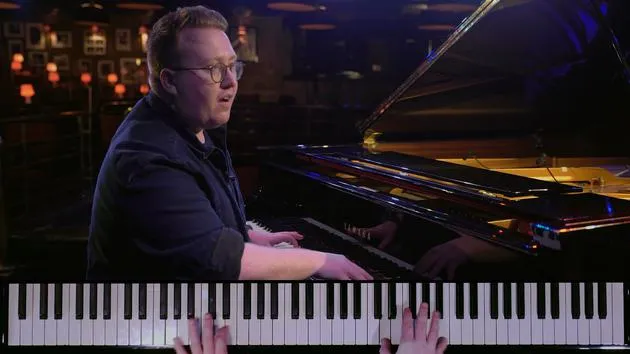
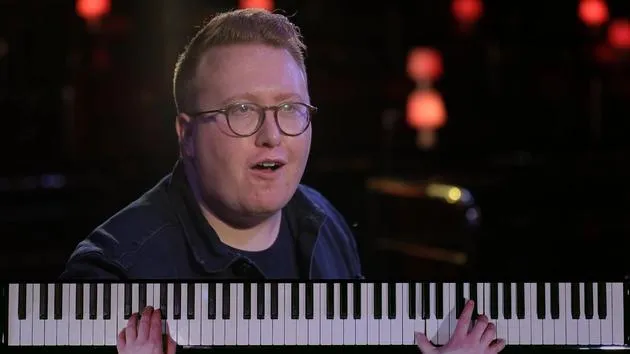
- This pattern is using the chord of C.
- We're going to use most of the notes in this middle section of the chord.
Notes and Movement
- Start with the minor third, which is the E flat.
- Moving from the minor third to the major third creates tension and resolution:
- "Oh, what's that?"
- "Oh, there he is, we're home."
This major to minor transition sounds bluesy, jazzy, and great.
- Start with the E flat.
- Move to the major third (E natural), then to F and F sharp.
- Finally, to G.
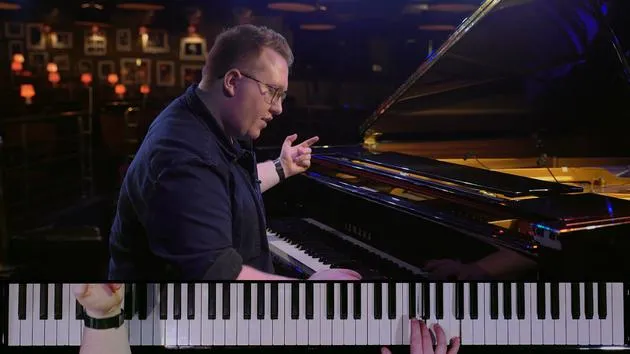
Add a bit of a pivot with your hand for movement.
You'll always be using the notes in the middle and the two C octaves with your thumb and little finger.
Speed Practice
At speed, you get this:
- Just C on its own, and then the note that we change plus your little finger every time.
And all of that is based around this:
- C, E flat, E natural, F, F sharp, G, and the occasional A.
Have a little play with these notes to come up with your own blues ideas.
Transitioning from C to E7
One thing that I really like is moving from C to E7.
- The fifth of C is G (the fifth note in the scale of C).
- The fifth note in E7 is G sharp, which is a semitone above G.
Although the chords seem distant, the fifth notes are only a semitone apart.
Improvisation Tip
You could resolve your improvisation in C on A G and start on E7 with G sharp.
This creates a nice familiarity in your playing. For example:
- You might go something like this:
- "It's that semitone of like, oh, we've moved chord."
Adding Thirds to Improvisation
Don't forget to use thirds in the improvisation as well.
- Thirds are where we take the note of the melody.
- For example, if the note is C, we add the third note of that chord, which is E.
Practicing Thirds
You can constantly move these thirds up and down the piano. This might take some practice.
- Exercise: Pick some thirds and move them up and down the piano.
- This is also the Rugrats theme, incidentally.
Use the melody to influence your soloing skills.
Example
Take the melody:
"Some folks like to get away, take a holiday."
- That's only three notes!
You can do nice things around that.
- Start on an E.
- Remember, the minor thirds of any chord always sound nice.
Using Incidentals
The melody starts on the major third. Use little incidentals, you might catch the minor third.
Here we go:
- I'll swing the left hand and play some right-hand ideas.
This was based only on the C pentatonic scale:
- C, D, E, G, A.
You can experiment with these five notes anywhere on the piano.
Advanced Techniques
When you're feeling more confident, you can learn this advanced rundown:
- This works from the top to the bottom of the piano.
Example Rundown
Let's take: C, G, G, C, G, F sharp, F natural, E flat, C.
This is similar to the C blues scale.
Adding Over Chords
At tempo, this works all the way down the piano.
Add this over a nice G7 chord with your pentatonic ideas.
Chromatics
And of course, here comes the big rundown.
Feel free to experiment and make these ideas your own!
21 lessons
1h 47m of structured video lessons
Advanced video features
Slow down, loop a passage, follow along
Mobile, tablet & desktop
Practise wherever you are
100% satisfaction guarantee
30-day money-back guarantee
Meet your guru
Meet your guru
The mantle of UK Piano Man has long been held by Elton John, Jools Holland and Jamie Cullum. Over the past five decades no one else has come remotely close - until now!
Fresh from his sell-out "Let The Good Times Roll" tour, Tom Seals - "quite possibly the future of jazz and blues" - has the world at his fingertips. His virtuoso soloing, excellent improvisation skills and distinctive voice have led top industry figures to hail him as the UK's finest boogie woogie and blues pianist and vocalist.
Still in his mid-twenties, Seals has already played sold-out shows across the globe, including London's legendary Ronnie Scott's, a stunning performance at Birdland Jazz Club on Broadway in New York, and work alongside Jools Holland.
Notable appearances include:
- Cheltenham Jazz Festival's 'Gregory Porter & Friends'
- Jools Holland's 'Boogie Woogie & Blues Spectacular'
- Birdland Jazz Club, New York City
- British Summer Time - Hyde Park
- Ronnie Scott's Jazz Club
- Gisburne Park Pop-Up
- Montreux Jazz Festival
- Cropredy Festival
- The Steinway Two Pianos Festival
- Glastonbury
- Newark Showground "Drive-In"
- Blenheim Palace
In his course, Tom throws open the secrets behind his playing - showing you how to swing standards at the piano, build authentic boogie woogie and blues lines, and find the freedom to improvise, so you can become the ultimate Piano Man yourself.
You can read Tom's full biography at www.tomseals.co.uk.







