



Soloing - The Harmonic Minor Bebop Scale

With
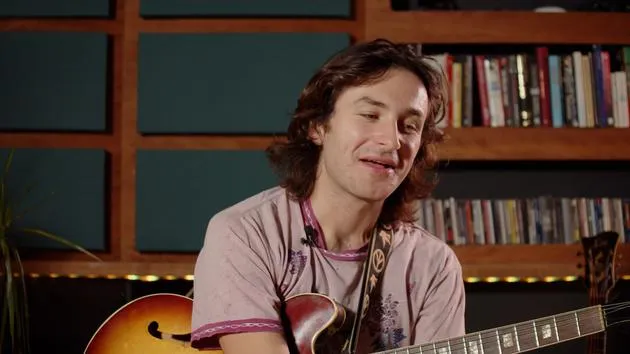
Rob LuftRob Luft shows how to solo over a minor II-V using the harmonic minor scale and its Phrygian dominant mode, the Django-flavoured sound that resolves into the minor chord.
What's in the course
28 lessons (2h 7m) · 1 free
01. Why study Django Reinhardt?
3:45
02. Chords and Harmony - A Section
11:06
03. Chords and Harmony - B Section
2:21
04. Right Hand Techniques - European vs American
5:04
05. How to Create Swing Feel
1:51
06. Melody Walkthrough
9:10
07. Soloing - Arpeggios and Enclosures
Free lesson10:40
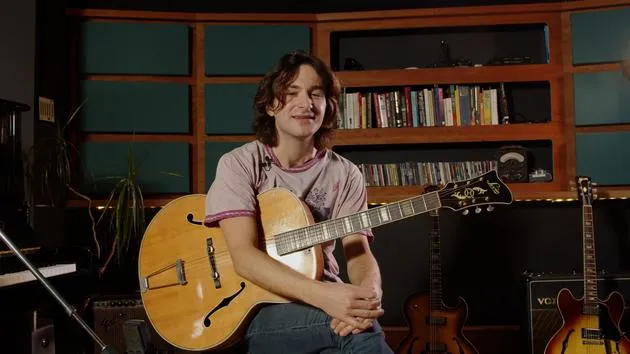
08. Soloing - The Harmonic Minor Bebop Scale
You are here8:27
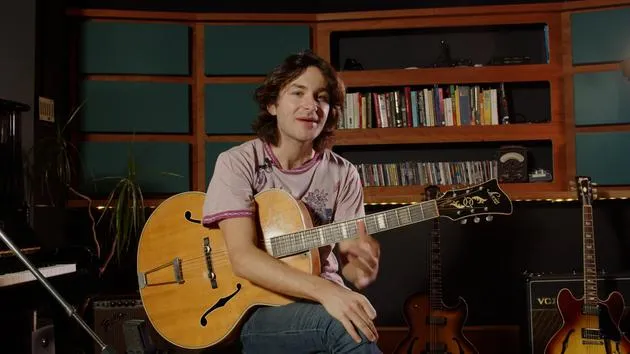
09. Soloing - Use of Pentatonics
9:45
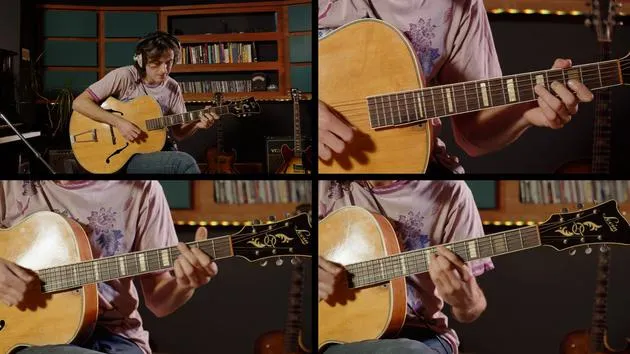
10. Clouds - Performance (Split-screen with accompaniment)
3:48
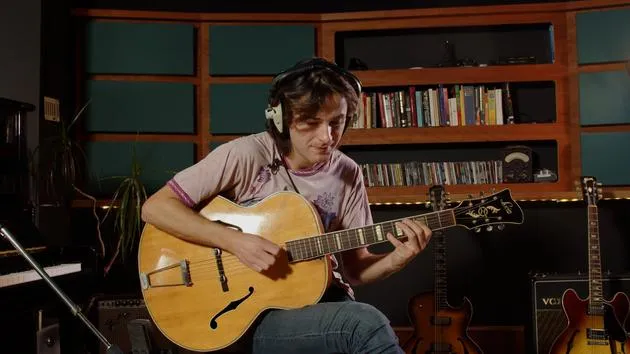
11. Clouds - Performance
3:49
12. Clouds - Performance (Simplified)
2:40
01. Why study Joe Pass?
2:23
02. Introduction to Solo Playing and Parallel Harmony
4:00
03. Diminished Lines and "Sicilian 3rds"
5:19
04. Playing in Time with Pianistic Voicings
5:22
05. How to Play the Second Half
5:06
06. Hybrid vs Finger Style Picking
5:57
07. November in Norway - Performance
2:29
08. November in Norway - Performance (Simplified)
1:27
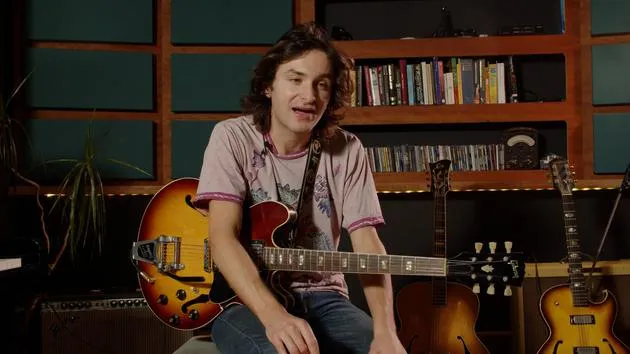
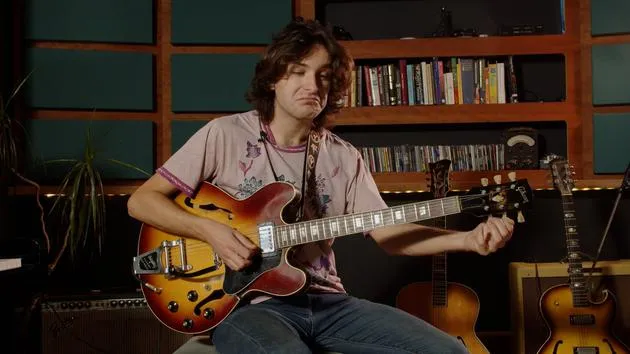
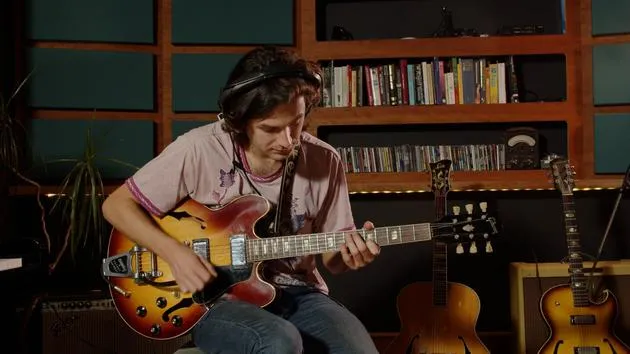
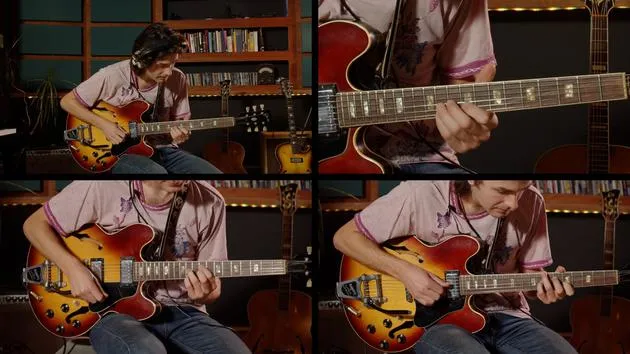
Lesson transcript
Understanding the D Harmonic Minor Scale and Its Applications
The Scale in Focus
And what scale am I actually using there? This is where Django taps into his heritage as a European Romany, or Roma Gypsy. The dominant chords that resolve to the relative minor will almost invariably use the harmonic minor scale.
D Harmonic Minor and A7
So, he'll be using not just any harmonic minor, but D harmonic minor over an A seventh chord. How does he do that?
- Just remind yourself that this is the D harmonic minor scale, a beautiful scale.
- It may sound, at first listening, completely related to a D minor chord.
Discovering New Sounds
If you descend from this scale to the fifth (to the A), you encounter a new mode. A mode simply means a scale starting on a certain degree of a parent scale.
- Here, our parent scale is D harmonic minor.
- Starting on its fifth degree (A), we discover a new scale sound that is very Spanish and flamenco-like.
We call this the Phrygian Dominant mode. It sounds like this, and it truly captures that flamenco quality, very folky, closely related to world music and Eastern European music.
Resolving Chords
This scale resolves beautifully from A7 to D minor. You can take any core note from the scale, descend it, and resolve from A to A, creating a satisfying sound transition from A7 to D minor.
The Septatonic Scale
However, there's a challenge with this scale: it's a septatonic scale, meaning it has seven notes per octave.
- While we all know about pentatonic scales, which have five notes per octave, a septatonic scale includes seven notes before repeating the octave.
- The notes are: A, B flat, C sharp, D, E, F, G, A.
Playing in Jazz
In jazz, we typically play eighth-note phrases, and this presents a problem. To effectively descend from octave to octave in one bar, we need to add one more note.
Time Signature Consideration
- In 4/4 time, with four beats in a bar (four quarter notes), if we want to play an eight-note phrase to resolve rhythmically from beat one to beat one, we must add an extra note.
- Django would add the F (as well as the flat seventh G), and the major seventh G sharp.
This addition allows for easy descending from octave to octave.
The Bebop Scale
We call this combined sound the bebop scale. It's important to note that although it's termed "bebop," this scale was present in music before and after the bebop era.
- It's simply the sound of an A Phrygian dominant with both the flat seventh and the major seventh, creating an eight-note scale.
Top Tip for Jazz Musicians
My top tip for playing this scale, indeed for all scales in jazz, is:
- If you ascend a scale, it often sounds like mere practice.
- If you descend the same scale, it sounds like music.
This descending technique can quickly transform your sound, especially with the bebop scale.
Additional Techniques
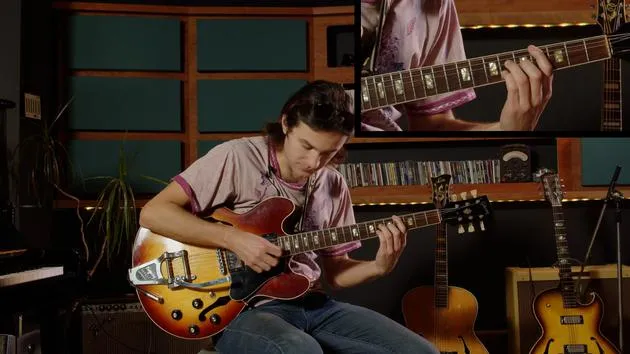
- Be aware of playing the scale in different positions. You can begin on the seventh fret of the D string for a woodier sound, or the 10th fret of the B string.
- Incorporating occasional slides can help create that swinging jazz articulation.
For instance, I often slide from an off beat to an on beat, like from the second eighth note of the bar to the third eighth note, to enhance the swing feel.
Conclusion
So, when playing in the relative minor, using the D harmonic minor scale over an A seventh chord resolves beautifully to D minor.
The Art of Improvisation
Great jazz improvisers like Charlie Parker, Miles Davis, Django Reinhardt, and Louis Armstrong often utilized a little turn, starting with the first three notes and then turning back, essential for rhythmic resolution.
We've explored the harmonic minor and looked at arpeggios on dominant chords starting from the third; it's an exciting approach!
28 lessons
2h 7m of structured video lessons
Advanced video features
Slow down, loop a passage, follow along
Mobile, tablet & desktop
Practise wherever you are
100% satisfaction guarantee
30-day money-back guarantee
Meet your guru
Meet your guru
Rob Luft is an award-winning musician from London, widely described as one of the UK's most prominent and talented young contemporary jazz guitarists. Praised by The Times as set 'to achieve great things in the future', Rob won the 2016 Kenny Wheeler Jazz Prize in association with Edition Records, and took 2nd Prize in the 2016 Montreux Jazz Guitar Competition. His debut album, 'Riser', was released in July 2017 to widespread critical acclaim across the European jazz media. John Fordham wrote in The Guardian that it's a 'very sophisticated debut, but given Luft's old-soul achievements since his early teens, we should have heard it coming'.
'So young and so talented!' - Jamie Cullum, BBC Radio 2 (UK)
'...an extraordinary talent!' - Julian Joseph, BBC Radio 3 (UK)
'The virtuosity of the three [guitarists Al di Meola, John McLaughlin and Paco de Lucia] is reminiscent of the 23-year-old Londoner Rob Luft, who is celebrated as a new "Wunderkind"' - Spiegel Online (D)
In Play Authentic Jazz Guitar, Rob opens up the harmonic language, phrasing and improvising instincts behind that 'old-soul' sound, showing you how he really thinks about the fretboard so you can start finding your own voice in jazz.







