


New Scale C Major
With
Talia Girton
What's in the course
21 lessons (0h 42m) · 1 free
Lesson transcript
Introduction to Diatonic Scales
Previously, we learned about pentatonic scales. Now we're going to try some diatonic scales.
Difference Between Scales
- Pentatonic scales have five notes.
- Diatonic scales have seven notes.
C Major Scale
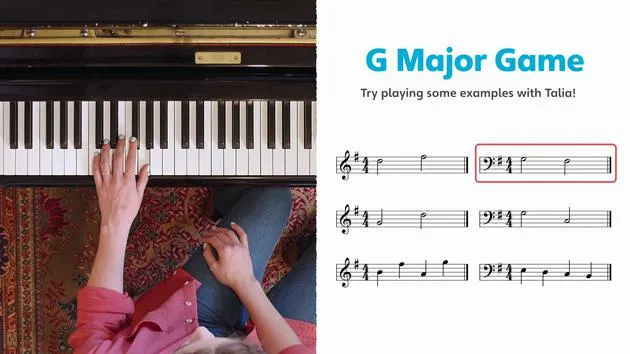
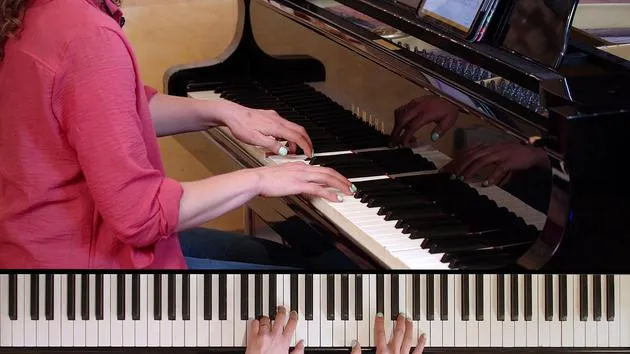
The first scale that we'll look at is the C major scale. I'll show you really slowly, and then I'll explain what I'm doing with my fingers.
Right Hand
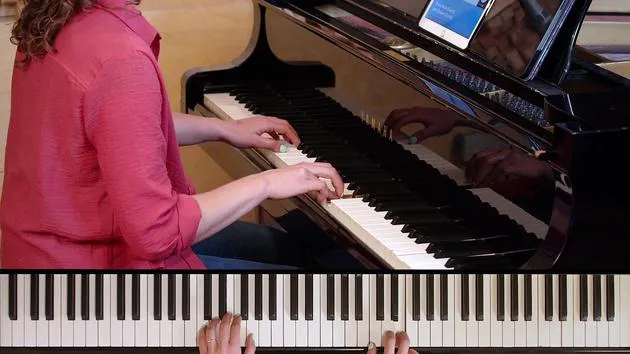
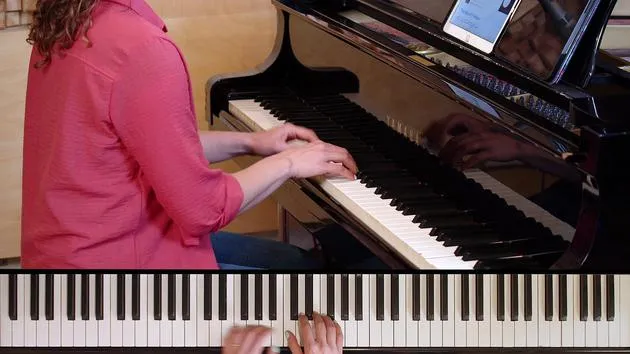
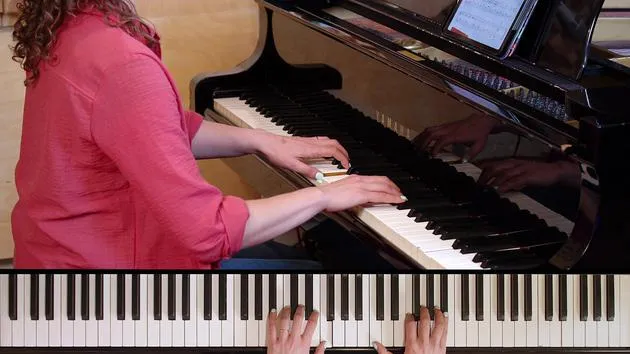
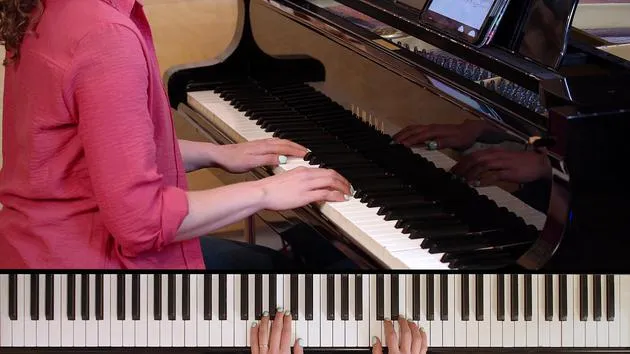
The right hand of the C major scale looks like this:
- Start with your one finger on middle C.
- We want it to sound really smooth and even, as if you've got eight fingers to make your way up the octave and back down.
Sequence:
- C, D, E.
- Thumb goes to F.
- Two goes to G.
- A, B, C.
Descending:
- Straight back down: B, A, G, F.
- 3 goes to E.
- 2 goes to D.
- Ending on C.
Let me show you that one more time.
Left Hand
The left hand of the C major scale uses the fingers in the opposite direction.
- First, we use all five fingers going up, and then on the way down, we switch.
- After the three finger, it looks like this.
Sequence:
- C, D, E, F, G.
- 3 goes to A.
- 2 goes to B.
- Ending on C.
Descending:
- Straight back down: B, A.
- Thumb goes to G.
- 2 goes to F.
- E, D.
- Ending on C.
Practicing Hands Separately
You'll probably need to practice both hands separately for several weeks until you're ready to try hands together.
Hands Together
It gets a bit tricky at this point because the fingers are switching at different moments of the scale.
It looks like this:
- Break it down slowly with both hands:
- C, D, E
- Right thumb to F.
- G, left 3 to A, B, C.
- B, A, left thumb to G.
- F, right 3 to E, D, C.
Final Tips
As always, make sure to go very slowly and take it at your own pace.
21 lessons
0h 42m of structured video lessons
Advanced video features
Slow down, loop a passage, follow along
Mobile, tablet & desktop
Practise wherever you are
100% satisfaction guarantee
30-day money-back guarantee
Meet your guru
Meet your guru
Talia Girton is a musician and HCPC-registered music therapist, and the founder of The Cycling Music Teachers. Her work brings together music therapy, counselling and education, and she tutors internationally on the music therapy training course at UDELAS in Panama as well as contributing to professional development with the European Piano Teachers Association (EPTA). On MusicGurus she teaches the Piano Method and Piano Foundations courses, guiding complete beginners from first steps through rhythm, both hands, theory and performance.