



Sharp Suit (Walkthrough)

With
Talia Girton
What's in the course
21 lessons (0h 42m) · 1 free











Lesson transcript
Music Lesson: Sharp Suit
Let's have a look at Sharp Suit. In my opinion, this is the trickiest piece in the entire course. So, take your time, go slowly, and be patient with yourself.
Rhythmic Patterns
We're going to explore some of the rhythmic patterns that show up several times in the piece.
Bass Clef
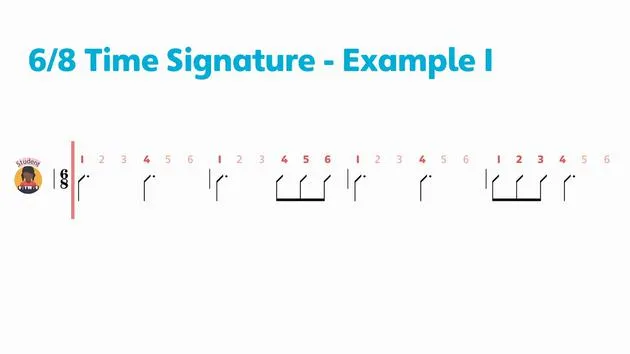
Let's first look at the bass clef of bar one. You can see that there is:
- A dotted quarter note
- Followed by an eighth note
- Another dotted quarter note
- And another eighth note.
If I snap that rhythm, it sounds like:
1 and 2 and 3 and 4.
The same rhythmic pattern repeats for all of the bass clef notes, with some minor variations for the rest of the piece.
Right Hand Rhythms
There's also some tricky right hand rhythms, so I want to do a couple of those with you.
Bars Two to Three
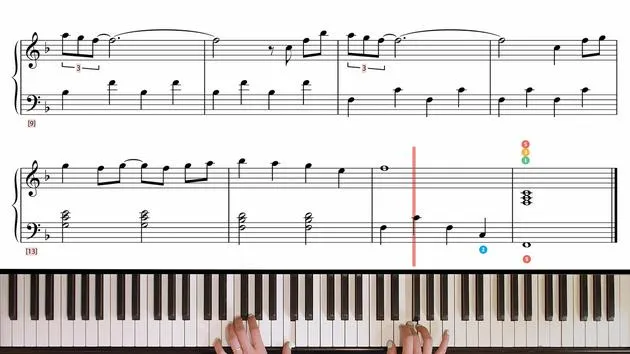
First, have a look at bars two to three in the treble clef.
I'll count you in:
1 and 2.
Then I'll try playing the right hand part here:
1 and 2 and 3 and 4 and 1 and 2 and 3 and 4.
Bars Six to Seven
There's another tricky rhythmic part in bars six to seven. Watch out for those tied notes here as well. It sounds like this:
I'll count to four first:
1 and 2 and 3 and 4 and 1 and 2 and 3 and 4 and 1 and 2 and 3 and.
So, you're really going to have to be careful with that syncopation.
Practice Tips
Once again, take this piece slowly.
- Do it separate hands first
- In very small chunks.
Then you can try it with the backing track.
Remember: You've got the interactive sheet music, so you can speed up and slow down the track as needed, allowing you to go at a pace that's comfortable for you.
Demonstration
Let's have a listen to what this song would sound like:
1 and 2 and 3 and 4 and 1 and 2 and 3 and 4 and 1 and 2 and 3 and 4 and 1 and 2.
3 and 4 and 1 and 2, 3 and 4 and 1 and 2 & 3 and 4.
And 1 and 2 and 3 and 4 & 1 and 2 and 3 and 4.
And 1 and 2 and 3 and 4.
And 1, 2 and 3 and 4.
And 1 and 2 and 3 and 4, and 1 and 2 and 3 and 4 and 1 and 2 and 3 and 4.
Finger Numbers and Position Changes
Be sure to watch out for the finger numbers because they're going to be really helpful where you need to make those changes. You might also need to pay attention to where you need to change your finger position, but it's actually not written in the music for you.
Conclusion
So, take some time to think about this again. This is a really, really tricky piece, so take your time, be patient with yourself, and break it down into small chunks. If you ever get frustrated, take a break and come back to it.
Let's now have a look at what this would sound like with the backing track.
21 lessons
0h 42m of structured video lessons
Advanced video features
Slow down, loop a passage, follow along
Mobile, tablet & desktop
Practise wherever you are
100% satisfaction guarantee
30-day money-back guarantee
Meet your guru
Meet your guru
Talia Girton is a musician and HCPC-registered music therapist, and the founder of The Cycling Music Teachers. Her work brings together music therapy, counselling and education, and she tutors internationally on the music therapy training course at UDELAS in Panama as well as contributing to professional development with the European Piano Teachers Association (EPTA). On MusicGurus she teaches the Piano Method and Piano Foundations courses, guiding complete beginners from first steps through rhythm, both hands, theory and performance.







