



Première étape : génération du son
Avec
Aamir YaqubAamir Yaqub aborde la première étape de la synthèse soustractive, la génération du son, et comment un oscillateur produit des formes d'onde sinusoïdale, triangulaire, carrée et en dents de scie, avec des exemples audio.
Le contenu du cours
20 leçons (1h 47min) · 1 gratuites
01. Bienvenue dans la synthèse
Leçon gratuite0:53
02. Introduction à la synthèse, synthèse soustractive
3:22
03. Première étape : génération du son
Tu es ici4:09
04. Deuxième étape - Façonnage du son et filtres
1:35
05. Façonner le volume - ADSR
3:27
06. LFO
1:54
07. Alchemy
4:11
08. Retro synth
4:55
09. Synthés ES1 et ES2
4:00
10. Synthétiseur ESP
1:17
11. ESM, ESE, EFM1
8:54
12. Sculpture, EVOC20 et vocoding
7:53
13. Drum Synth et Ultrabeat
7:11
14. Drum Kit and Drum Machine Designer
7:23
15. Synthés de clavier : orgue vintage, EP, Clav, Mellotron
9:03
16. Studio Horns et Studio Strings
4:48
17. Effets MIDI - Arpégiateur
21:21
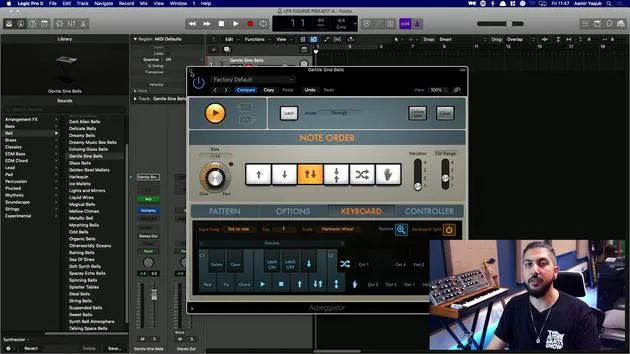
18. Effets MIDI - Chord Trigger
5:45
19. Autres effets MIDI
4:33
Transcription de la leçon
Subtractive Synthesis: Tone Generation
So let's look at the first stage of subtractive synthesis: tone generation. A tone being generated in a synthesizer will happen via an oscillator. Essentially, this is a device for generating waveforms.
Types of Waveforms
In older analog synths, we had regular or cyclic waveforms such as:
- Sine
- Triangle
- Square
- Sawtooth
Here you can see on the screen what they look like. Computer-based oscillators in other forms of synthesis can actually generate all sorts of different weird and wonderful wave shapes.
Sine Wave
- A sine wave is a pure tone with no harmonics and sounds like a whistle.
Triangle Wave
- A triangle wave contains only odd harmonics; it sounds similar to an organ.
Square Wave
- A square wave is mostly odd numbered harmonics and sounds close to an actual clarinet.
Sawtooth Wave
- A sawtooth wave contains both even and odd harmonics and sounds very close to a saxophone.
Noise Wave
- A noise wave is random and noisy, reminiscent of a waterfall.
In-Depth Waveform Analysis
Diving in a little bit further, let's explore these waveforms:
Sine Wave
- Description: Clean and clear sounding wave.
- Harmonics: Contains only the first harmonic (pure fundamental tone).
- Usage: Creates a pure sound like a whistle.
Sawtooth Wave
- Description: Clear and bright sounding.
- Harmonics: Contains both odd and even harmonics, as well as the fundamental tone.
- Ideal For: Creating sounds like strings, pads, some bass, and brass sounds.
Square Wave
- Description: Hollow and woody sounding.
- Harmonics: Contains a wide range of odd harmonics in addition to the fundamental tone.
- Usage: Useful for creating reed instruments, pads, basses, and can emulate kick drums, congas, tomtoms, and other percussive instruments.
Pulse Wave
- The square wave can be reshaped to make the waveform cycles or pulses more rectangular by using pulse width modulation (PWM).
- The more rectangular the wave becomes, the more nasal it sounds.
- When modulated, the square wave is known as a pulse wave, containing fewer harmonics, which can be great for reed sounds, bass sounds, and brass sounds as well.
Triangle Wave
- Description: Contains only odd harmonics in addition to the fundamental tone.
- Harmonics Roll-off: High harmonics roll off faster than those of a square wave.
- Ideal For: Creating flute sounds, pad sounds, and vocal "OO" sounds.
Noise Waves
Noise waves can usually be split into various categories, two of the most notable being white noise and pink noise.
-
White Noise:
- Contains all frequencies at full level.
- Some people use this to help them go to sleep.
-
Pink Noise:
- It is filtered noise where the level of higher frequencies is reduced by 3dB per octave.
- Great for emulating percussive sounds such as snare drums or atmospheric sounds like wind or the sound of the sea.
There are loads of noise wave colors, but we'll focus on white noise and pink noise for our discussion.
20 leçons
1h 47m de leçons vidéo structurées
Fonctions vidéo avancées
Ralentissez, bouclez un passage, suivez la partition
Mobile, tablette et ordinateur
Pratiquez où vous voulez
Satisfaction garantie à 100 %
Garantie remboursement 30 jours
Rencontrez votre guru
Rencontrez votre guru
Aamir Yaqub est un producteur et ingénieur du son basé à Londres. Il a travaillé avec certains des plus grands noms de la musique, dont Alicia Keys, David Guetta, Rihanna, Sia et will.i.am, tout en développant des artistes indépendants.
Au fil de ses cours, il enseigne l'intégralité de son flux de travail sur Logic Pro : de l'interface et de l'enregistrement à la création de beats, la synthèse et les effets MIDI, jusqu'au mixage et à la finalisation d'un morceau.







