



Retro synth
Avec
Aamir YaqubUne visite du Retro Synth de Logic Pro : ses quatre moteurs (analog, sync, wavetable et FM) et comment l'oscillateur analogique, le filtre et les enveloppes façonnent un son.
Le contenu du cours
20 leçons (1h 47min) · 1 gratuites
01. Bienvenue dans la synthèse
Leçon gratuite0:53
02. Introduction à la synthèse, synthèse soustractive
3:22
03. Première étape : génération du son
4:09
04. Deuxième étape - Façonnage du son et filtres
1:35
05. Façonner le volume - ADSR
3:27
06. LFO
1:54
07. Alchemy
4:11
08. Retro synth
Tu es ici4:55
09. Synthés ES1 et ES2
4:00
10. Synthétiseur ESP
1:17
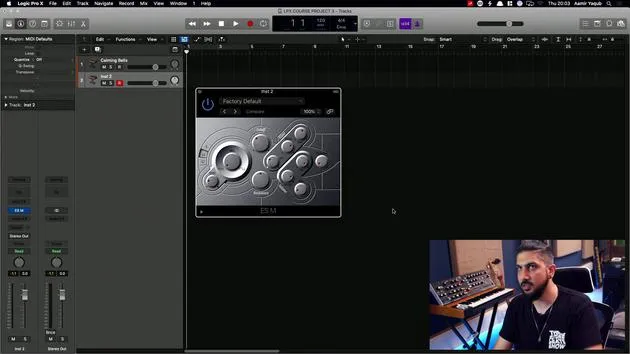
11. ESM, ESE, EFM1
8:54
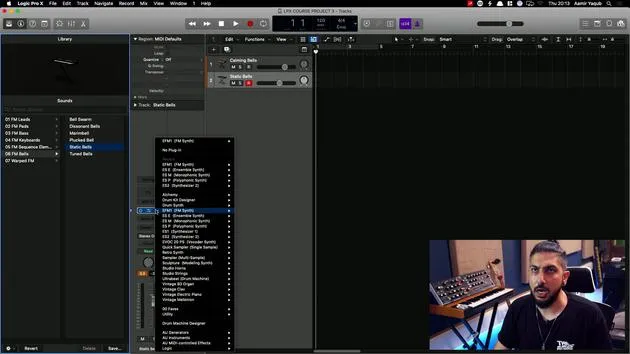
12. Sculpture, EVOC20 et vocoding
7:53
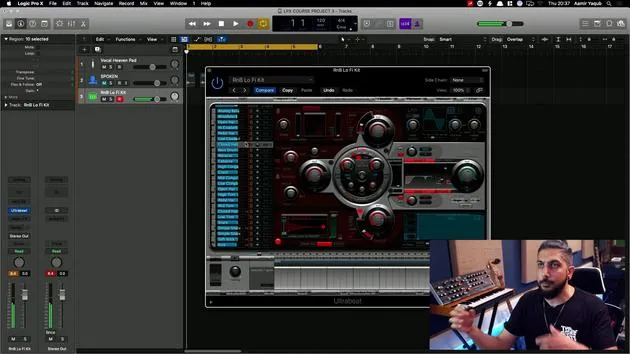
13. Drum Synth et Ultrabeat
7:11
14. Drum Kit and Drum Machine Designer
7:23
15. Synthés de clavier : orgue vintage, EP, Clav, Mellotron
9:03
16. Studio Horns et Studio Strings
4:48
17. Effets MIDI - Arpégiateur
21:21
18. Effets MIDI - Chord Trigger
5:45
19. Autres effets MIDI
4:33
Transcription de la leçon
Exploring Retrosynth
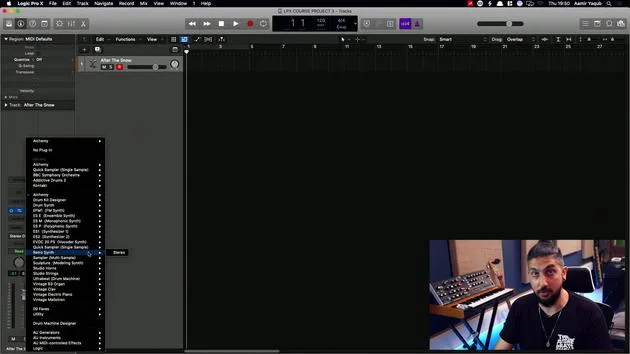
So now I'm going to open up Retrosynth. Retrosynth is a cool synth. As you can tell, it's a retrosynth.
Overview
When you look at it, what you're seeing is a 16-voice synthesizer that can produce a wide variety of sounds. Here are the four different synth engines at work:
- Analog
- Sync
- Wavetable
- FM
Analog Engine
Looking at the analog engine, this was probably designed to mimic some of the early Moog synthesizers. You can see:
- Oscillator Section: This is where we shape and generate our tones.
- Filter: Adjusts the sound frequencies.
- Amplitude Envelope (ADSR): Controls the attack, decay, sustain, and release.
- Filter Envelope: Shapes the dynamics of the filter.
- LFO: Low-frequency oscillator for modulation effects.
- Glide Functionality: Smooth transitions between notes.
- Effects: Options like flanger or chorus can be applied for additional texture.
Retrosynth is really cool in terms of the analog engine because it allows us to achieve vintage, old-school sounds.
FM Engine
However, if you look at the FM engine and how FM synthesis works, you can achieve much more belly-type, digital sounds.
Working with Presets
One of the best ways to understand how sounds are constructed is to experiment with presets and play with some of the available parameters. For example, if I wanted a synth lead, I might choose Vintage Doppler.
- Initial Sound
- Adjust the filter to make it sound a bit brighter.
- Increase attack for a quicker response to make it more percussive.
- Add more chorus to introduce a whistley tone.
As you can see, I'm starting to open up the world of synthesis using simple parameters.
Benefits of Using Retrosynth
Spending time playing around with something like Retrosynth can be very beneficial to your advancement in the world of synthesis. It allows you to gradually move up to more complicated synthesizers in Logic once you feel confident with the basics.
Example: Calming Bells
If you look at a preset like Calming Bells:
- Play around with it and think, "I want it to sound darker."
- You can bring the chorus rate down for a slower movement.
- Experiment with vibrato or LFO rates.
There's so much you can do when you use a sound as a preset or launch pad. You can learn a lot about how to make certain modules interact with each other.
In summary, embrace experimentation in Retrosynth to deepen your understanding and creativity in synthesis!
20 leçons
1h 47m de leçons vidéo structurées
Fonctions vidéo avancées
Ralentissez, bouclez un passage, suivez la partition
Mobile, tablette et ordinateur
Pratiquez où vous voulez
Satisfaction garantie à 100 %
Garantie remboursement 30 jours
Rencontrez votre guru
Rencontrez votre guru
Aamir Yaqub est un producteur et ingénieur du son basé à Londres. Il a travaillé avec certains des plus grands noms de la musique, dont Alicia Keys, David Guetta, Rihanna, Sia et will.i.am, tout en développant des artistes indépendants.
Au fil de ses cours, il enseigne l'intégralité de son flux de travail sur Logic Pro : de l'interface et de l'enregistrement à la création de beats, la synthèse et les effets MIDI, jusqu'au mixage et à la finalisation d'un morceau.







