



Extensions d'accords mineurs
Lesson time: (2min 45sec)
Course preview
This lesson is part of the course Exploring Jazz Saxophone : Partie 1 - Pour commencer
Watch a preview of the full course below.
Lesson transcript:
Soloing Concepts in Dorian Modal Tunes
So, once you've played the head of the major seventh heaven, there's then space for soloing. I'm just going to introduce a few concepts for you to think about when you're soloing.
Exploring the Dorian Scale
In these modal tunes, where it's based on a Dorian scale, it's really nice to explore:
- Chord tones
- Passing notes
We've played them all very close together as a scale:
- Root
- Second
- Third
- Fourth
- Fifth
- Sixth
- Seventh
- Octave
Using Non-Chord Notes
What I want to do is focus on the non-chord notes, the passing notes: the second, fourth, and sixth, and I want to put them up an octave to create a little bit more space.
From the bottom, we're going to get the:
- Root
- Third
- Fifth
- Seventh
as per our usual minor seventh voicing.
But then I'm going to take:
- The second and instead of playing it here, I'll play it up an octave.
- Same thing with the fourth.
- Same thing with the sixth.
And I'll end up with this voicing:
We end up with all the notes of the mode sounding at the same time.
The Sound on Piano
On the piano, this chord will sound like this:
Being able to spread out your scale and shoot some notes up an octave really gives you those lovely, colorful, expressive notes at the top.
Melody Structure
I really like the G sharp. I often start my melody here. I also enjoy ending on the C sharp on the ninth.
- It's not a chord tone, but it's a really colorful, expressive-sounding note.
- It gives a little bit of ambiguity and mystery to my melody.
Bridge Melody
Notice how the bridge melody is exactly the same but an upper semitone. This is quite a popular pattern used by Miles Davis.
What I've already mentioned, but also check out John Coltrane's "Impressions."
About the instructor
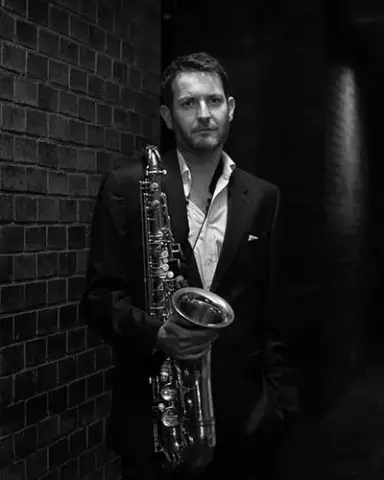
Depuis l'obtention de son diplôme au Leeds College of Music (BA Hons) et à la Guildhall School of Music (Post Graduate Diploma in Performance), Ollie a bâti une carrière riche et variée dans la musique. En tant que saxophoniste, il s'est produit en concert et en studio avec des artistes aussi divers qu'Amy Winehouse, Tim Minchin, Bonobo, Frank Turner, le London Jazz Orchestra, le Hackney Colliery Band, l'Ambient Jazz Ensemble et le Nelson Riddle Orchestra. Il est également coleader du quartet de jazz 'Time Is Of The Essence', et compose et arrange du matériel pour cette formation et d'autres ensembles. Ollie est actif dans l'éducation musicale, actuellement comme responsable de cours du département jazz de la Guildhall School of Music and Drama (école junior), où il dirige des ensembles de jazz, un big band et des cours de théorie. Il a écrit une série de livres 'Exploring Jazz' pour Schott Music, publiés dans le monde entier et inscrits aux programmes d'examen au Royaume-Uni. Ollie a également animé des ateliers pour l'Oxford University, Pro Corda Strings et BABSWE, ainsi que pour les écoles d'été de la Guildhall School of Music. Dans ses cours Exploring Jazz Saxophone, Ollie te mène des tout premiers pas jusqu'à improviser en toute confiance sur des morceaux et des grilles d'accords, en développant les compétences d'improvisation qui mettent le vocabulaire d'un véritable jazzman à portée de tes doigts. read more