



Lick sur accord de septième mineure

Avec
Ollie WestonOllie Weston enseigne un lick simple de septième mineure en G mineur, construit à partir des notes de l'accord, et montre comment le transposer dans d'autres tonalités sur les backing tracks.
Le contenu du cours
51 leçons (2h 9min) · 1 gratuites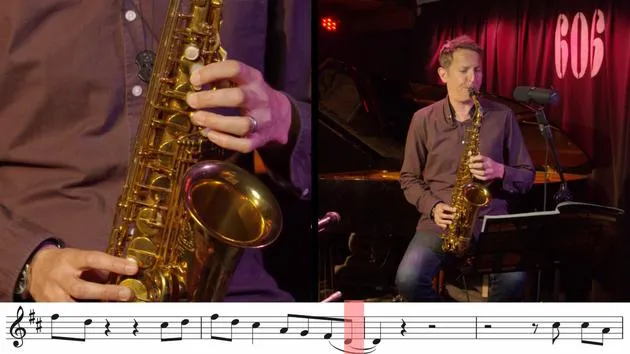
01. Introduction + démonstration de Leaving Town
Leçon gratuite3:02
02. La gamme blues
2:48
03. Croches swing
1:42
04. Combiner la gamme blues et les croches swing
3:57
05. Parcourir la forme du blues en utilisant les fondamentales
1:18
06. Écris ton propre blues
0:59
07. Leaving Town Blues - Improvise
4:13
08. Récapitulatif de l'improvisation
0:49
01. Introduction aux accords de septième mineure
3:32
02. Entraînement de la gamme dorienne
1:40
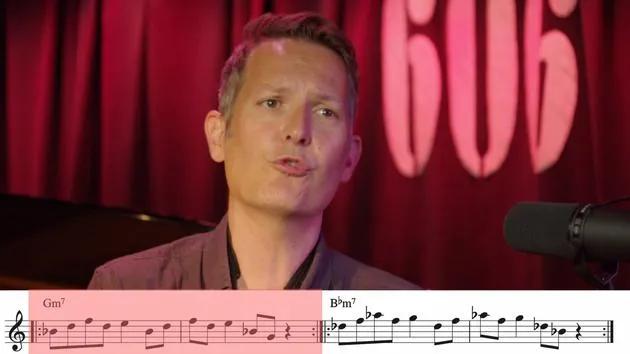
03. Lick sur accord de septième mineure
Tu es ici2:22
04. Motifs de pentatonique mineure
3:51
05. Exercice de pentatonique mineure
1:52
06. Gamme pentatonique vs gamme blues
1:59
07. So Far so Good - Introduction
1:09
08. So Far so Good - Head
1:37
09. Extensions d'accords mineurs
2:45
10. Idées rythmiques
2:13
11. So Far so Good - Interprétation avec solo
3:50
01. Introduction aux modes
6:09
02. Exercice sur les modes diatoniques
4:04
03. Les modes sur une fondamentale statique
1:58
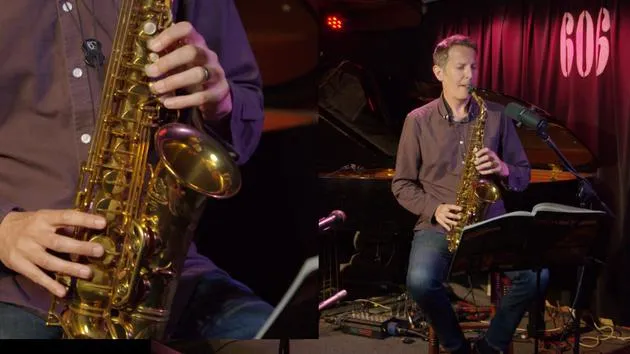
04. Exercice de modes sur une fondamentale statique
1:06
05. Récapitulatif des modes à fondamentale statique
0:34
06. Exercice de phrases pour les modes
1:07
07. Exercice de phrasés pour les modes (démonstration)
1:29
08. Exemples de chansons
1:56
09. First Impresssions - Accords et harmonie
4:06
10. First Impressions - Interprétation
4:06
11. First Impresssions - Introduction et analyse
3:30
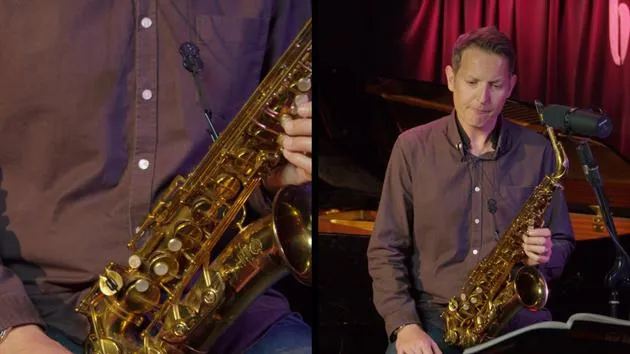
Transcription de la leçon
Developing Your Minor Language
So, having played all your scales, your Dorian scales, and your chord tones, let's have a look at some ways to develop your minor language.
Learning a Simple Phrase
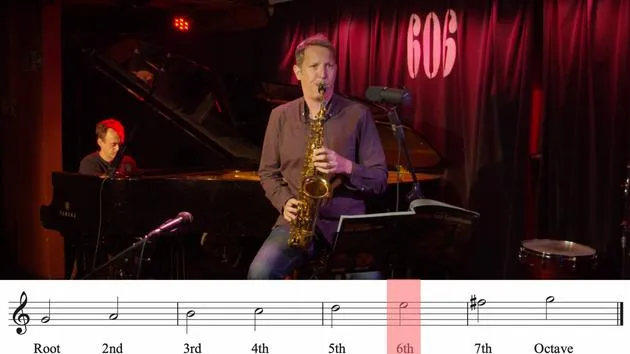
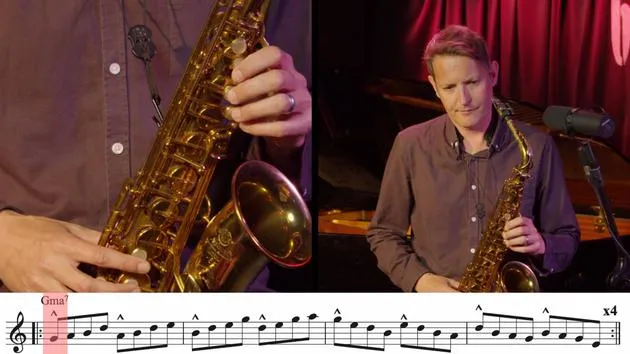
The first thing I'm going to do is introduce a short phrase that jazz has sometimes called a lick. It's just a really simple pattern in G minor.
The Phrase Breakdown
- Starts on the third
- Goes to the fifth
- Moves to the seventh
- Returns to the fifth
- Then to the sixth
- Back to the third
- Finally, returns to the root
Try to get used to numbering your phrases. I'm always coming back to my fingers and thinking, "What is the third of this phrase?" This allows for quick transitions between keys.
Transposing the Phrase
Here it is in G minor, but I'm also comfortable playing it in:
- B flat minor
- C sharp minor
- E minor
Having this ability to quickly access the numerical pattern of a phrase and move it through different keys is a really useful skill for jazz musicians, as you can never quite be sure what key you're going to be playing in sometimes.
Practicing with Backing Tracks
You can use your backing tracks for practice. You'll have:
- 16 bars of G minor
- 16 bars of B flat minor
- 16 bars of C sharp minor
- 16 bars of E minor
Having written out a phrase in those four keys, it's really good to start exploring your own language and try to create your own melodies that you can transfer through keys.
The Importance of Numbering
I always find numbering things to be really useful. If I've learned the phrase in G minor, I know it starts on the third and includes the fifth and seventh.
Being able to access this numerical knowledge quickly is an essential skill for a jazz player. It enables you to recognize unfamiliar chords and tap into your vocabulary.
Conclusion
So, put the tracks on! You've got 16 bars per chord on the backing track. Explore the sounds and create your own licks and phrases that you'll want to use in your solos.
51 leçons
2h 9m de leçons vidéo structurées
Fonctions vidéo avancées
Ralentissez, bouclez un passage, suivez la partition
Mobile, tablette et ordinateur
Pratiquez où vous voulez
Satisfaction garantie à 100 %
Garantie remboursement 30 jours
Rencontrez votre guru
Rencontrez votre guru
Depuis l'obtention de son diplôme au Leeds College of Music (BA Hons) et à la Guildhall School of Music (Post Graduate Diploma in Performance), Ollie a bâti une carrière riche et variée dans la musique. En tant que saxophoniste, il s'est produit en concert et en studio avec des artistes aussi divers qu'Amy Winehouse, Tim Minchin, Bonobo, Frank Turner, le London Jazz Orchestra, le Hackney Colliery Band, l'Ambient Jazz Ensemble et le Nelson Riddle Orchestra. Il est également coleader du quartet de jazz 'Time Is Of The Essence', et compose et arrange du matériel pour cette formation et d'autres ensembles.
Ollie est actif dans l'éducation musicale, actuellement comme responsable de cours du département jazz de la Guildhall School of Music and Drama (école junior), où il dirige des ensembles de jazz, un big band et des cours de théorie. Il a écrit une série de livres 'Exploring Jazz' pour Schott Music, publiés dans le monde entier et inscrits aux programmes d'examen au Royaume-Uni. Ollie a également animé des ateliers pour l'Oxford University, Pro Corda Strings et BABSWE, ainsi que pour les écoles d'été de la Guildhall School of Music.
Dans ses cours Exploring Jazz Saxophone, Ollie te mène des tout premiers pas jusqu'à improviser en toute confiance sur des morceaux et des grilles d'accords, en développant les compétences d'improvisation qui mettent le vocabulaire d'un véritable jazzman à portée de tes doigts.







