



Tierces et septièmes

Lesson time: (3min 48sec)
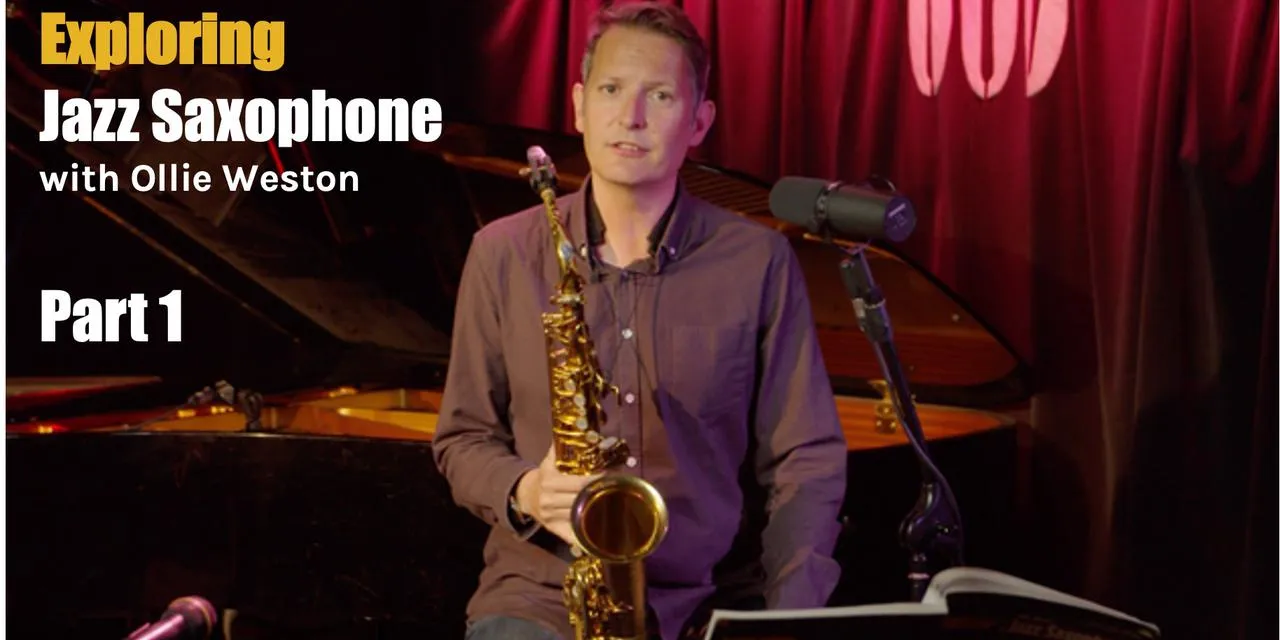
Ollie Weston montre comment viser la tierce et la septième de chaque accord - le triton au cœur d'un accord de septième - ajoute de la couleur en jouant un blues de 12 mesures.
Course preview
This lesson is part of the course Exploring Jazz Saxophone : Partie 1 - Pour commencer
Watch a preview of the full course below.
Lesson transcript:
Exploring Thirds and Sevenths in Music
So the first thing to try is to explore the third and the seventh. The root and the fifth are also really useful as chord tones, as discussed.
But the real character and detail within a seventh chord is created between the third and the seventh, this tritone, this "devil in music" that I talked about.
12-Bar Blues Example
I'm going to play through a 12-bar blues, focusing on the thirds and the sevenths so you can hear them in context and see how they react to the chords on the piano and the root notes on the double bass.
Count-In:
1, 2, 1, 2, 3, 4.
Finding those thirds and sevenths adds more detail and movement within a 12-bar blues than just playing the blues scale. Eventually, you'll want to mix your blues scale with the more detailed voicing of these seventh chords.
Noticing Small Movements
What I like to do is notice the small movements between the chords. For instance, if I take the third of D7, my F sharp, and when the chord changes to G7, there's an F natural present, it's the seventh of G.
This creates a little semitone movement that I can use to capture the detail of the chord without having to make massive jumps on my instrument.
Demonstration
I'm just going to play you a chorus where I move between the thirds and sevenths of D7 and G7, focusing on the third of the D7 chord and the seventh of the G7 chord. By moving that semitone, I'm able to capture the detail of the chord.
Count-In:
1, 2, 1, 2, 3, 4.
Now, if I reverse that and, instead of starting on the third, I start on the seventh, I can do exactly the same thing. My sevenths and thirds swap through the sequence of the blues.
Here it is, starting on A C this time and moving between C and B.
Count-In:
1, 2, 1, 2, 3, 4.
Conclusion
On their own, these aren't necessarily strong melodies, but they're really useful exercises to practice hearing the inner workings of a chord sequence. Now that we are following a sequence and changing chords, it's really useful to know these guide tones.
About the instructor
Depuis l'obtention de son diplôme au Leeds College of Music (BA Hons) et à la Guildhall School of Music (Post Graduate Diploma in Performance), Ollie a bâti une carrière riche et variée dans la musique. En tant que saxophoniste, il s'est produit en concert et en studio avec des artistes aussi divers qu'Amy Winehouse, Tim Minchin, Bonobo, Frank Turner, le London Jazz Orchestra, le Hackney Colliery Band, l'Ambient Jazz Ensemble et le Nelson Riddle Orchestra. Il est également coleader du quartet de jazz 'Time Is Of The Essence', et compose et arrange du matériel pour cette formation et d'autres ensembles. Ollie est actif dans l'éducation musicale, actuellement comme responsable de cours du département jazz de la Guildhall School of Music and Drama (école junior), où il dirige des ensembles de jazz, un big band et des cours de théorie. Il a écrit une série de livres 'Exploring Jazz' pour Schott Music, publiés dans le monde entier et inscrits aux programmes d'examen au Royaume-Uni. Ollie a également animé des ateliers pour l'Oxford University, Pro Corda Strings et BABSWE, ainsi que pour les écoles d'été de la Guildhall School of Music. Dans ses cours Exploring Jazz Saxophone, Ollie te mène des tout premiers pas jusqu'à improviser en toute confiance sur des morceaux et des grilles d'accords, en développant les compétences d'improvisation qui mettent le vocabulaire d'un véritable jazzman à portée de tes doigts. read more