



Bajo de Alberti (acompañamiento)

Lesson time: (10min 30sec)
Dejan Lazic explica las figuras de acompañamiento del bajo de Alberti en el tercer movimiento de Moonlight Sonata, cómo equilibrarlas frente a la melodía y cómo practicarlas.
Course preview
This lesson is part of the course Domina la Sonata Claro de Luna de Beethoven: movimientos I, II y III
Watch a preview of the full course below.
Lesson transcript:
Beethoven's Moonlight Sonata: Third Movement
Hi everyone, we are back with Beethoven and the Moonlight Sonata, third movement, the most virtuosic one.
Contrasts in the Sonata
We were talking about the great contrasts Beethoven included when composing this sonata:
- First Movement: Very intimate, soft, and slow.
- Second Movement: Cheerful and dance-like, described as a "flower between the two Abbesses," as Lis called it, in D flat major.
- Third Movement: Back to C sharp minor with incredible broken chords passages.
Rhapsodic Movement
This movement doesn't start with a clear theme or subject. Instead, it begins with broken chords, similar to how we started the first movement. Later, we discover that there is indeed a motivic subject, a theme worthy of singing.
Theme Introduction
The thematic material appears a bit later, in Bar 21, after we encounter a fermata. Do you remember the pedal note: G sharp fermata?
Fermata Timing
- Importance of Timing: No one really knows how long this fermata should be.
- Repetition: Since you are likely repeating this first section multiple times, you can experiment with timing.
- Consider making it dramatically longer the first time and a bit shorter another time.
- Beethoven's Improvisation: Beethoven was a great improviser. Performers noted that he often played the same piece differently in repeats.
Transitioning from Second Movement
After the second movement, which ends in B flat major, we transition immediately to C sharp minor, setting up the "engine" for the third movement.
Fingering Recommendations
For fingering, I recommend:
- Not the usual: Octave 1:5.
- Consider 1-4 for certain sections since the fourth finger is positioned between the black keys and doesn't project as well.
Accentuation and Dynamics
- Use piano sforzando and prepare for novelty.
- In Bar 19, we see a crescendo for the first time with the same figure (broken chords), but it's done with slurs, meaning it should be played legato and more expressively.
Alberti Bass
We encounter the Alberti bass, a familiar accompaniment figure used extensively by the Italian composer Alberti, a singer and harpsichordist.
- This figure appears frequently in Beethoven's writing and is a mix of humor and irony.
- It's essential to play it with minimal pedal to ensure clarity since it belongs more to the 18th century than to a 19th-century piece.
Variations of Alberti Bass
- The figure appears in various forms:
- In the left hand during the middle section,
- In the right hand from Bar 75.
Practicing Tips
Pay attention to the thumb:
- We discussed the importance of the thumb's flexibility earlier.
- For G sharp minor, your thumb should be very flexible:
- In the left hand, use G sharp 5-3-1 for the first inversion.
- Then, try 4 to 1 to maintain a natural hand position.
Additional Considerations
- Avoid practicing too fast, focusing instead on maintaining proper technique to avoid strain.
- Ensure that you take care of your thumbs throughout the practice.
See you next time!
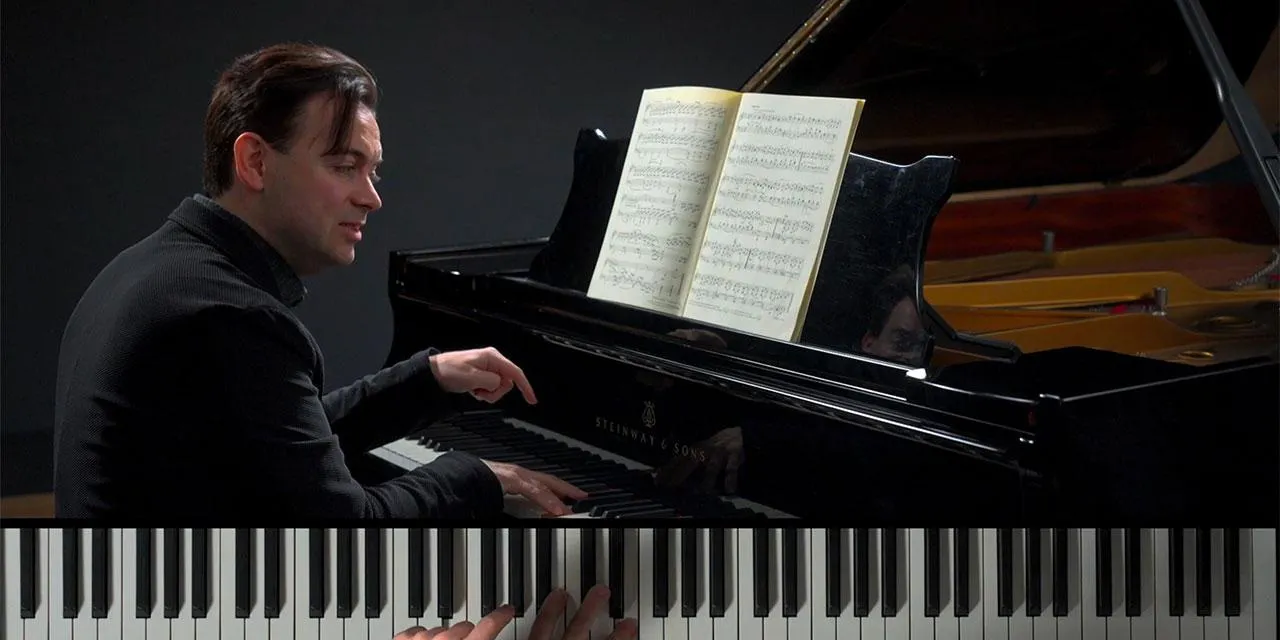
About the instructor
Las frescas interpretaciones del repertorio de Dejan Lazić lo han consolidado como uno de los solistas más singulares e inusuales de su generación. Actúa con regularidad con las principales orquestas del mundo, entre ellas las orquestas sinfónicas de Boston y Chicago, la Budapest Festival Orchestra, la Royal Concertgebouw Orchestra, la London Philharmonic, la Philharmonia Orchestra, la NDR Elbphilharmonie Orchester, así como las orquestas de cámara de Australia, Basilea y los Países Bajos, y ha establecido estrechas colaboraciones con directores como Giovanni Antonini, Iván Fischer, Michael Francis, Andris Nelsons, Ivan Repušić, Thomas Søndergård, Robert Spano, John Storgårds, Krzysztof Urbański y Jan Willem de Vriend. Dejan Lazić ha publicado numerosos CD con Channel Classics y Onyx Classics, y una grabación del Triple Concierto de Beethoven para Sony Classical. Su grabación en directo del Concierto para piano n.º 2 de Rachmaninov con la London Philharmonic Orchestra y Kirill Petrenko recibió el premio alemán "Echo Klassik". También cuenta con un gran número de seguidores en el Lejano Oriente y desarrolla una intensa actividad como recitalista y músico de cámara, participando con regularidad en importantes festivales internacionales. Las composiciones de Dejan Lazić reciben un reconocimiento cada vez mayor, y en 2015 fue fichado como compositor por el grupo editorial Sikorski Music Publishing. Su arreglo del Concierto para violín de Brahms como Concierto para piano "n.º 3" se estrenó y grabó con la Atlanta Symphony Orchestra y Robert Spano en 2009 y ha cosechado un gran éxito sostenido, en los BBC Proms, el Concertgebouw de Ámsterdam, el Festival de Pascua de Hamburgo y el Festival Chopin de Varsovia, en ambas Américas y en Japón. Su Concierto para piano en estilo istrio (Op. 18) se estrenó en el Aspen Music Festival en 2014 y desde entonces se ha interpretado por toda Europa y en Estados Unidos. Otras obras incluyen diversa música orquestal, de cámara y para piano, cadencias, así como varios arreglos de obras de Mozart, Schubert, R. Strauss, Wagner y Debussy. Dejan Lazić nació en Zagreb, Croacia, en el seno de una familia de músicos. Creció en Salzburgo, Austria, donde estudió en el Mozarteum (piano, clarinete y composición). Sus primeros encuentros con Zoltán Kocsis e Imre Rohmann en el Festival Bartók de Hungría fueron decisivos para su carrera artística, al igual que la notable influencia de Peter Eötvös. Dejan Lazić vive en Ámsterdam. En Master Moonlight Sonata by Beethoven, Dejan comparte la visión que hay detrás de esas aclamadas interpretaciones, guiándote a través de los tres movimientos de una de las obras más queridas del repertorio pianístico para que puedas moldearla con verdadera comprensión en lugar de por imitación. www.dejanlazic.com read more