



Pedal y equilibrar las tres características principales

Lesson time: (5min 27sec)
Aprende a usar correctamente el pedal (prácticas históricas frente a armónicas). Descubre además cómo Dejan equilibra el bajo, los tresillos y la melodía: tres características en dos manos.
Course preview
This lesson is part of the course Domina la Sonata Claro de Luna de Beethoven: movimientos I, II y III
Watch a preview of the full course below.
Lesson transcript:
Welcome Back to Our Course on Beethoven's Moonlight Sonata
In previous lessons, we've discussed:
- Sound production
- Structure and pace of the piece
- Three main features:
- The bass in the left hand
- The triplets in the right hand
- The famous motif, the melody in the right hand
The Role of Triplets
The triplets are often seen as accompaniment, but they are actually much more than that. One shouldn't take a passive approach towards them.
Exploring the Pedal
Before we dive into the world of pedal, it's important to note that there are many different views on how this piece should be performed and pedalized.
Beethoven's Pedal Marking
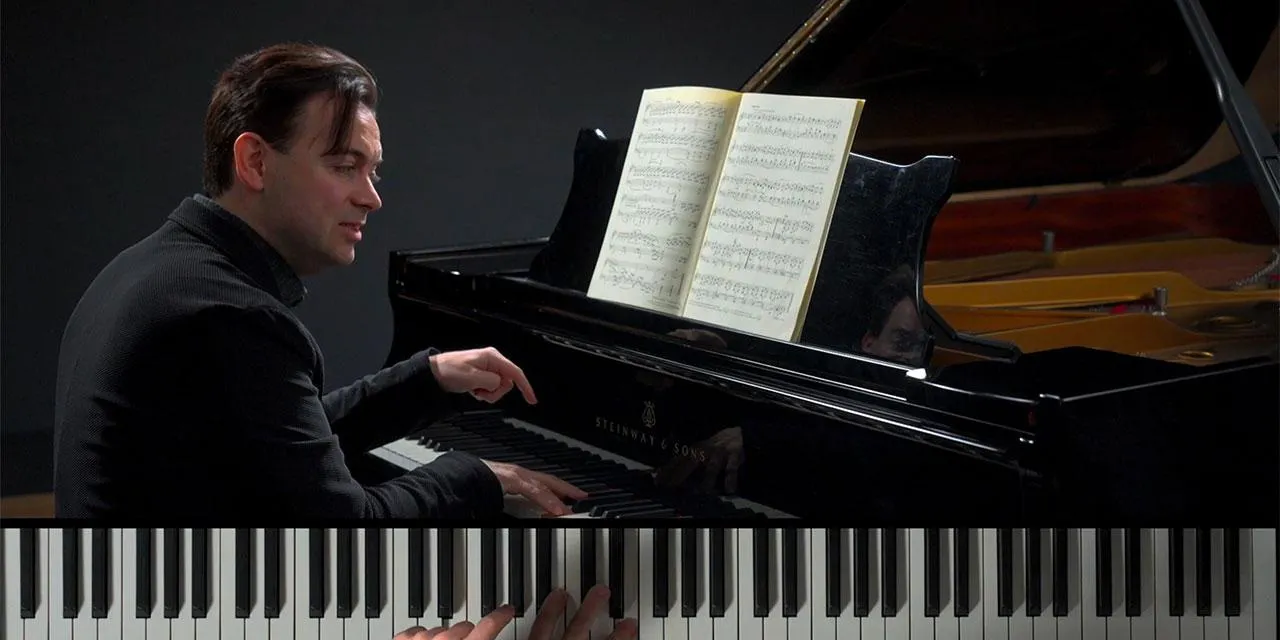
Beethoven's mark for the first movement instructs performers to use one sustained pedal throughout. On a modern instrument, like the Steinway we have here in Amsterdam tonight, sound production is much more robust.
- The piano is not only louder but also more massive than the instruments used in Beethoven's time when this sonata was written (i.e., 1801).
- The range is bigger, and the pedal catches those tones, allowing them to resonate for a much longer time.
The Concern for Pianists
This can be a worrying circumstance for many pianists. Let me show you how it sounds if I simply follow Beethoven's instruction and push down the pedal throughout the piece.
Although I won't play the whole movement, I will demonstrate the beginning:
[Plays the beginning of the movement]
Notice how those harmonies already clash, which can be interesting, but one might wonder, Is it too much?
Authentic Sound
I don't believe this is how Beethoven intended the piece to sound. Having played on a few instruments from Beethoven's time, I think we should respect his remarks from 220 years ago but also adapt them to our modern instruments to capture the essence of what he wanted.
Adapting the Pedal Technique
Half Pedaling
One approach is to change the pedal here and there, or to use half-pedaling.
- Half pedaling means that for certain chords, instead of changing the pedal entirely, you can lift and push down partially, creating a blend that isn't too clean.
For instance, consider this chord:
If I completely lift the pedal, it might sound too crisp.
Now, if I simply leave the pedal down, you would still distinctly hear the initial bass note, which may be too loud. Beethoven's original pianos did not sustain tones as long, allowing harmonies to dissolve more quickly.
Suggested Pedal Usage
What I propose, and this is not a new idea, is to manage the pedal in a way that is not overly explicit.
For example, when you encounter similar harmonies, such as:
- The notes G sharp, C sharp, and E in C sharp minor
- A subsequent change in the bass while the other notes remain the same
You could use the same pedal for these two harmonies, allowing for a smoother transition without needing to change the pedal constantly.
"This approach creates a more authentic sound that resonates more closely with what Beethoven intended."
About the instructor
Las frescas interpretaciones del repertorio de Dejan Lazić lo han consolidado como uno de los solistas más singulares e inusuales de su generación. Actúa con regularidad con las principales orquestas del mundo, entre ellas las orquestas sinfónicas de Boston y Chicago, la Budapest Festival Orchestra, la Royal Concertgebouw Orchestra, la London Philharmonic, la Philharmonia Orchestra, la NDR Elbphilharmonie Orchester, así como las orquestas de cámara de Australia, Basilea y los Países Bajos, y ha establecido estrechas colaboraciones con directores como Giovanni Antonini, Iván Fischer, Michael Francis, Andris Nelsons, Ivan Repušić, Thomas Søndergård, Robert Spano, John Storgårds, Krzysztof Urbański y Jan Willem de Vriend. Dejan Lazić ha publicado numerosos CD con Channel Classics y Onyx Classics, y una grabación del Triple Concierto de Beethoven para Sony Classical. Su grabación en directo del Concierto para piano n.º 2 de Rachmaninov con la London Philharmonic Orchestra y Kirill Petrenko recibió el premio alemán "Echo Klassik". También cuenta con un gran número de seguidores en el Lejano Oriente y desarrolla una intensa actividad como recitalista y músico de cámara, participando con regularidad en importantes festivales internacionales. Las composiciones de Dejan Lazić reciben un reconocimiento cada vez mayor, y en 2015 fue fichado como compositor por el grupo editorial Sikorski Music Publishing. Su arreglo del Concierto para violín de Brahms como Concierto para piano "n.º 3" se estrenó y grabó con la Atlanta Symphony Orchestra y Robert Spano en 2009 y ha cosechado un gran éxito sostenido, en los BBC Proms, el Concertgebouw de Ámsterdam, el Festival de Pascua de Hamburgo y el Festival Chopin de Varsovia, en ambas Américas y en Japón. Su Concierto para piano en estilo istrio (Op. 18) se estrenó en el Aspen Music Festival en 2014 y desde entonces se ha interpretado por toda Europa y en Estados Unidos. Otras obras incluyen diversa música orquestal, de cámara y para piano, cadencias, así como varios arreglos de obras de Mozart, Schubert, R. Strauss, Wagner y Debussy. Dejan Lazić nació en Zagreb, Croacia, en el seno de una familia de músicos. Creció en Salzburgo, Austria, donde estudió en el Mozarteum (piano, clarinete y composición). Sus primeros encuentros con Zoltán Kocsis e Imre Rohmann en el Festival Bartók de Hungría fueron decisivos para su carrera artística, al igual que la notable influencia de Peter Eötvös. Dejan Lazić vive en Ámsterdam. En Master Moonlight Sonata by Beethoven, Dejan comparte la visión que hay detrás de esas aclamadas interpretaciones, guiándote a través de los tres movimientos de una de las obras más queridas del repertorio pianístico para que puedas moldearla con verdadera comprensión en lugar de por imitación. www.dejanlazic.com read more