



Producción del sonido

Lesson time: (14min 3sec)
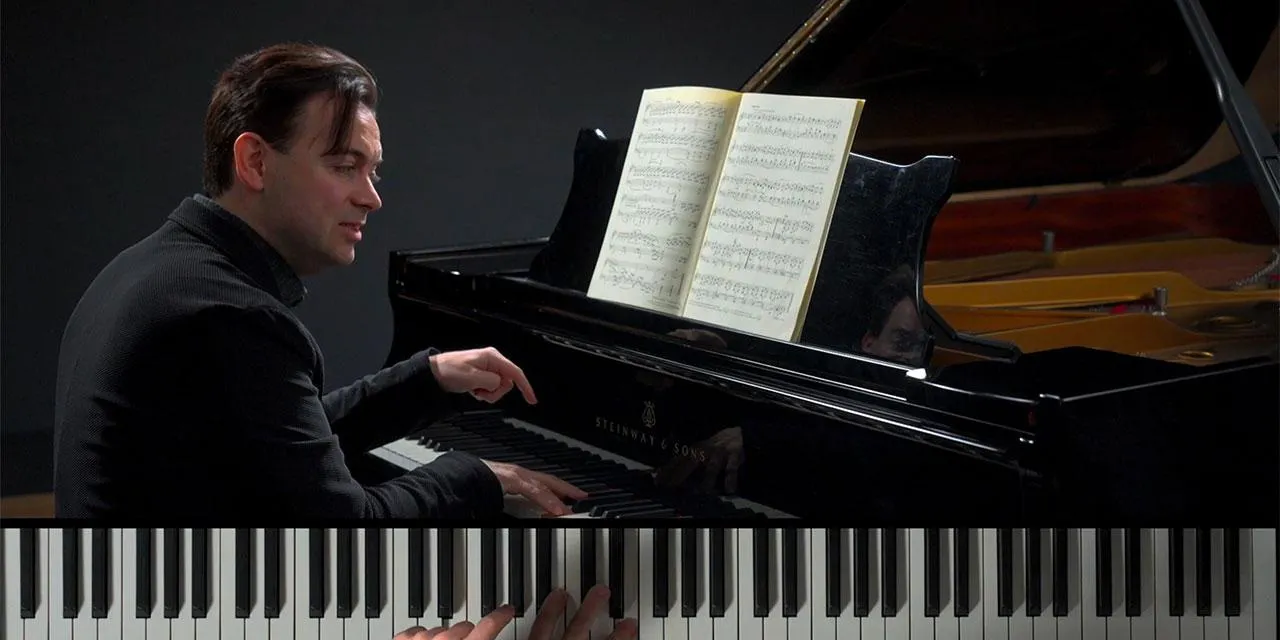
Dejan Lazić muestra cómo producir el sonido sempre pianissimo que requiere el primer movimiento, manteniendo el pulgar ligero, ejecutando los tresillos de forma uniforme y controlando el pedal.
Course preview
This lesson is part of the course Domina la Sonata Claro de Luna de Beethoven: movimientos I, II y III
Watch a preview of the full course below.
Lesson transcript:
Beethoven's Moonlight Sonata: Opus 27, Number 2
Introduction
Hello, and welcome back to this course! Today, we will delve into Beethoven's famous Moonlight Sonata, Opus 27, Number 2.
This sonata is his 14th piano sonata and stands pretty much in the middle of his 32 sonatas, written in 1801.
First Movements and Sound Production
Sempre Pianissimo
Let's first talk about sound production.
- Beethoven's marking right at the beginning is sempre pianissimo, which means this whole movement should be played very, very quietly.
How can we achieve that?
Until bar five, where we introduce the famous motive in the right hand, we encounter:
- Triplets in the right hand
- Long bass notes in the left hand, also in pianissimo.
The piano can sound like an entire orchestra, with a great range from very soft to very loud and many different colors. Today, I would like to address how to achieve this pianissimo throughout the movement and also touch upon the topic of pedalization.
Right Hand Technique
First, let's talk about the right hand.
- It should be played very calmly.
Key Points:
- Pay attention to your thumb.
- Our hand is not ideally constructed for playing the piano, the fifth finger is short, and the thumb is poorly positioned.
When playing black keys with your thumb, you might have to turn your hand inwards.
The Thumb Challenges:
- Since we place our other fingers naturally, the thumb often ends up sounding too loud, so it must be tamed.
Concentrate on making the thumb flexible and avoiding false accents. Focus more on fingers 2 and 4 while keeping the thumb light.
Left Hand Considerations
Now, regarding the left hand:
- The bass notes can be quite loud, especially on a modern Steinway piano, which has a massive and robust sound.
It is crucial to maintain balance so the left hand doesn't overpower the piece. Pay special attention to:
- The thumb in the right hand and octave in the left hand should be played very gently.
Additionally, when playing black keys, remember that while you could theoretically use your second finger, the thumb is needed for the lower octave when the motive appears.
The Challenge of Dynamics
It's vital to recognize that:
- The fifth finger, often the weakest, plays important musical material.
- The strongest finger (the thumb) should be played the softest.
This is what makes the movement particularly difficult. When I learned this sonata as a child, I thought it was relatively easy. However, as I matured and explored the harmonic structure, phrasing, and pacing, I realized how deep this music truly is.
Starting in Bar Five
Let's begin in bar five.
- Be cautious with your left hand, and only emphasize the right hand's fifth finger clearly on the motive.
The last note in this motif, which lasts for three beats, should be sustained.
Image This:
- If you were a horn player or singer, you would sustain the note, but on the piano, the sound declines once the hammer hits the string.
To enhance the G sharp, consider:
- Playing the triplets a bit loudly to emphasize its presence and sustain the tone in the air.
Creativity in Performance
When it comes to sound production, it's a multidimensional aspect, including timing.
- I took a little time between the major triplets in E major, slowing down slightly.
Although this isn't specified in the music, remember that Beethoven's Sonata Quasi Una Fantasia suggests a free improvisation style. Adapt your performance based on how you feel in the moment, making each performance unique.
Phrasing and Structure
As we discuss phrasing, pay attention to Beethoven's notations:
- In bars 7 and 8, the right hand has a slur over two bars, while the left hand only covers one bar.
This means the right hand continues the phrase, creating a more prominent emphasis there.
Concluding Thoughts
Geniuses like Beethoven didn't make decisions lightly; there's intent behind every marking.
We'll explore the following in our next lesson:
- The reasoning behind the structure and markings in his works.
- More on sound production, timing, and phrasing.
I look forward to welcoming you back!
About the instructor
Las frescas interpretaciones del repertorio de Dejan Lazić lo han consolidado como uno de los solistas más singulares e inusuales de su generación. Actúa con regularidad con las principales orquestas del mundo, entre ellas las orquestas sinfónicas de Boston y Chicago, la Budapest Festival Orchestra, la Royal Concertgebouw Orchestra, la London Philharmonic, la Philharmonia Orchestra, la NDR Elbphilharmonie Orchester, así como las orquestas de cámara de Australia, Basilea y los Países Bajos, y ha establecido estrechas colaboraciones con directores como Giovanni Antonini, Iván Fischer, Michael Francis, Andris Nelsons, Ivan Repušić, Thomas Søndergård, Robert Spano, John Storgårds, Krzysztof Urbański y Jan Willem de Vriend. Dejan Lazić ha publicado numerosos CD con Channel Classics y Onyx Classics, y una grabación del Triple Concierto de Beethoven para Sony Classical. Su grabación en directo del Concierto para piano n.º 2 de Rachmaninov con la London Philharmonic Orchestra y Kirill Petrenko recibió el premio alemán "Echo Klassik". También cuenta con un gran número de seguidores en el Lejano Oriente y desarrolla una intensa actividad como recitalista y músico de cámara, participando con regularidad en importantes festivales internacionales. Las composiciones de Dejan Lazić reciben un reconocimiento cada vez mayor, y en 2015 fue fichado como compositor por el grupo editorial Sikorski Music Publishing. Su arreglo del Concierto para violín de Brahms como Concierto para piano "n.º 3" se estrenó y grabó con la Atlanta Symphony Orchestra y Robert Spano en 2009 y ha cosechado un gran éxito sostenido, en los BBC Proms, el Concertgebouw de Ámsterdam, el Festival de Pascua de Hamburgo y el Festival Chopin de Varsovia, en ambas Américas y en Japón. Su Concierto para piano en estilo istrio (Op. 18) se estrenó en el Aspen Music Festival en 2014 y desde entonces se ha interpretado por toda Europa y en Estados Unidos. Otras obras incluyen diversa música orquestal, de cámara y para piano, cadencias, así como varios arreglos de obras de Mozart, Schubert, R. Strauss, Wagner y Debussy. Dejan Lazić nació en Zagreb, Croacia, en el seno de una familia de músicos. Creció en Salzburgo, Austria, donde estudió en el Mozarteum (piano, clarinete y composición). Sus primeros encuentros con Zoltán Kocsis e Imre Rohmann en el Festival Bartók de Hungría fueron decisivos para su carrera artística, al igual que la notable influencia de Peter Eötvös. Dejan Lazić vive en Ámsterdam. En Master Moonlight Sonata by Beethoven, Dejan comparte la visión que hay detrás de esas aclamadas interpretaciones, guiándote a través de los tres movimientos de una de las obras más queridas del repertorio pianístico para que puedas moldearla con verdadera comprensión en lugar de por imitación. www.dejanlazic.com read more