



Tempo: «Minuetto», «Menuett» o «Menuet»
Lesson time: (7min 35sec)
Dejan Lazić recurre a la analogía de un cuarteto de cuerda para explorar el tempo y el carácter de este movimiento, y si debe tratarse como un Minuetto italiano, un Menuett alemán o un Menuet francés.
Course preview
This lesson is part of the course Domina la Sonata Claro de Luna de Beethoven: movimientos I, II y III
Watch a preview of the full course below.
Lesson transcript:
Exploring Individual Voices in Beethoven's Piece
Let us talk about individual voices in this piece. We discussed movement one, emphasizing the strictness of the bass line, the triplets, and the melody.
Main Features of Movement One
In this movement, we have three main features that stand in stark contrast to each other. Here, we're focusing on togetherness and the complexity of a string quartet.
- The composition is written in four voices throughout.
- The very beginning features a three-voice introduction, leading to a four-voice answer question.
Imagining the String Quartet
In envisioning a string quartet, consider the following:
- First Violin
- Second Violin
- Viola
- Cello (paused until later)
From this point onward, we utilize four voices: first and second violins could be imagined in octaves, alongside the viola and cello.
Chamber Music Quality
There are no distinctions between the bass and the middle section, the triplets, and the melodic structure. Here, we are much more 'chamber music-like,' showcasing not just D flat major but also this incredible chamber music quality.
- We will explore the piano's massive range later in the third movement, which follows shortly.
Dynamics and Beethoven's Mark
We start from a piano dynamic, progressing from very soft to very loud, from very low to very high registers. However, here we remain much more constrained. It is essential that we adhere to Beethoven's Allegretto marking and everything present in this Urtext edition.
Legato and Pizzicato
- Bars one and two: Note the legato slurs.
- Following that: very short notes, where one could even imagine a pizzicato by strings.
This has been masterfully repeated by Beethoven with a syncopated variation. Instead of having the melody resolving at expected intervals, it arrives later than anticipated.
Lyrical Phrasing and Crescendo
After this, we find an incredibly lyrical part, leading to an outburst around bar 22.
- This mini crescendo lasts only for practically one bar, then we revert back to piano.
This encapsulates the world of Beethoven, which can be challenging on the piano, you must be incredibly quick and alert, paying careful attention to your fingerings.
Keying Techniques
Avoid using your thumb as much as possible on black key legato passages.
- Imagine your keyboard being really hot: you have to bounce off to achieve a short texture.
- The left hand remains legato while the right hand is separated into two phrases.
Emergence of New Material
Great news about Beethoven: in every two or four bars, especially every phrase, new material emerges, something completely unexpected.
Practice Insights
When practicing this piece, always ask the question, "Why?"
- Why is there a slur in the left hand?
- In the right hand, we have repeating notes, which are less prominent.
As the mini crescendo occurs, you reach a sforzando before transitioning back into piano. The same phrase is then revisited, but there's a new variation emerging each time.
Understanding Beethoven's Humor
Beethoven has an incredible sense of humor; when you expect a resolution, he takes you a step back.
- Strive to be constrained, as this foreshadows both great Impressionist developments and reflects back on the rococo and gallant styles.
This understanding is crucial when you practice and perform this movement.
Enjoy!
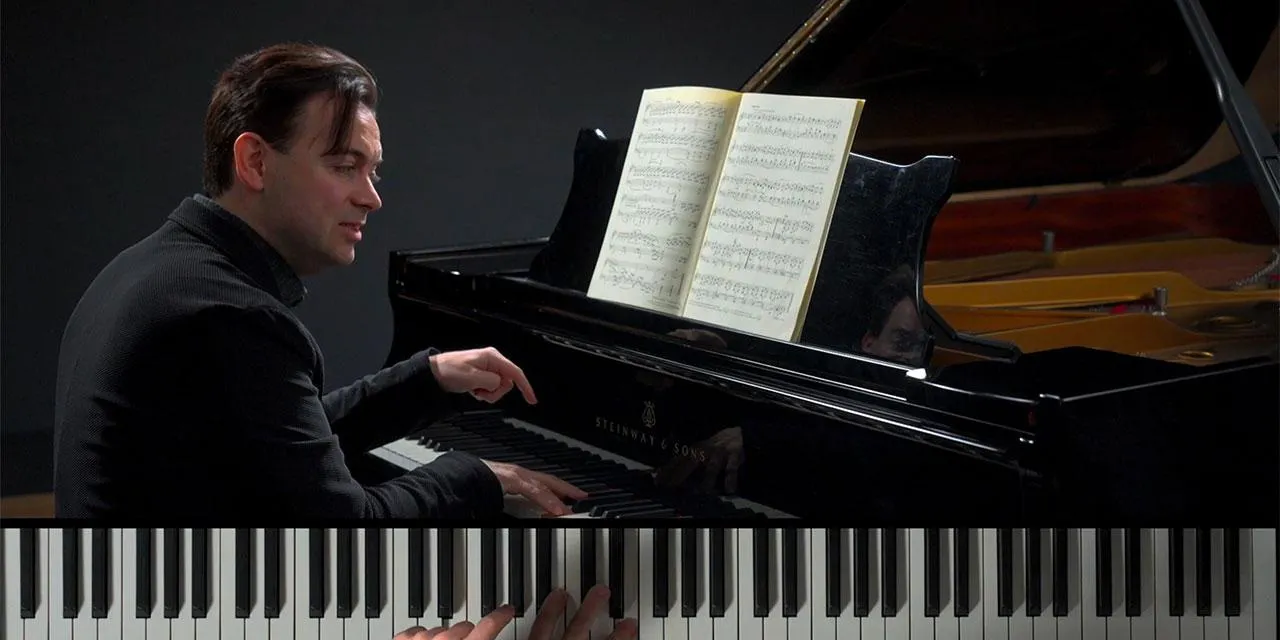
About the instructor
Las frescas interpretaciones del repertorio de Dejan Lazić lo han consolidado como uno de los solistas más singulares e inusuales de su generación. Actúa con regularidad con las principales orquestas del mundo, entre ellas las orquestas sinfónicas de Boston y Chicago, la Budapest Festival Orchestra, la Royal Concertgebouw Orchestra, la London Philharmonic, la Philharmonia Orchestra, la NDR Elbphilharmonie Orchester, así como las orquestas de cámara de Australia, Basilea y los Países Bajos, y ha establecido estrechas colaboraciones con directores como Giovanni Antonini, Iván Fischer, Michael Francis, Andris Nelsons, Ivan Repušić, Thomas Søndergård, Robert Spano, John Storgårds, Krzysztof Urbański y Jan Willem de Vriend. Dejan Lazić ha publicado numerosos CD con Channel Classics y Onyx Classics, y una grabación del Triple Concierto de Beethoven para Sony Classical. Su grabación en directo del Concierto para piano n.º 2 de Rachmaninov con la London Philharmonic Orchestra y Kirill Petrenko recibió el premio alemán "Echo Klassik". También cuenta con un gran número de seguidores en el Lejano Oriente y desarrolla una intensa actividad como recitalista y músico de cámara, participando con regularidad en importantes festivales internacionales. Las composiciones de Dejan Lazić reciben un reconocimiento cada vez mayor, y en 2015 fue fichado como compositor por el grupo editorial Sikorski Music Publishing. Su arreglo del Concierto para violín de Brahms como Concierto para piano "n.º 3" se estrenó y grabó con la Atlanta Symphony Orchestra y Robert Spano en 2009 y ha cosechado un gran éxito sostenido, en los BBC Proms, el Concertgebouw de Ámsterdam, el Festival de Pascua de Hamburgo y el Festival Chopin de Varsovia, en ambas Américas y en Japón. Su Concierto para piano en estilo istrio (Op. 18) se estrenó en el Aspen Music Festival en 2014 y desde entonces se ha interpretado por toda Europa y en Estados Unidos. Otras obras incluyen diversa música orquestal, de cámara y para piano, cadencias, así como varios arreglos de obras de Mozart, Schubert, R. Strauss, Wagner y Debussy. Dejan Lazić nació en Zagreb, Croacia, en el seno de una familia de músicos. Creció en Salzburgo, Austria, donde estudió en el Mozarteum (piano, clarinete y composición). Sus primeros encuentros con Zoltán Kocsis e Imre Rohmann en el Festival Bartók de Hungría fueron decisivos para su carrera artística, al igual que la notable influencia de Peter Eötvös. Dejan Lazić vive en Ámsterdam. En Master Moonlight Sonata by Beethoven, Dejan comparte la visión que hay detrás de esas aclamadas interpretaciones, guiándote a través de los tres movimientos de una de las obras más queridas del repertorio pianístico para que puedas moldearla con verdadera comprensión en lugar de por imitación. www.dejanlazic.com read more