



Dinámicas y retos técnicos

Lesson time: (14min 30sec)
Dejan te enseña cómo lograr un “sempre pianissimo” & legato a lo largo de este movimiento, y cómo superar retos técnicos que no son necesariamente virtuosos.
Course preview
This lesson is part of the course Domina la Sonata Claro de Luna de Beethoven: movimientos I, II y III
Watch a preview of the full course below.
Lesson transcript:
Proper Pedalization in Beethoven's First Movement
Introduction
Today, we will delve deeper into the topic of pedal usage in Beethoven's first movement. Beethoven clearly indicates that this piece should be played throughout with the pedal lying down. The term senza sordino means the pedal should not be pushed down, sordino meaning mute. So, senza translates to without mute, which means we play with the pedal down.
The Challenge of Modern Instruments
Using the pedal on a modern instrument, such as a Steinway, can be problematic. Modern pianos tend to sustain the bass, especially in the low register, for too long, resulting in a mushy sound. This can make it difficult to distinguish different harmonies, sounds, and phrases.
In this movement, Beethoven frequently shifts between minor and major keys, specifically from B minor to B major (starting at B15). It's essential to consider how Beethoven might have heard his piano in 1801, 220 years ago. His piano did not sustain notes for as long as modern instruments.
Recommendations for Pedal Usage
Pedal Techniques
- Half Pedal: Experiment with using a half pedal to adapt to modern acoustics.
- Lift the Pedal: Occasionally lift the pedal entirely to create clarity and distinction in the harmonies.
Analyzing Bar Changes
Let's examine a specific segment:
- Beginning from Bar 15, where Beethoven explores minor and major harmonies.
- The Neapolitan chord appears in Bar 21, leading to F-sharp minor, a completely different sound world.
Using one pedal here would result in unclear sounds, which definitely isn't what Beethoven intended. He wanted listeners to be able to "see through the cloud" of harmonies.
Connecting to Other Composers
This exploration may remind us of Debussy and Ravel, who represent French impressionism, a century ahead of Beethoven. Despite Beethoven's genius, he was remarkably forward-thinking with this 1801 piece.
Right Hand Technique
- Remember those triplets with a calm hand.
- Be careful with your thumb and ensure the left hand doesn't overpower the sound.
Further Pedal Applications
Bars One and Two
In Bars 1 and 2, you can leave the pedal down. As the A changes, you might gently create a tremolando effect without fully releasing the pedal. This allows for a smoother sound transition.
Acoustical Considerations
- If you play in a church (which has a lot of acoustics), use less pedal.
- In a drier space, you can afford to use more pedal.
Middle Pedal Technique
A more radical approach involves using your left foot on the sustained middle pedal:
- Press down C-sharps, G-sharps, and F-sharps as these represent the tonic, subdominant, and dominant chords, recurring pedal tones in the bass.
- Press down these notes quietly before starting the piece and then engage the middle pedal.
This allows you to sustain critical harmonic tones while keeping others from sounding, helping to achieve a clearer articulation and helping you get closer to Beethoven's intended sound.
Additional Considerations
In Bar 28, you can fully utilize the right pedal, allowing for vibrato since you have a new harmony after two bars of the dominant chord. Pay attention to crescendo and decrescendo markings in bars 28-31 and obey every minor detail in the score, from sudden pianos to subtle fluctuations in expression.
Conclusion
As you play, think like a conductor, always questioning the significance of each note. Remember:
- Approach every movement with calm hands, avoiding any accents.
- Observe voicing fluctuations as they guide you through the piece.
- Tailor your pedal technique to the specific piano and environment you're in, there are no fixed rules; it's about what makes sense musically.
In your journey to connect with Beethoven's spirit, focus on enjoying the process. As long as it fits with the score and feels convincing, you will be well on your way to capturing the essence of this magnificent work. Enjoy!
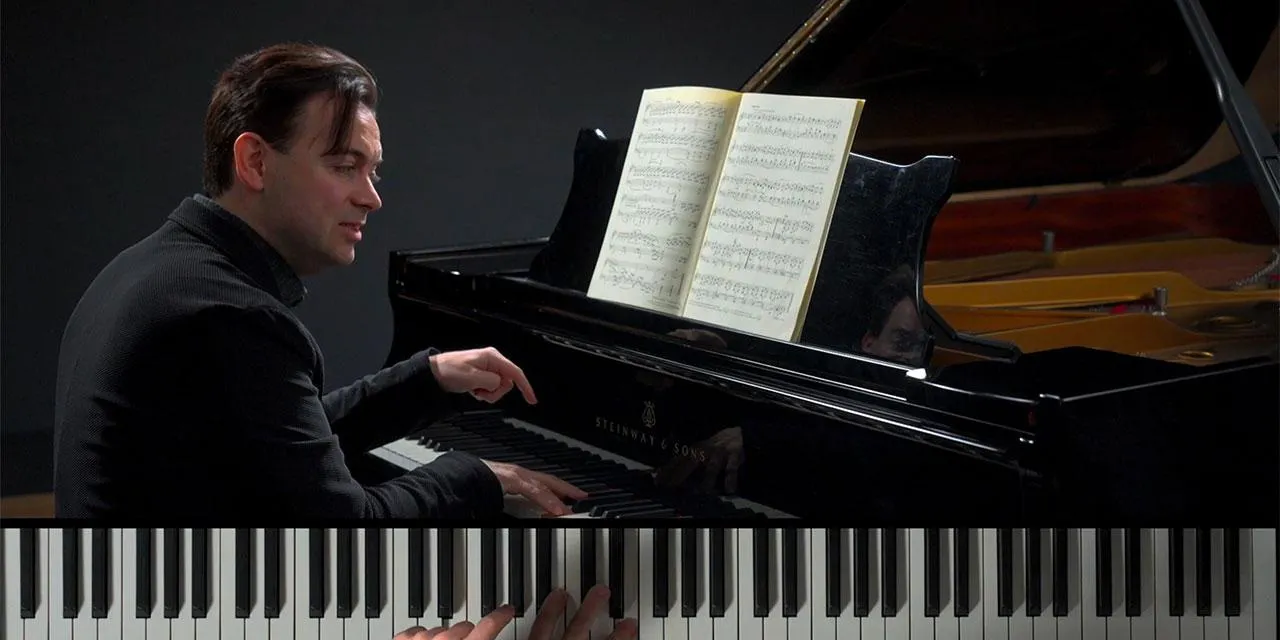
About the instructor
Las frescas interpretaciones del repertorio de Dejan Lazić lo han consolidado como uno de los solistas más singulares e inusuales de su generación. Actúa con regularidad con las principales orquestas del mundo, entre ellas las orquestas sinfónicas de Boston y Chicago, la Budapest Festival Orchestra, la Royal Concertgebouw Orchestra, la London Philharmonic, la Philharmonia Orchestra, la NDR Elbphilharmonie Orchester, así como las orquestas de cámara de Australia, Basilea y los Países Bajos, y ha establecido estrechas colaboraciones con directores como Giovanni Antonini, Iván Fischer, Michael Francis, Andris Nelsons, Ivan Repušić, Thomas Søndergård, Robert Spano, John Storgårds, Krzysztof Urbański y Jan Willem de Vriend. Dejan Lazić ha publicado numerosos CD con Channel Classics y Onyx Classics, y una grabación del Triple Concierto de Beethoven para Sony Classical. Su grabación en directo del Concierto para piano n.º 2 de Rachmaninov con la London Philharmonic Orchestra y Kirill Petrenko recibió el premio alemán "Echo Klassik". También cuenta con un gran número de seguidores en el Lejano Oriente y desarrolla una intensa actividad como recitalista y músico de cámara, participando con regularidad en importantes festivales internacionales. Las composiciones de Dejan Lazić reciben un reconocimiento cada vez mayor, y en 2015 fue fichado como compositor por el grupo editorial Sikorski Music Publishing. Su arreglo del Concierto para violín de Brahms como Concierto para piano "n.º 3" se estrenó y grabó con la Atlanta Symphony Orchestra y Robert Spano en 2009 y ha cosechado un gran éxito sostenido, en los BBC Proms, el Concertgebouw de Ámsterdam, el Festival de Pascua de Hamburgo y el Festival Chopin de Varsovia, en ambas Américas y en Japón. Su Concierto para piano en estilo istrio (Op. 18) se estrenó en el Aspen Music Festival en 2014 y desde entonces se ha interpretado por toda Europa y en Estados Unidos. Otras obras incluyen diversa música orquestal, de cámara y para piano, cadencias, así como varios arreglos de obras de Mozart, Schubert, R. Strauss, Wagner y Debussy. Dejan Lazić nació en Zagreb, Croacia, en el seno de una familia de músicos. Creció en Salzburgo, Austria, donde estudió en el Mozarteum (piano, clarinete y composición). Sus primeros encuentros con Zoltán Kocsis e Imre Rohmann en el Festival Bartók de Hungría fueron decisivos para su carrera artística, al igual que la notable influencia de Peter Eötvös. Dejan Lazić vive en Ámsterdam. En Master Moonlight Sonata by Beethoven, Dejan comparte la visión que hay detrás de esas aclamadas interpretaciones, guiándote a través de los tres movimientos de una de las obras más queridas del repertorio pianístico para que puedas moldearla con verdadera comprensión en lugar de por imitación. www.dejanlazic.com read more