



El círculo de quintas
Con
Chris HaighA primera vista, una secuencia de acordes suele parecer muy aleatoria y difícil de entender. En realidad, a menudo hay mucha lógica detrás, y una de las claves para comprenderla es el círculo de quintas
Qué incluye el curso
28 lecciones (1h 46m) · 1 gratis
Transcripción de la lección
The Circle of Fifths
In this chapter, we're going to be looking at the circle of fifths, sometimes called the cycle of fifths.
Understanding the Circle of Fifths
At first sight, a chord sequence often appears very random and difficult to make sense of. In fact, there's often a lot of logic behind it, and one of the keys to understanding this is the cycle of fifths.
- Visualizing the Cycle:
Imagine a circle like a clock face with C major at the top. The cycle proceeds anticlockwise around to the left:- C (no flats or sharps)
- F (one flat)
- B flat (two flats)
- Continue adding A flat each time until you reach G flat major (six flats).
- By some miracle of science, G flat is the same as F sharp (six sharps).
We continue around the circle, this time taking away A sharp each time through B, E, A, D, and G until we get back to C.
Key Relationships for Violinists
From a violinist's point of view, there are a couple of things to notice:
-
Easy Keys:
The easy keys C, G, D, and A are all bunched up at the top right of the circle. -
Common Flat Keys:
The common flat keys F, B flat, and E flat are bunched at the top left. These are keys you will need to be familiar with because they are favored by wind players. -
Challenging Keys:
The really hard keys are at the bottom.
Remembering Intervals
Since the violin is tuned in fifths, it's very easy to remember or quickly work out what is a fifth above or below any particular note. Simply imagine your finger playing any particular note:
- The same position as the string above is a fifth up.
- The same position as the string below is a fifth down.
Chord Progressions and the Cycle of Fifths
If we look at a 2-5-1 sequence in the key of C, the chords are:
- D minor 7
- G7
- C
Looking just at the roots of these chords, that's D, G, C. This root progression is part of the cycle of fifths, progressing anticlockwise. Because a dominant 7 chord always wants to resolve to its tonic, a fifth below, movement around the circle is almost always anticlockwise.
One of Stefan Grappelli's trademark tunes was Sweet Georgia Brown. This runs through:
- 4 bars of E7
- 4 bars of A7
- 4 bars of D7
- 4 bars of G
This is a classic cycle of fifths progression.
Exploring Different Tunes
Here's another tune using the same idea called Cycle Ride. The sequence of this tune is quite different from the ones we've used previously:
- The chords are definitely not diatonic.
- You cannot treat the sequence as if it were all in the key of G.
A G major sequence would normally have only one dominant chord, namely D7. This one has three, each one acting as a dominant to the next. Because we have four whole bars of each chord, there's plenty of time to think about what you're doing when it comes to improvising.
Improvisation Tips:
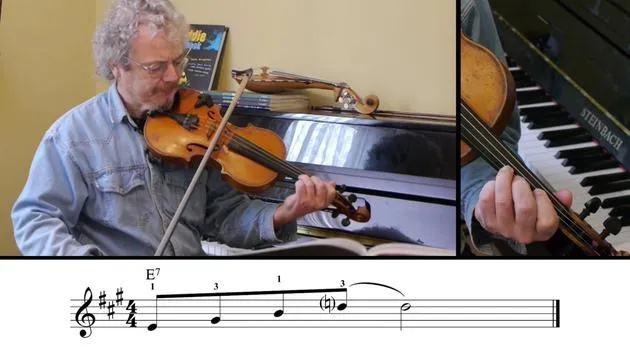
- Whatever you play over E7 will also work a fifth down on the next string down.
- Another option is to play a line and then repeat it over the next chord, changing only the few notes that the next chord requires, mostly flattening the third, which is the way the melody works in Sweet Georgia Brown.
- A third approach is simply to treat each new line as a new key, a new phrase, and a new scale.
Practicing New Licks
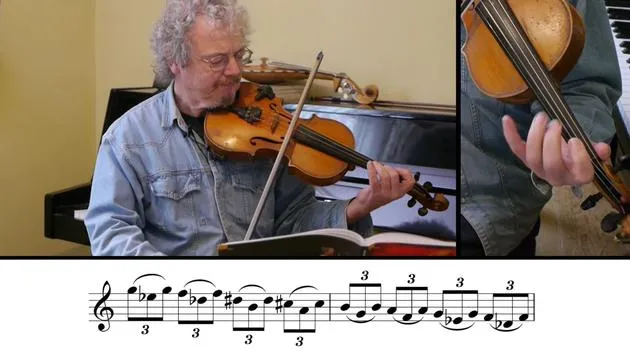
Finally, here's a very useful approach to practicing new licks. To make the most of them, you need to be able to play a lick in every key. This is much easier if you can associate the lick not with individual notes, but with patterns and relationships.
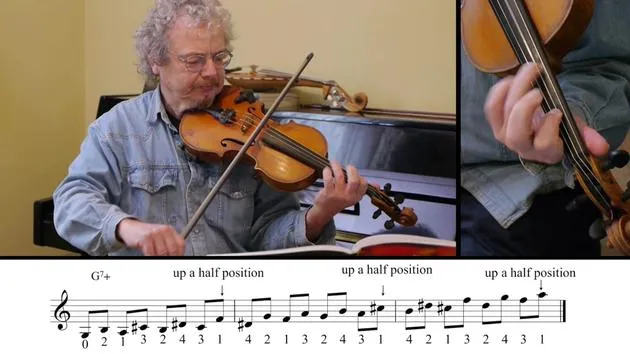
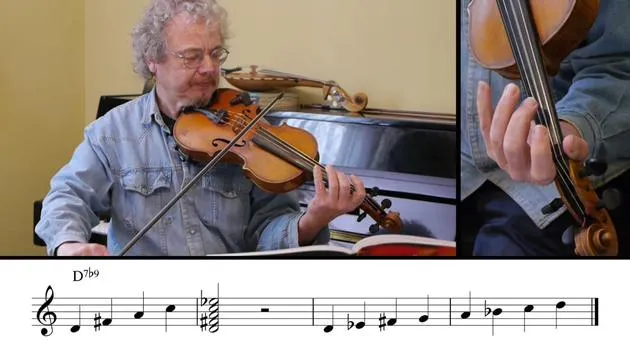
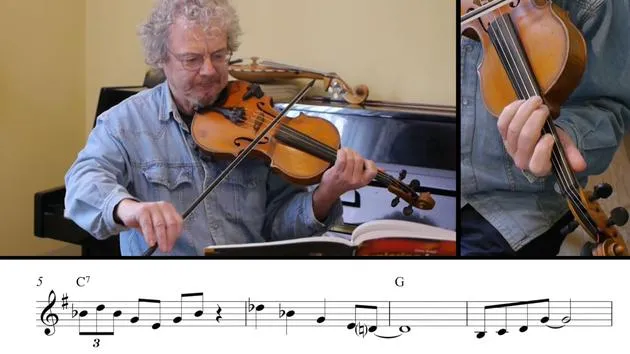
For example, here's a simple 2-5-1 lick with a fourth bar that links to the key a fifth.
Lick Practice Breakdown:
- Starting Point: It starts on the root of the two chord and goes up and down an arpeggio.
- Movement: It then drops a fifth, starts on the root of the V chord, and goes up the scale, stopping on the seventh, then dropping to the third of the root of the I chord.
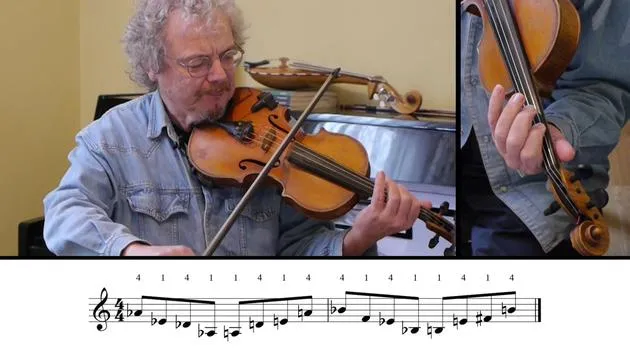
- Chromatic Scale: It then moves to the next key with the three-note chromatic scale, starting on the flattened seventh.
With these ideas in your head, it should be possible to play all the way through the cycle of fifths until you get back to where you started.
- At some point, you'll have to jump an octave in bar 4 in order to keep in a reasonable position.
You can use this chord sequence to practice this or any other 2-5-1 phrase. Use this chord sequence all the way around to continue practicing the lick. You can also use the sequence to practice improvisation.
28 lecciones
1h 46m de lecciones en vídeo estructuradas
Funciones de vídeo avanzadas
Ralentiza, repite un pasaje, sigue la partitura
Móvil, tablet y ordenador
Practica donde quieras
Garantía de satisfacción 100%
30 días de garantía de devolución
Conoce a tu gurú
Conoce a tu gurú
Chris Haigh es violinista profesional desde hace 25 años, con experiencia en muchos géneros distintos. Ha tocado en más de 75 álbumes, trabajando con artistas como Alison Moyet, Bob Geldof, All About Eve, Michael Ball, David Soul, Oumou Sangare, The Quireboys, Riverdance, Morcheeba, James Galway y Steps.
Ha tocado swing y jazz con The Kimbara Brothers, Diz Disley, Le Jazz, The Hot Club of London y los Quecumbar Allstars, y lidera una banda de swing soviético de siete integrantes, The Kremlinaires.
Chris imparte clases y talleres sobre técnica de violín de jazz y ha enseñado violín de jazz en las universidades de Middlesex, Brunel y Newcastle y en el Truro College. Entre sus créditos como autor figuran nueve libros de violín, entre ellos The Fiddle Handbook.
También dirige Fiddling Around (fiddlingaround.co.uk), probablemente la fuente de información sobre violín más completa y visitada de la red.







