



Usar escalas con acordes
Lesson time: (7min 26sec)
En esta lección veremos cómo usar la escala mayor como herramienta de improvisación y analizaremos un tipo concreto de escala – la escala bebop
Course preview
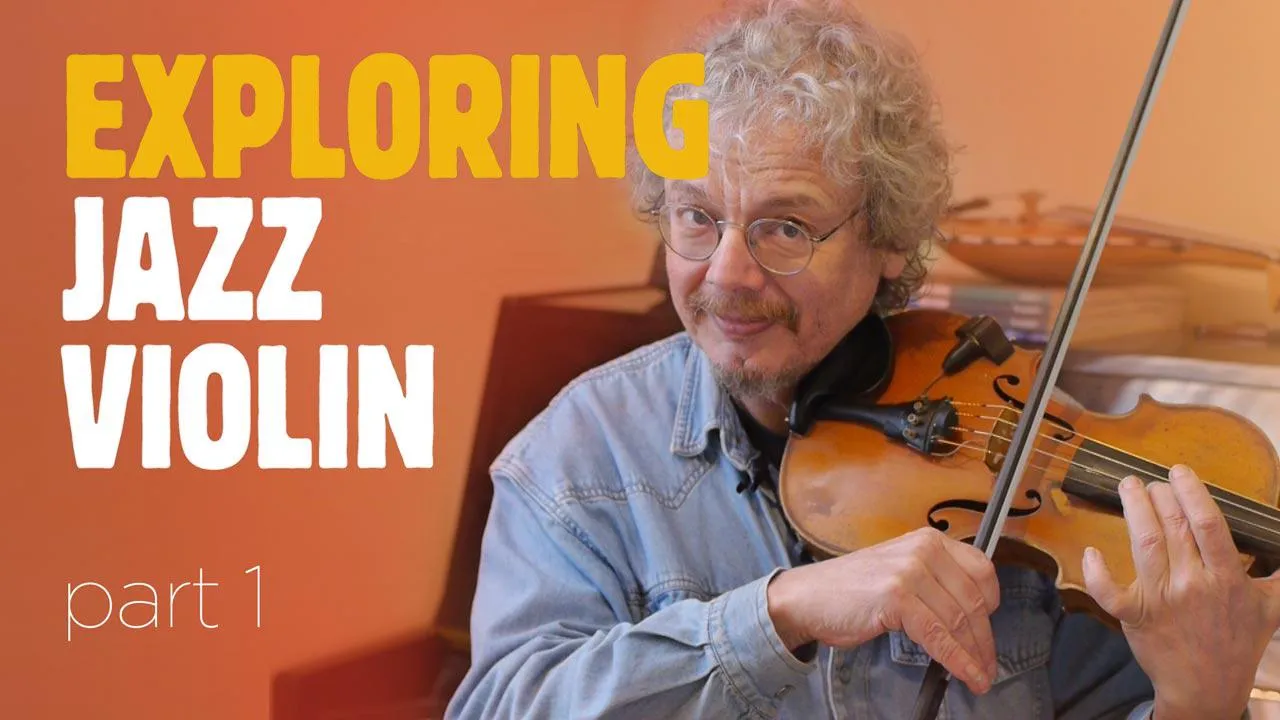
This lesson is part of the course Explorando el violín jazz, parte 1
Watch a preview of the full course below.
Lesson transcript:
Music Lesson: Exploring the Major and Bebop Scales
In the last lesson, we introduced the idea of using the major scale as the first step for improvisation. In this lesson, we will further develop that concept and explore a particular type of scale: the bebop scale.
Enhancing the Major Scale
So far, we've used the major scale fairly mechanically, without much effort to make it tasteful or musical. However, there are numerous ways you can make simple scales more useful and interesting. Here are a couple of techniques:
- Play Each Note Twice: Use chambering to create a more textured sound.
- Step Patterns: Instead of going straight up the scale, try a step pattern. For example, you could create something like this:
Now, with variations like these, you can get a great deal of mileage from the simple major scale. You should find that with a tune, as we've been doing, most of the scale fits most of the time. However, sometimes it may not sound so great.
Understanding Chords and Notes
For instance, if you look at a D minor chord, the three main notes of the chord are:
- 1: D
- 3: F
- 5: A
Now, when we play a C major scale, the notes we're emphasizing because of the swing aspect are the:
- 1: C
- 3: E
- 5: G
So, the strong notes of the C major scale are C, E, and G. Meanwhile, the weak notes are D, F, and A (the notes of the D minor chord).
Listening Exercises
Let's listen to the C major scale played over the C major chord:
Sound Example
Now, let's listen to the C played over D minor chords. Here's the D minor chord:
Sound Example
You could hear that it really wasn't fitting very well at all. The problem is that if we're placing the strong notes of one scale against the wrong chord, it isn't going to sound great. Even though all those notes fit with that scale or that chord, emphasizing the wrong ones results in a less appealing sound.
Starting Your Phrases Correctly
To make the C major scale work over varying chords:
- If you're playing on a C major scale, start your phrase on a C note.
- If you're playing on a D minor chord, start your phrase on a D note.
This placement is crucial for making the scale sound good.
Now, with this in mind, go back to the tune, come home, and try improvising again on the C major scale. Listen closely to the chords and attempt to place your phrases accordingly.
The Octave Problem and the Bebop Scale
From our previous discussions about scales, a certain problem arises. As you move from one octave to the next, you transition from placing the notes correctly to incorrectly.
When you play the G major scale, the first octave works well because the strong notes are all stressed. However, in the second octave, we start to emphasize all of the weak notes (the 2, 4, and 6), instead of the strong notes (1, 3, and 5).
Example of the Issue
You will notice that in the first octave, we're emphasizing the right notes for G. But as soon as we start the next octave, it feels as if we're playing an A minor scale despite actually playing a G. This results in emphasizing all the wrong notes.
Introducing the Bebop Scale
To address this problem, jazz musicians in the 40s developed what's known as the bebop scale.
This term doesn't imply that it can only be used in bebop music; it is useful in various contexts. The bebop scale is achieved by adding an extra chromatic note, a flattened seventh. It sounds like this:
Sound Example
With this additional note, we can ensure the two octaves work exactly the same, preventing us from starting the second octave in the wrong place.
Demonstrating the Bebop Scale
Now we're going to demonstrate this over the tune, head first. We'll play the G major scale over that tune. I'll perform it first, and then you can try it with the backing track.
Grappelli was particularly fond of using the flat ninth note at the end of a descending scale. This technique is a hallmark of the bebop scale. The purpose of this scale is partly to emphasize that flattened ninth note and to hit the last bar with a strong note.
Happy practicing!
About the instructor
Chris Haigh es violinista profesional desde hace 25 años, con experiencia en muchos géneros distintos. Ha tocado en más de 75 álbumes, trabajando con artistas como Alison Moyet, Bob Geldof, All About Eve, Michael Ball, David Soul, Oumou Sangare, The Quireboys, Riverdance, Morcheeba, James Galway y Steps. Ha tocado swing y jazz con The Kimbara Brothers, Diz Disley, Le Jazz, The Hot Club of London y los Quecumbar Allstars, y lidera una banda de swing soviético de siete integrantes, The Kremlinaires. Chris imparte clases y talleres sobre técnica de violín de jazz y ha enseñado violín de jazz en las universidades de Middlesex, Brunel y Newcastle y en el Truro College. Entre sus créditos como autor figuran nueve libros de violín, entre ellos The Fiddle Handbook. También dirige Fiddling Around (fiddlingaround.co.uk), probablemente la fuente de información sobre violín más completa y visitada de la red. read more