



Licks de Western swing
Con
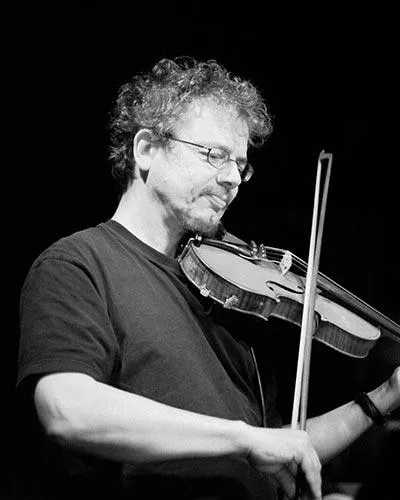
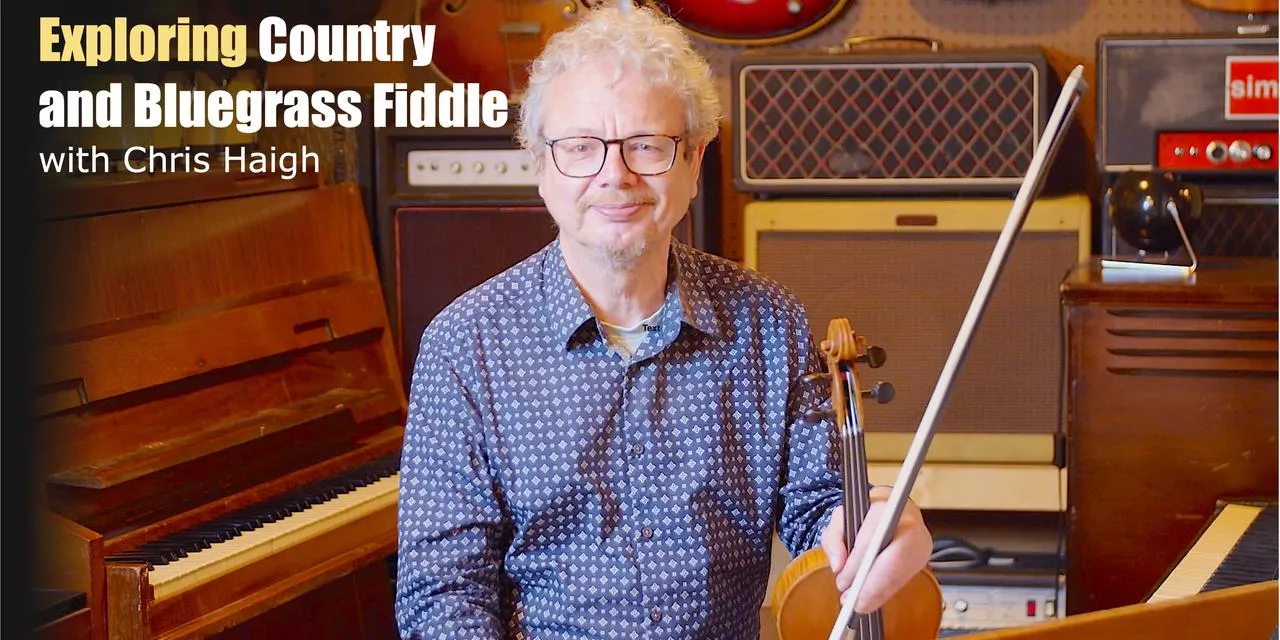
Chris HaighChris Haigh comparte licks de violín de Western swing construidos sobre sustituciones de acordes, como convertir un A7 en un Si bemol disminuido para ese mágico color swing.
Qué incluye el curso
25 lecciones (1h 30m) · 1 gratis
01. El Georgia Shuffle
5:42
02. Whiskey Before Breakfast (Interpretación)
0:44
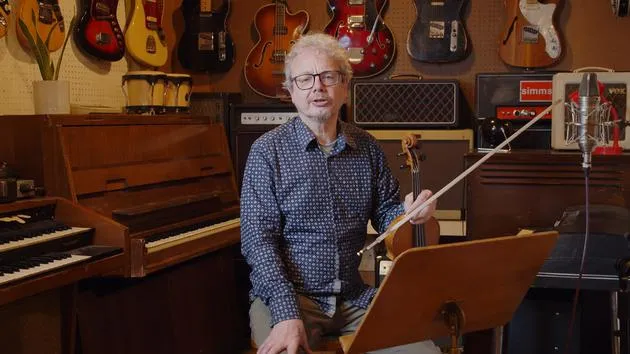
03. Dobles cuerdas en Wednesday Night Waltz
8:34
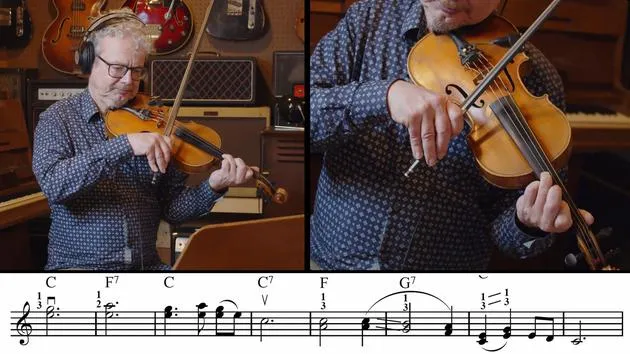
04. Wednesday Night Waltz (interpretación)
0:54
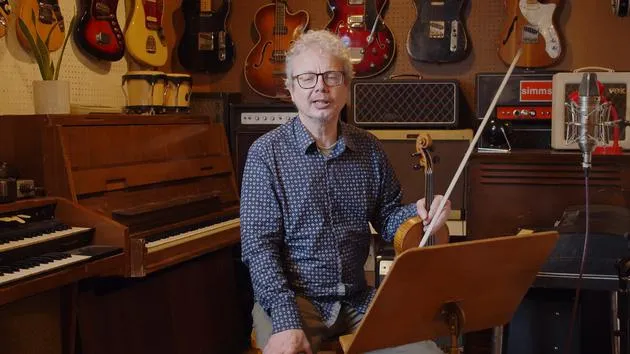
05. Más dobles cuerdas: Cheatem County Breakdown
4:06
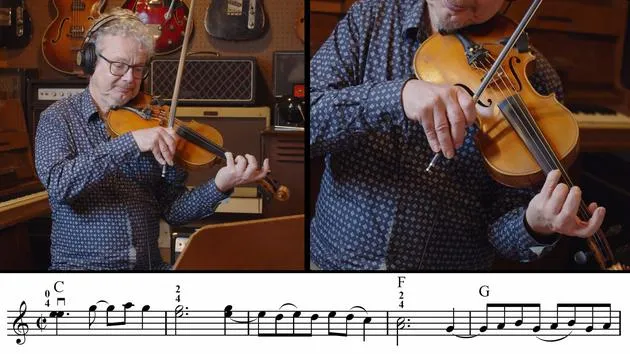
06. Cheatem County Breakdown (Interpretación)
0:44
07. Vaqueros cantantes: Yellow Rose of Texas
5:34
08. Yellow Rose of Texas (Interpretación)
0:22
01. Western swing: Beaumont Rag
9:50
02. Beaumont Rag (interpretación)
1:12
03. Bob Wills - Red River Valley
5:25
04. Red River Valley (Interpretación)
0:33
05. Violín a dos voces: escala, Goodbye Liza Jane
3:35
06. Improvisación de Western Swing
5:06
07. Goodbye Liza Jane (interpretación en solo)
1:17
08. Licks de Western swing
Estás aquí9:19
09. Girl I Left Behind Me (análisis del solo)
2:33
10. Girl I Left Behind Me (interpretación en solitario)
0:28
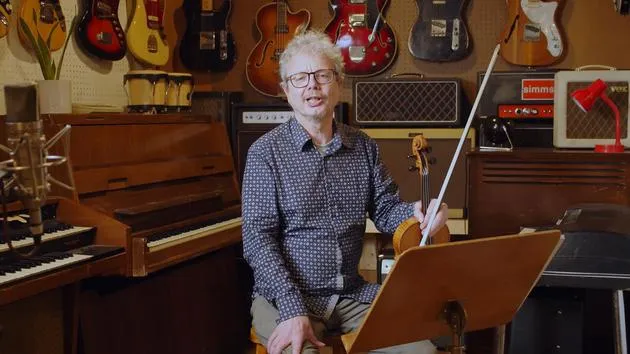
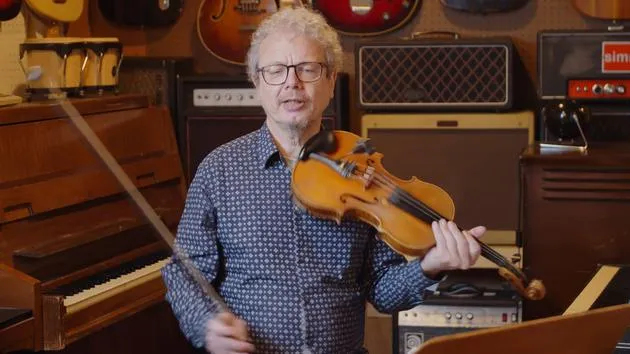
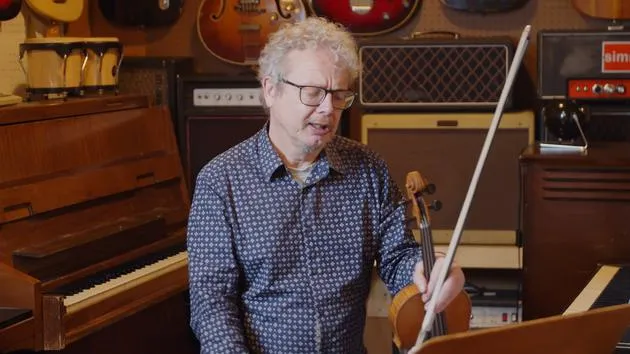
Transcripción de la lección
Western Swing Licks Lesson
Hi. In this lesson, we're going to look at some more Western swing licks. A lot of these involve chord substitutions, which is something I'm not going to explain in this lesson. You don't necessarily have to understand it to be able to do it. However, if you are fascinated by augmented and diminished substitutions, my book, Exploring Jazz Violin, will explain some of this. We also have the Music Gurus series based on that course.
The Excitement of Western Swing Licks
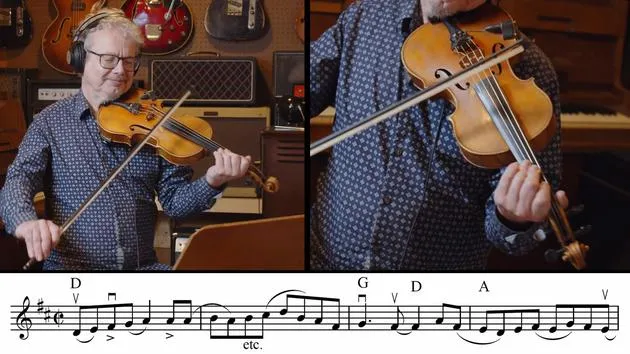
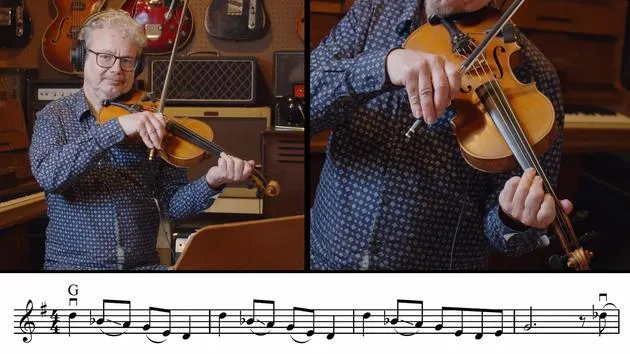
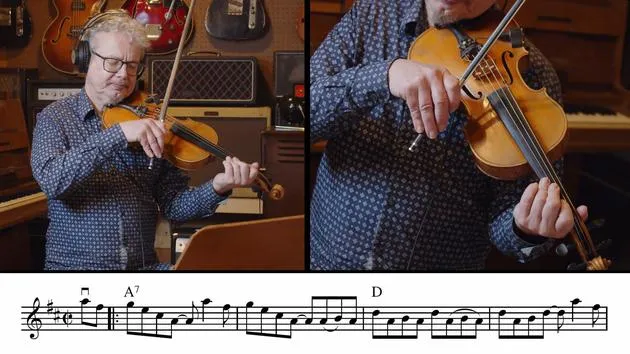
The excitement of Western swing licks often comes from these strange substitutions, where one chord magically turns into another. Let me give you an example:
- An A7 chord going to a D is a very straightforward phrase following those chords.
- If you turn the A into a B flat diminished chord, it fits over the chord but achieves that strange and magical effect.
Example of Diminished Substitution
Let me show you how I did that:
- First finger: B flat
- Second finger: C sharp
- Fourth finger: B flat
That's something you would never come up with yourself if you hadn't thought about it and prepared it in advance. It's a really effective thing to do.
If the accompanist is playing a 7D, you don't have to tell them that you're going to do that because the substitution is when two chords do the same job but are slightly different. That's a diminished substitution.
Augmented Substitution Example
Now, let's look at an augmented substitution. Here's an example of an A augmented chord.
- We've got a sharpened fifth, which you can achieve with your second finger.
- This is quite unnatural and something that, again, you have to prepare in advance.
This will fit over an A7 and work very effectively at the end of a line.
- If you play something like this, it punctuates the end of the line and adds excitement and surprise.
- I'll do that again.
You may recognize that from some Western swing themes you've heard before.
Challenging Lick from Johnny Gimble
Let's look at a challenging lick that comes from Johnny Gimble, one of the most advanced soloists in Western swing. I'll first show you what it sounds like and then explain how to do it.
Starting with the F sharp
We're going to start off with an F sharp:
- Start with F sharp, bring the first finger up next to it (two and one next to one another).
- Then do four and three on the same two strings, which are two tones away from one another.
Before you go any further, get that right and keep your first and second tones.
Moving Up the Neck
Now, we're going to move up:
- One half-step and up one string.
- Now your first finger is playing an F sharp, and your second finger is doing a D.
Then, the same thing that the third and fourth fingers did before is going to happen again.
- Move up one string and one half-step, and we're going to do a triplet on the upper strings: 1, 2, 3, 4.
This lick looks pretty impossible when you see it written down. When you hear it, it seems impossible, and when you actually try it, it's almost impossible. But it's possible!
There's something about the two fingers touching the strings in this way that feels almost hallucinatory. When you hear that lick, it is a total surprise.
Another Challenging Lick
Here's another one similar, which looks even worse on the page.
- This one starts with an open E, open A, and then your first finger on the F natural and the second finger on a C natural.
- Slide the first and second finger up the same distance, one semitone.
We're just repeating this three pairs of notes: 1, 2, 3, 4. It sounds flashy and looks almost impossible, but this lick, used by Joe Venuti, the pioneering 20s jazz fiddler, is relatively easy.
Emphasizing the Sixth Note
Now for an E6 lick:
- Start with the second finger playing C sharp and the third finger below it playing a G sharp.
- Slide that down and up, then alternate it with an open string.
When you first hear it, it sounds impossible. But when you actually know how to do it, it's surprisingly easy.
General Principles of Double Stops
Next, we explore a general principle for finding a double stop:
- Slide it down, slide it up, then bring the whole thing up a third into third position.
- This works in many different places.
Yodeling in Western Swing
The final lick is a yodel. Yodeling, a feature of Western swing singing, works really well on the fiddle:
- It usually involves crossing strings and a downward motion.
There are many different yodels out there, but that's a good one to learn.
Assignment
Your assignment is to learn all of these licks. If you include the Johnny Gimble lick, this will probably take you about six months. If you find that one impossible, leave it for now and just learn the other ones, which are relatively easy.
See if you can play these licks not just in this key but in different keys as well!
25 lecciones
1h 30m de lecciones en vídeo estructuradas
Funciones de vídeo avanzadas
Ralentiza, repite un pasaje, sigue la partitura
Móvil, tablet y ordenador
Practica donde quieras
Garantía de satisfacción 100%
30 días de garantía de devolución
Conoce a tu gurú
Conoce a tu gurú
Chris Haigh es violinista profesional desde hace 25 años, con experiencia en muchos géneros distintos. Ha tocado en más de 75 álbumes, trabajando con artistas como Alison Moyet, Bob Geldof, All About Eve, Michael Ball, David Soul, Oumou Sangare, The Quireboys, Riverdance, Morcheeba, James Galway y Steps.
Ha tocado swing y jazz con The Kimbara Brothers, Diz Disley, Le Jazz, The Hot Club of London y los Quecumbar Allstars, y lidera una banda de swing soviético de siete integrantes, The Kremlinaires.
Chris imparte clases y talleres sobre técnica de violín de jazz y ha enseñado violín de jazz en las universidades de Middlesex, Brunel y Newcastle y en el Truro College. Entre sus créditos como autor figuran nueve libros de violín, entre ellos The Fiddle Handbook.
También dirige Fiddling Around (fiddlingaround.co.uk), probablemente la fuente de información sobre violín más completa y visitada de la red.







