



Make You Feel My Love (análisis).

Lesson time: (12min 33sec)
Es hora de poner en práctica lo que hemos aprendido hasta ahora con la versión de Adele de la canción, 'Make You Feel My Love'. Juliet nos explica las partes más difíciles de la pieza y cómo abordarlas.
Course preview
This lesson is part of the course Habilidades esenciales para cantantes
Watch a preview of the full course below.
Lesson transcript:
Welcome to Your First Singing Challenge
Hello, female singers, and welcome to your first singing challenge. Today, we'll explore Adele's version of "To Make You Feel My Love." This song, originally written by Bob Dylan, has many different renditions. As you listen to these versions, take note of the subtle differences in interpretation.
The Song's Structure
Octave and Semitone
This song covers an octave and a semitone. Here's a quick breakdown:
- Octave: From one note to the same note in a higher register.
- Semitone: The additional note in the phrase, e.g., "your face."
Introduction to Cara
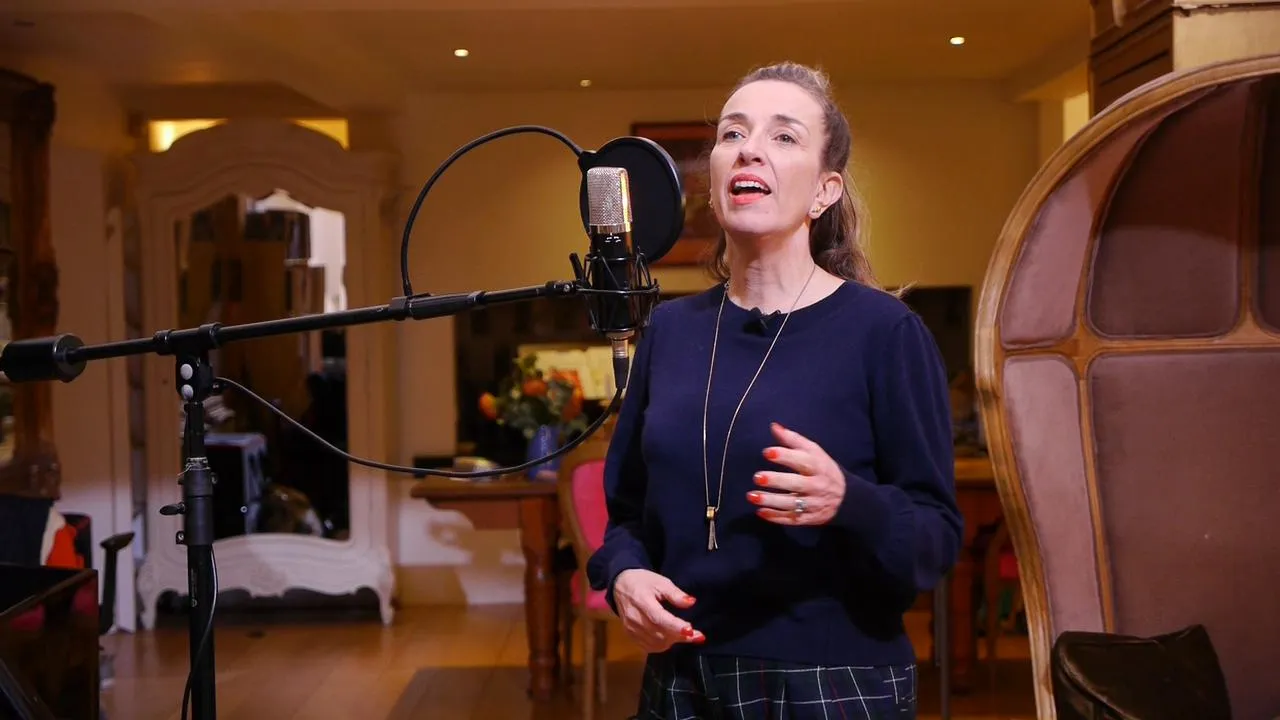
I'm very happy to welcome wonderful singer Cara. Thank you for being here with us! We're going to run through a couple of tricky points with the song.
Singing the First Line
Practice with Cara
Cara, can we sing the first line together?
Count: 2, 3, 4, 1.
"When the rain is blowing in your face."
Beautiful!
Key Points to Consider
- Watch the Low Note: The first low note might tend to drop; ensure it remains connected.
- Connection with the Emotion: Think about the emotional journey. Notice the narrative change in the song:
- "When the rain is blowing in your face, the whole world is on your case, then I could offer you a warm embrace to make you feel my love."
Emotional Interpretation
Experiment with Emotion
Let's experiment with the emotional delivery of the first lines.
Count: 2, 3, 4, 1.
"When the rain is blowing in your face, and the whole world is on your case..."
Observations
- Cara added warmth when she sang "Warm Embrace." What techniques did you use to convey that warmth?
- "I think it was a lot softer on the approach."
Transitioning Between Verses
Chorus and Verse Connection
One technical challenge of this song is moving from the end of the second verse into the chorus, particularly the octave jump.
Practice Line:
"To make you feel my love."
Count: 2, 3, 4.
"I know you haven't made your mind up yet, but I will never do you wrong."
Smooth Transitions
- Negotiating the Leap: Notice the leap in your voice when transitioning.
- Confidence: Having confidence in your leap is crucial.
Warm-up Techniques
- Use sirens to explore your voice's range.
Glottal Onset
Be cautious of glottal onset, which happens when there's too much air pressure coming through closed vocal folds.
Practice:
Count: 2, 3, 4, 1.
"I know you haven't made your mind up yet, but I will never do you wrong."
Timing and Phrasing
Importance of Timing
- Initial Entry: We start after 1, counting as "3, 4, 1."
- Later Entry: In the line, "I could make you happy," we start on 4.
Phrasing Techniques
Verbalize how long each phrase lasts to embody the song:
-
Visualize Length:
- "I'd go hungry, I'd go black and blue, breathe..."
-
Integrate Movement:
- Use your body to connect with the lengths of phrases, facilitating breath management.
Concluding the Song
Holding the Last Note
The ending requires strong breath support to prolong the final note:
"To make you feel my love."
Studying Lyrics
- Lyric Comprehension: Get to grips with the lyrics, emphasize key parts, and connect with the emotional journey of the song.
Final Tips
Octave Practice
- Warm-up: Use sliding exercises and sirens to practice octave jumps.
- Avoid Harshness: For the initial chorus entry, ensure you don't have too much breath behind the sound.
Keep It Smooth
- Energy Level: Keep your singing energy up without effort; avoid pushing or shouting.
Remember, singing should never be too effortful. Maintain a nice energy flow without strain!
About the instructor
Juliet Russell es cantante, compositora, coach vocal y directora de coros. Le apasiona ayudar a personas y comunidades a desarrollar su voz y su creatividad. Coach vocal en The Voice y The Voice Kids de ITV y en Michael McIntyre’s Big Show de la BBC, Juliet también ha trabajado con artistas galardonados con premios Grammy, Brit, MTV Europe y MOBO. Ha colaborado y actuado con artistas innovadores como Damon Albarn, Imogen Heap, Paloma Faith, alt-J, Yoko Ono, Seal y Ringo Starr. En 2015, con el apoyo del Arts Council of England, llevó de gira su álbum Earth Meets Sky, con músicos locales y coros comunitarios para crear diez actuaciones únicas por todo el Reino Unido. Recibe con regularidad encargos para crear nuevas piezas corales y arreglos vocales, y ha actuado a nivel nacional e internacional. Comprometida con el desarrollo de artistas, Juliet ejerce de mentora y coach de artistas emergentes, trabajando con empresas de management, discográficas y editoriales, así como con artistas independientes. Tiene un estudio vocal en pleno corazón de la vibrante Brick Lane de Londres. Juliet fue directora artística fundadora de Sense of Sound y directora creativa de Sing Up Greenwich y de Sing Late en el V&A. Dirige el Portobello Live Choir, un coro comunitario del oeste de Londres, y el coro profesional Assemble, y es formadora del programa Singing for Lung Health de la British Lung Foundation. read more