



Das Multivitamin
Lesson time: (17min 42sec)
Ein Glissando-Warm-up für einen starken, schnellen Luftstrom und eine vordere Zungenposition beim Absteigen, das zu Gerards Allround-Trompetenübung "Multivitamin" führt.
Course preview
This lesson is part of the course Der innere Zugang zum Trompetenspiel
Watch a preview of the full course below.
Lesson transcript:
Lesson: The Multivitamin Exercise
This next lesson is my exercise entitled The Multivitamin, and you'll find out why in a moment.
Preparing for the Multivitamin
Before we dive into the Multivitamin, we need to do a glissando exercise. As you may have noticed from previous lessons, this exercise doesn't sound great, but it is essential for focusing on:
- A strong air stream
- A fast air stream
- A central tongue position further forward as you descend
The Glissando Exercise
Exercise Overview:
- This exercise is like a flexibility exercise.
Procedure:
- Anytime you ascend, perform the airspeed warm-up (as in lesson one).
- When descending, get to the top note (e.g., C to G):
- Speed up your air massively.
- Slowly glissando downwards.
Note: This will not sound nice, but it's a necessary part of the process. We are trying to break the laws of physics with the trumpet, playing across those breaks and glissando slowly.
It's okay if it sounds horrible, it has to! Focus on:
- Fast air
- Tongue very far forward
- Slowly crossing the harmonics
I'll demonstrate it one more time. If you accidentally jump down, that's fine; it's a part of development.
Transition to the Multivitamin
Now, let's move into The Multivitamin. This exercise combines the airspeed warm-up without the glissando while descending.
The Exercise Steps
- Get to the top of the little arpeggio exercise.
- When you reach the C, imagine a stereo dial turning up the volume quickly, this represents speeding up your air.
- Descend a little slower than how you ascended, playing it loudly.
Example Pattern:
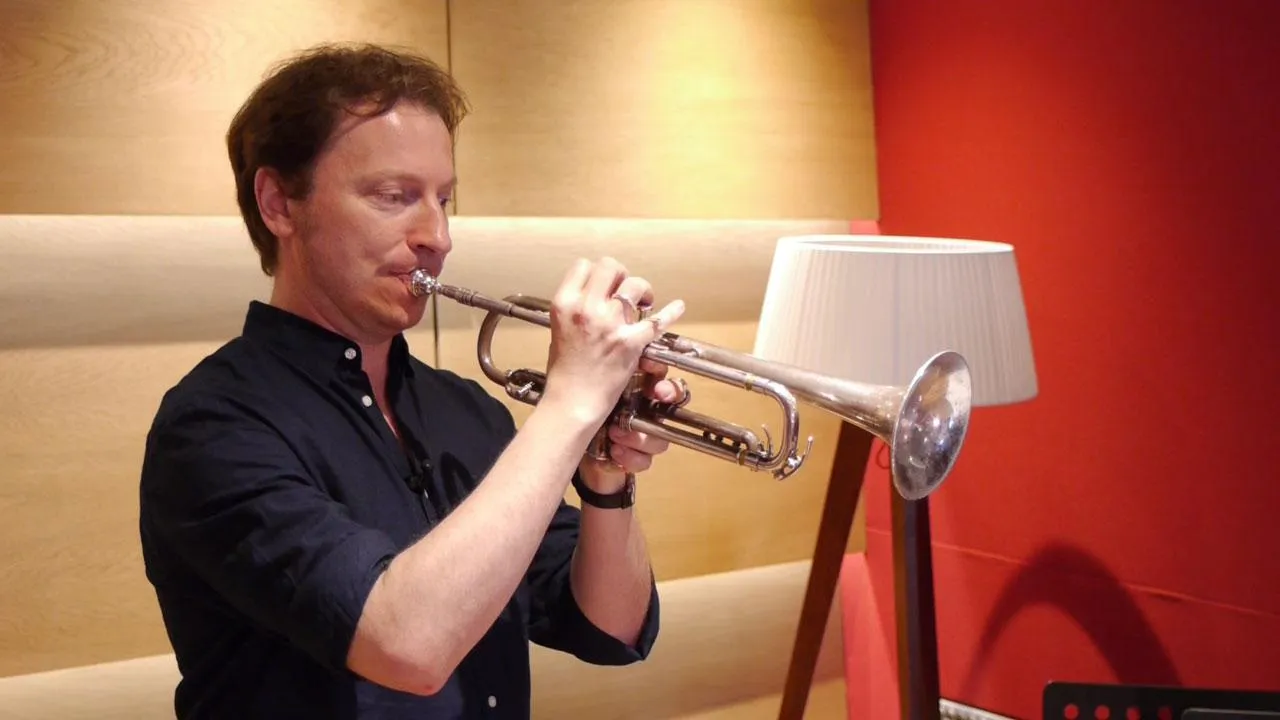
- If I play C, G, C, G, C, it would sound like this. You can see the movement in my face.
The aim is to develop a blowing technique where you maintain a steady air stream without shifting your embouchure significantly in the lower register.
Adding Staccato
After playing the exercise twice, we will take the same notes and play them as very short staccato.
Rules for Staccato:
- Staccato should be shorter than you think.
- Say it like: da da da da da da da da da.
If you see eighth notes written as staccato, play them like 16th notes:
- Instead of da da da da da da da, go with da da, da da da da da da da da.
Demonstrating the Exercise
Now, I will demonstrate the exercise to you.
Note: Simply descend in half steps.
Concluding the Exercise
Once you've reached the bottom of the trumpet, ideally:
- Because of the 1, 2, 3 placement, your aperture (the hole) has not opened as much as it might normally.
- You may need more air as you descend lower.
Breathing Technique:
- When taking a breath, don't play from where you left off; go back a bit.
- Take your breath as if you were smelling something pleasant: breathe in slowly and play.
This process helps keep you relaxed.
Focus on Staccato
When starting with staccato or short staccato:
- Look at the top center of your bell.
- Keep your air flowing.
Demonstrating Focus:
- When I look at my bell, the difference is considerable. More focus means less movement, leading to a steadier air stream with very short tonguing.
Stages of the Conclusion
Stage 1
At the end, after reaching F sharp:
- Go from off to off and take your time.
- Remember to turn the dial up quickly to reach the top note.
Stage 2: Staccato Alone
Now, let's go up and down with the pattern using only staccato.
Articulation Practice:
- Put the trumpet near your face and articulate without pitch.
Example:
- Say it quickly da da da da da da.
This transition helps in creating a smoother relation between saying and playing, speeding up your single tonguing.
Stage 3: Legato Version
The final stage:
- A legato version incorporating everything we've done but with less movement.
- Maintain a steady airflow and slightly crescendo on descent for safety.
Remember, the goal is to:
- Reduce the movement at the five to one transition.
Good luck!
About the instructor
In den vergangenen 25 Jahren hat sich Gerard Presencer einen beachtlichen Ruf als einer der angesehensten Trompeter der europäischen Szene erarbeitet. Mit 18 Jahren gelang ihm der Durchbruch auf der internationalen Bühne, als US3 ihn bat, den Solopart auf Blue Notes Cantaloupe Island (neu interpretiert als Cantaloop Flip-Fantasia) zu spielen, das zu einer der meistverkauften Jazzplatten der 1990er-Jahre wurde. Seither ist er mit einem Who's who internationaler Jazzkünstler aufgetreten und fordert sich und sein Instrument weiterhin heraus, indem er seine Komfortzone verlässt, um sich als Spieler und Autor weiterzuentwickeln. In anderen Genres hat Gerard als Studiomusiker mit Künstlern wie Sting, Jamiroquai, Zero 7, James Brown, Ray Charles, Joni Mitchell und Jonny Greenwood aufgenommen. Gerard war zudem in den letzten 25 Jahren ein unverzichtbares Mitglied der verschiedenen Jazzformationen von Charlie Watts, tourte um die Welt und veröffentlichte mehrere Alben mit dem jazzbegeisterten Stone. Als Pädagoge leitete Gerard von 1999 bis 2010 die Jazzabteilung an der Royal Academy of Music in London und ist derzeit Leiter der Blechbläserabteilung am Jazz Institut in Berlin. In diesem Kurs teilt er seinen inneren Ansatz zum Trompetenspiel - die mentalen und körperlichen Gewohnheiten hinter einem großartigen Klang -, damit du Ton, Kontrolle und Musikalität von innen heraus entwickeln kannst. read more