



Der Septakkord
Lesson time: (3min 43sec)
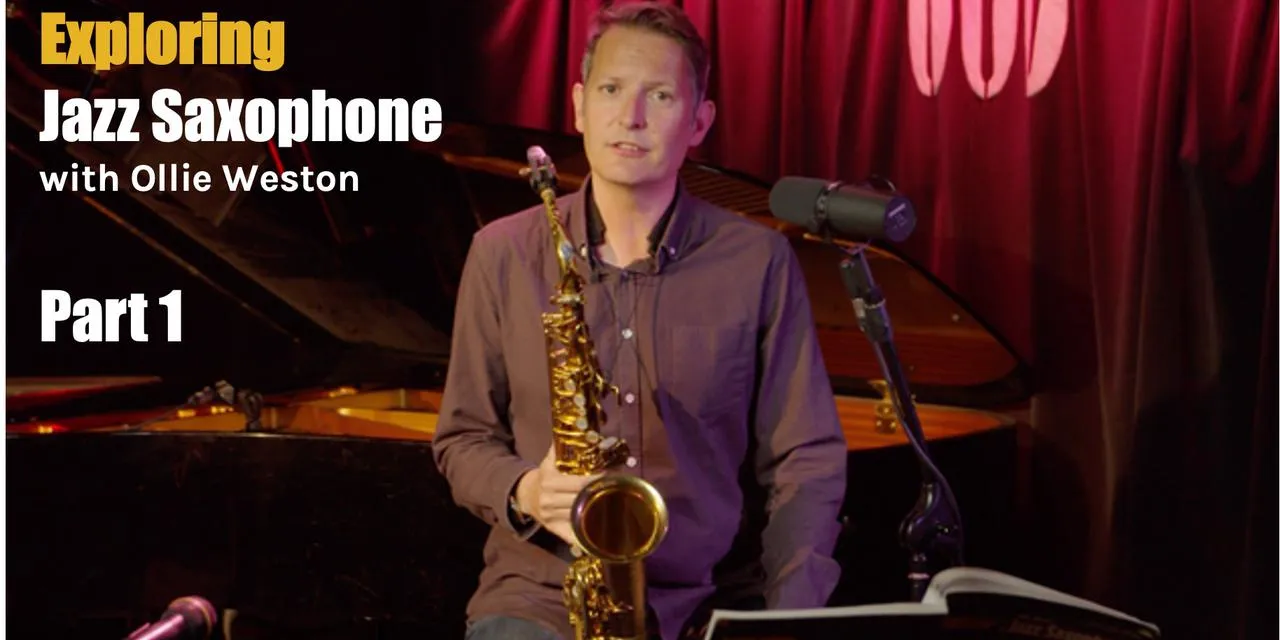
Ollie Weston zerlegt den Dominantseptakkord, wie seine große Terz und kleine Septime diesen bluesigen Tritonus-Klang erzeugen, und die mixolydische Tonleiter, die darüber passt.
Course preview
This lesson is part of the course Exploring Jazz Saxophone: Teil 1 - Erste Schritte
Watch a preview of the full course below.
Lesson transcript:
Introduction to the Seventh Chord
In this lesson, I'm going to introduce the seventh chord.
Understanding the Seventh Chord
This is neither a major seventh nor a minor seventh; it is simply called a seventh chord. It is interesting because it has:
- The major third of a major chord
- A flattened seventh of a minor chord
Example in G
Let's take the key of G as an example:
- Root: G
- Third: B
- Fifth: D
- Seventh: F natural (rather than F sharp)
So, when I play this chord on the piano, it will sound like this:
It has quite a bluesy sound. The flattened seventh contributes to our blues sound.
Connection to Classical Music
If you've ever played a dominant seventh in classical music, it's the same chord as this. The interest in the chord comes from the relationship between:
- Major third
- Flattened seventh
This interval, known as a tritone, has a fascinating history. It was once referred to as diabolos in musica, an Italian term meaning "the devil in music," due to its unsettled sound. However, for our purposes in blues and jazz, it creates a fantastic sound.
Linking Chord Tones
In the same way that we've done for minor and major seventh chords, I am going to link my chord tones (root, third, fifth, and seventh) with relevant passing notes.
This leads us to a scale that perfectly fits a G7 chord. This scale is a type of mixolydian mode.
Modes Covered
So far, we have covered:
- Mixolydian Mode
- Dorian Mode
Practice Track for Seventh Chords
Just like with the minor seventh and major seventh chords, I've created a workout track for seventh chords. These are organized in the same way, going up in minor thirds:
- G7
- B flat 7
- C sharp 7
- E7
Playing the Scale
I'm going to play my Mixolydian scale and my G7 chord tones over the track:
1, 2, 1, 2, 3, 4.
And again, the tracks go through 12 keys.
Practice Time Overview
We'll need to consider our familiar 12 key dilemma regarding how to effectively divide our practice time and commitment.
About the instructor
Seit seinem Abschluss am Leeds College of Music (BA Hons) und an der Guildhall School of Music (Post Graduate Diploma in Performance) hat Ollie eine rege und vielseitige Karriere in der Musik aufgebaut. Als Saxofonist ist er live und im Studio mit so unterschiedlichen Künstlern wie Amy Winehouse, Tim Minchin, Bonobo, Frank Turner, dem London Jazz Orchestra, der Hackney Colliery Band, dem Ambient Jazz Ensemble und dem Nelson Riddle Orchestra aufgetreten. Er ist zudem Co-Leader des Jazzquartetts 'Time Is Of The Essence' und komponiert und arrangiert Material für dieses und andere Ensembles. Ollie ist in der Musikpädagogik aktiv, derzeit als Studiengangsleiter der Jazzabteilung an der Guildhall School of Music and Drama (Junior School), wo er Jazzensembles, Big Band und Theorieklassen leitet. Er hat für Schott Music eine Reihe von 'Exploring Jazz'-Büchern geschrieben, die weltweit veröffentlicht werden und in britischen Prüfungslehrplänen enthalten sind. Ollie hat außerdem Workshops für die Oxford University, Pro Corda Strings und BABSWE sowie für die Sommerschulen der Guildhall School of Music geleitet. In seinen Exploring-Jazz-Saxophone-Kursen führt dich Ollie von den ersten Schritten bis hin zum selbstbewussten Improvisieren über Songs und Akkordfolgen und baut dabei die Improvisationsfähigkeiten auf, die dir das Vokabular eines echten Jazzmusikers in die Finger legen. read more