



Terzen und Septimen

Lesson time: (3min 48sec)
Ollie Weston zeigt, wie das Anspielen von Terz und Septime jedes Akkords - der Tritonus im Herzen eines Septakkords - Farbe hinzufügt, während er einen 12-taktigen Blues spielt.
Course preview
This lesson is part of the course Exploring Jazz Saxophone: Teil 1 - Erste Schritte
Watch a preview of the full course below.
Lesson transcript:
Exploring Thirds and Sevenths in Music
So the first thing to try is to explore the third and the seventh. The root and the fifth are also really useful as chord tones, as discussed.
But the real character and detail within a seventh chord is created between the third and the seventh, this tritone, this "devil in music" that I talked about.
12-Bar Blues Example
I'm going to play through a 12-bar blues, focusing on the thirds and the sevenths so you can hear them in context and see how they react to the chords on the piano and the root notes on the double bass.
Count-In:
1, 2, 1, 2, 3, 4.
Finding those thirds and sevenths adds more detail and movement within a 12-bar blues than just playing the blues scale. Eventually, you'll want to mix your blues scale with the more detailed voicing of these seventh chords.
Noticing Small Movements
What I like to do is notice the small movements between the chords. For instance, if I take the third of D7, my F sharp, and when the chord changes to G7, there's an F natural present, it's the seventh of G.
This creates a little semitone movement that I can use to capture the detail of the chord without having to make massive jumps on my instrument.
Demonstration
I'm just going to play you a chorus where I move between the thirds and sevenths of D7 and G7, focusing on the third of the D7 chord and the seventh of the G7 chord. By moving that semitone, I'm able to capture the detail of the chord.
Count-In:
1, 2, 1, 2, 3, 4.
Now, if I reverse that and, instead of starting on the third, I start on the seventh, I can do exactly the same thing. My sevenths and thirds swap through the sequence of the blues.
Here it is, starting on A C this time and moving between C and B.
Count-In:
1, 2, 1, 2, 3, 4.
Conclusion
On their own, these aren't necessarily strong melodies, but they're really useful exercises to practice hearing the inner workings of a chord sequence. Now that we are following a sequence and changing chords, it's really useful to know these guide tones.
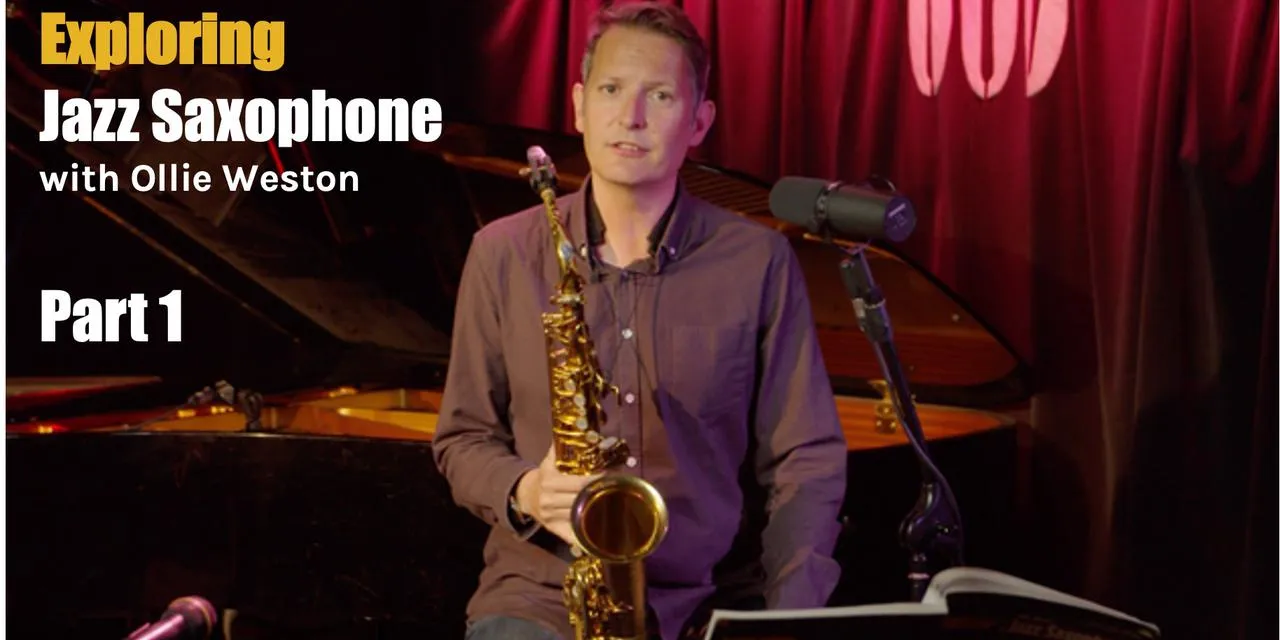
About the instructor
Seit seinem Abschluss am Leeds College of Music (BA Hons) und an der Guildhall School of Music (Post Graduate Diploma in Performance) hat Ollie eine rege und vielseitige Karriere in der Musik aufgebaut. Als Saxofonist ist er live und im Studio mit so unterschiedlichen Künstlern wie Amy Winehouse, Tim Minchin, Bonobo, Frank Turner, dem London Jazz Orchestra, der Hackney Colliery Band, dem Ambient Jazz Ensemble und dem Nelson Riddle Orchestra aufgetreten. Er ist zudem Co-Leader des Jazzquartetts 'Time Is Of The Essence' und komponiert und arrangiert Material für dieses und andere Ensembles. Ollie ist in der Musikpädagogik aktiv, derzeit als Studiengangsleiter der Jazzabteilung an der Guildhall School of Music and Drama (Junior School), wo er Jazzensembles, Big Band und Theorieklassen leitet. Er hat für Schott Music eine Reihe von 'Exploring Jazz'-Büchern geschrieben, die weltweit veröffentlicht werden und in britischen Prüfungslehrplänen enthalten sind. Ollie hat außerdem Workshops für die Oxford University, Pro Corda Strings und BABSWE sowie für die Sommerschulen der Guildhall School of Music geleitet. In seinen Exploring-Jazz-Saxophone-Kursen führt dich Ollie von den ersten Schritten bis hin zum selbstbewussten Improvisieren über Songs und Akkordfolgen und baut dabei die Improvisationsfähigkeiten auf, die dir das Vokabular eines echten Jazzmusikers in die Finger legen. read more