



Warm to exercise five: Drifting the bow
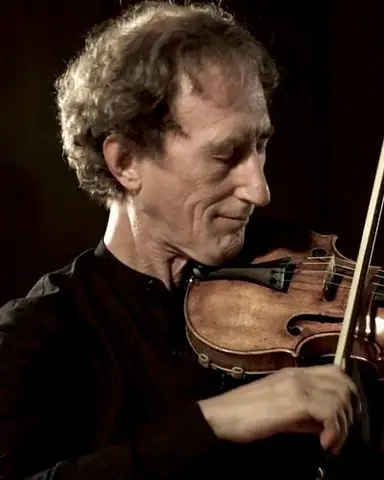
Lesson time: (14min 11sec)
A warm-up for Exercise 5: drift the bow between bridge and fingerboard to feel one bow angle at a time before combining them.
Course preview
This lesson is part of the course The Secrets of Tone Production Part 4: Final Fundamental Tone Exercises
Watch a preview of the full course below.
Lesson transcript:
Preparatory Exercise Breakdown
This preparatory exercise breaks Exercise 5 down so that you can explore the feel of one angle of the bow at a time.
You can use it as:
- An additional exercise in its own right
- A warm-up for Exercise 5
Exercise Instructions
What you do is this:
-
Place the bow on the string at the point and angle the bow inwards rather extremely.
-
Begin at sound point five:
- Slowly push the bow up-bow a few centimeters.
- Let the bow drift naturally to the bridge.
-
Arriving at the bridge:
- Do not change the angle as we do in Exercise 5 itself.
- Simply move the bow the other way and allow it to drift back towards the fingerboard.
-
Variations:
- You can also, of course, do it at the middle or lower in the bow.
- Repeat using longer and longer strokes in all parts of the bow.
-
Angle the bow outwards:
- Perform the exercise in reverse.
- So now you do deep out.
Focusing on Feel
Now, try this very nice feeling:
- Angle the bow this way.
- If you just turn your violin, keep the bow at this angle to the bridge.
On the down-bow, it will automatically go to the fingerboard.
- Keep the angle consistent
- Go right to the fingerboard:
- Heavy and light
- Heavy and light
If you turn the bow the other way on the down-bow:
- Let's do it in the upper half.
- On the down-bow, it takes you to the bridge.
Understanding Sound
Now, what caused that sound?
- Too much pressure?
No, it's not too much pressure.
- This is what everybody says:
- Everyone scratches when they play nearer the bridge.
- Ask them what caused that, and they always say "too much pressure."
- Nearly every time, they're wrong.
Listen to what too much pressure would sound like.
- No way are you doing too much pressure.
- It's not enough.
Harmonics and Weight
All these high, silvery, harmonic sounds mean not enough weight or too fast a bow. But it's the low-frequency tearing sounds that signify too much weight:
- So just do this:
- Heavy and slow.
- Away.
Brilliant. Excellent.
- Heavy and slow.
- Careful: I could see you going too fast.
- Slow down into the bridge.
It was almost fantastic, but we want total purity of sound.
Cause and Effect
Everything in life is about cause and effect:
- For every effect that we experience, there's always a specific cause.
- If you carry on making the same cause, you get the same effect.
- If you try even harder, you just get even more of what you're already getting.
Do you need to do it slower?
- You need to change something. If you want a different result, you've got to change something.
Fantastic. Bravo. Go slow.
- It's such a nice feeling to just hold in there before you come away.
- Feel the tension of the string.
- Really explore that feeling.
Angling the Bow
Angle it:
-
Don't angle it too much, though.
-
We often do these things too extremely.
-
You're bowing the wrong way.
-
On the down-bow, that goes to the bridge.
-
On the up-bow, it takes you away.
Now explore here even more deeply.
- Nearly clean!
- That was getting there; 99% clean.
- Almost.
Bravo, Bravo! Well done!
You can do it more cleanly, can't you?
- Want to have one more shot?
- Let me have a go.
- I'm not promising.
Weight and Speed
It's about more weight, slower and more weight.
- When you think it's going to break:
- Slower and more weight.
- Watch this: Even slower here.
You see, it's the very last moment, last millimeter.
- If you put the bow on the string at that angle to the bridge on the down-bow, it naturally wanders to the bridge.
Try it:
- Just pull the bow. That's it.
- As you do so, you really need to increase the weight.
Keep the angle the same and just push the up-bow. Let it travel to the fingerboard.
- You're completely ignoring the string there.
- You're over-pressing near the fingerboard and under-pressing near the bridge.
Breathing Technique
Go heavy and keep the angle the same:
- Just go in and out, heavy and back like breathing.
- Breathe in and out.
Beautiful, beautiful.
Now, if you angle the bow the other way:
- Start near the bridge and just pull the bow on the down-bow.
- It will go to the fingerboard.
Lighten as you do.
- Oh, and now light, light, light.
- Can you hear the pitch of the note change?
- Too much pressure changes the pitch of the note.
Lighter, lighter, lighter.
Final Adjustments
Now, slow, slow, heavy, heavy.
Just let it wander back. Again, you need to slow down at the change.
- Here we go: Slow.
Lovely. Well done.
So, you want to put the bow on the string at this angle and draw the down-bow.
- Good.
- What you want to feel is the tension of the string here.
Let the bow go to nothing there, and go deep and away.
What caused that sound?
- Was it a high frequency or a low frequency distortion?
- So is that fast? Too fast, or too slow?
- Too fast for the weight and the sound point.
Perfect.
- Not when you came back: Go deeper.
- Listen to this: Go deep into the string, heavy, heavy.
Better! Keep the angle right.
But what caused that sound there?
- Not enough speed.
- It was too slow, but it was also too heavy.
So the pitch of the note went down, and it sounded just heavy.
Then from here, just push back and make sure you go into the string.
Conclusion
You don't want to do this.
Okay, very good, very good.
- Your bow angle is good until here, and then you seem to start to straighten it.
- Can you keep it the same and just push and pull?
So easy, so easy.
Now look:
- If you put the bow on the string at this angle and just pull the bow, it will drift towards the bridge.
- Increase the pressure.
Right, stop there.
- Keep the angle the same and now push back.
- It will drift back.
Can you do that?
Just down, up.
Keep the angle like this:
- Heavy.
- And back.
Keep the angle.
Here we go.
- Deep in the string.
- Bravo.
Angle it the other way:
- Start near the bridge because it's going to go to the fingerboard.
- Light. Light here.
Now go heavy.
- Deep, deep, deep.
- Bravo!
So if you angle the bow this way, on the down-bow, the bow will naturally move to the fingerboard.
And on the up-bow, it'll naturally move back to the bridge.
Tim, can you just do this?
Look at this:
- Such a nice feeling.
- Let it go in, heavy at the bridge.
Slow. Slow and heavy.
Now you've got it.
Brilliant! Brilliant!
Now instead of this angle, do this angle.
- It works the other way around:
- On the down-bow, it takes the bow to the bridge.
- On the up-bow, it takes you away.
Remember, when you get to the bridge, slow down and get heavy.
Even that!
- I was just going to say wonderful.
- Then at the last moment, it broke.
Slow and heavy!
Believe it, you don't believe it goes slower than you'd imagined possible?
There, you see?
And again.
Well done! Fantastic!
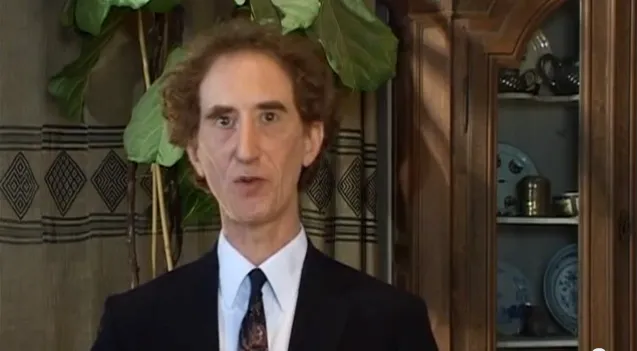
About the instructor
Simon Fischer enjoys a distinguished and wide-ranging career as a performer, educator and recording artist. He has performed worldwide as a recitalist, and committed three Brahms Sonatas to record, a recording that received high praise in Gramophone Magazine. Simon is recognised as having a place amongst the world's elite teachers. He is a professor at the Guildhall School of Music, and has held positions at the Yehudi Menuhin School, Wells Cathedral School and the Purcell School, and for 15 years was a visiting professor at the Royal Scottish Academy of Music. Having studied in London with Yfrah Neaman, and in New York with Dorothy DeLay, Fischer's approach unites the best elements of the French, Russian and American violin traditions. Fischer's published work greatly influences the teaching of the violin. Having written for The Strad magazine since 1991, his monthly articles have attracted a worldwide following. Published by Edition Peters, his technique books Basics and Practice (translated into Korean, Italian and German), Scales and The Violin Lesson, and the DVD The Secrets of Tone Production (now available to stream via MusicGurus), have become standards on many continents. His book and DVD Warming Up was described by The Strad magazine as "23 pages of pure technical gold". In 2014 Simon Fischer was awarded the European String Teachers Association prize "In celebration of a lifetime contribution to String Teaching". In his four-part Secrets of Tone Production course, Simon guides you through getting to know your instrument and then working through his fundamental tone exercises step by step, so you can produce a richer, more controlled and more beautiful sound on the violin. read more