



Explanation and demonstration of exercise four
With
Simon Fischer
What's in the course
17 lessons (1h 15m) · 1 free
01. Introduction to Combinations
0:18
02. Alternative approach to Exercise one
1:23
03. Exercise six: Speed exercise + Pressure exercise
0:55
04. Exercise seven: Speed exercise + Changing soundpoint
3:30
05. Exercise eight: Pressure exercise + Sounding soundpoint
1:44
06. Exercise nine: Same weight, increasing speed
1:21
07. Exercise ten: Same speed, increasing weight
1:14
08. Conclusion
1:33
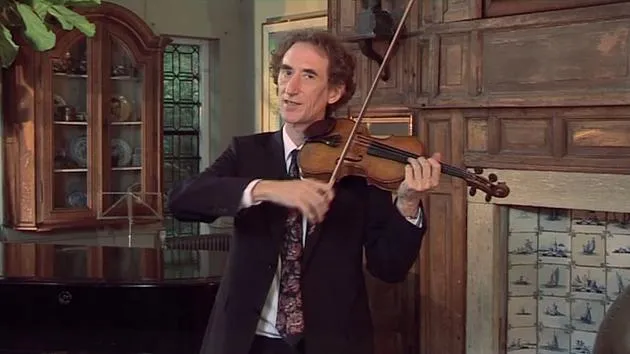
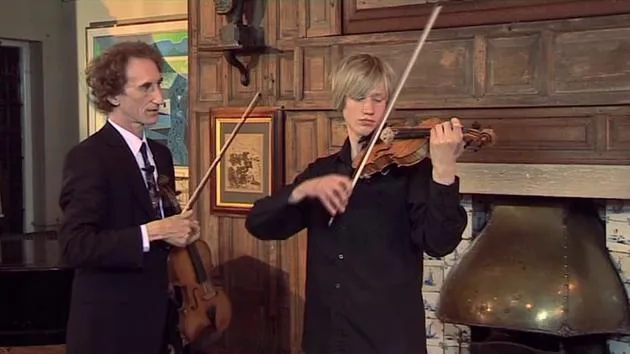
Lesson transcript
Speed Exercise in Bowing Techniques
The speed exercise uses exactly the same divisions as the pressure exercise. But here, the bow moves fast or slow, instead of heavy or light. As you can hear, there's quite a difference. Let's look at it in detail.
Key Techniques
-
Fast Part of the Stroke:
- Use more bow and very slightly more pressure.
-
Slow Part of the Stroke:
- Use less bow and less pressure.
Tip: Keep the speed and pressure exercises as different from each other as possible. Use as little extra pressure as you can during the fast part of the stroke. Just enough to maintain good contact with the string. Float the bow along the string horizontally rather than digging in vertically.
Practice Suggestions
Let's try it again. Just a little more weight you need, don't you?
Rhythm Exercise
- Feel the rhythm, Oliver:
- It goes fast, slow, fast, slow:
- Fast, Slow
- Fast, Slow
- It goes fast, slow, fast, slow:
That's very good.
Two in One Bow
- Do two in one elbow:
- Fast, Slow
- Fast, Slow
- Fast, Slow
Just a little heavier at the point. It's like a whipping motion.
Instructions:
- You do that just at the moment when you're going: fast, slow.
- But remember, it's the opposite of what you want.
Transition Practice
- Coming back, now do three on the next down bow:
- Fast, Fast
- Dum, bum, bum, bum, bum, bum, bum, bum, bum, bum.
That's good. Now do four.
Caution:
- Be careful when you change bow at the heel. There's a kerfuffle there.
- Fast, Slow, Fast, Slow, Fast, Slow.
Well done!
Speed Patterns
- Next set:
- Fast, Slow, Fast, Slow.
- Coming up is six at:
- Bum, bum, bum, bum.
Count:
- One, two... The feeling should be one of a long string, not a long string this way.
That's better.
Bow Division
- Say "bow" this time.
- Yes, but this seems too much like the pressure exercise to me.
Technique Reminder:
- Just go along, along, along.
- Start on the string, or from the air? You know, you're doing this.
Focus on Execution
Look at this: just that, and then go 4, 5.
- Here's the middle:
- You want 1, 2, 3, 4, 4, 5, 6.
That's it! Fast, Fast, Fast.
Increasing Difficulty
- Now do 8:
- 1, dum, bum, bum, bum, bum, bum, bum.
- Yeah, go along, along, along, along, not down in, down in, down in.
Note:
- Don't do it with your head either. That's better. Just the bow.
Instrument Practice
Can I borrow your instrument? What you want to do is get it ringing.
- Listen to this:
- Play little near the bridge.
Now, for fast, slow, fast, slow:
- Little near the bridge, Olivia.
Reminder:
- Don't nod while playing. Keep the violin still.
Chamber Music Tip
If you want to bring somebody in while playing chamber music, watch the scroll.
- Technique:
- Line it up with an object in front of you and try to keep it in exactly the same place.
Practice:
- Fast, slow, fast, slow, fast, slow.
Down Bow Considerations
-
At the beginning of the down bow, your speed pattern should be fast, slow, right from the beginning.
-
There's still a moment on the down bow at the point. So:
- Fast, slow, slow to the end.
Now slow. That's great!
Advanced Techniques
I'll show you something else here:
- If you go fast, slow, stop. Do it like that.
Goal:
- We want total purity; don't let it sound like "bong."
Joining Techniques
- Now join it together.
- You must stop the bow before you go the other way.
Final Note:
- Ensure you're not going slow, fast, slow on the down bow.
Bow Control and Purity
- Keep practicing to ensure a pure sound from the first note to the last.
- Fast, slow, fast, slow, and be careful with your positioning near the bridge.
Summary of Key Points
- It's essential to differentiate fast from slow.
- Use all the bow:
- "You pay for all the hair; you may as well use it all."
Make sure to play under your hand and play right to the point.
Final Practice Exercise:
- Feel the pulse. It's fast, slow, and fast, slow.
Let's do it one more time, and I'll subdivide it for you:
- Bom, bom, bom, ...
Exactly, Olivia! Can you make more difference between the fast and the slow?
Thank you!
- Remember to play as close to the bridge as possible; keep the bow parallel.
That's it! Good progress.
17 lessons
1h 15m of structured video lessons
Advanced video features
Slow down, loop a passage, follow along
Mobile, tablet & desktop
Practise wherever you are
100% satisfaction guarantee
30-day money-back guarantee
Meet your guru
Meet your guru
Simon Fischer enjoys a distinguished and wide-ranging career as a performer, educator and recording artist.
He has performed worldwide as a recitalist, and committed three Brahms Sonatas to record, a recording that received high praise in Gramophone Magazine.
Simon is recognised as having a place amongst the world's elite teachers. He is a professor at the Guildhall School of Music, and has held positions at the Yehudi Menuhin School, Wells Cathedral School and the Purcell School, and for 15 years was a visiting professor at the Royal Scottish Academy of Music. Having studied in London with Yfrah Neaman, and in New York with Dorothy DeLay, Fischer's approach unites the best elements of the French, Russian and American violin traditions.
Fischer's published work greatly influences the teaching of the violin. Having written for The Strad magazine since 1991, his monthly articles have attracted a worldwide following. Published by Edition Peters, his technique books Basics and Practice (translated into Korean, Italian and German), Scales and The Violin Lesson, and the DVD The Secrets of Tone Production (now available to stream via MusicGurus), have become standards on many continents. His book and DVD Warming Up was described by The Strad magazine as "23 pages of pure technical gold".
In 2014 Simon Fischer was awarded the European String Teachers Association prize "In celebration of a lifetime contribution to String Teaching".
In his four-part Secrets of Tone Production course, Simon guides you through getting to know your instrument and then working through his fundamental tone exercises step by step, so you can produce a richer, more controlled and more beautiful sound on the violin.







